The First Rule of Wealth: Stop Making Excuses
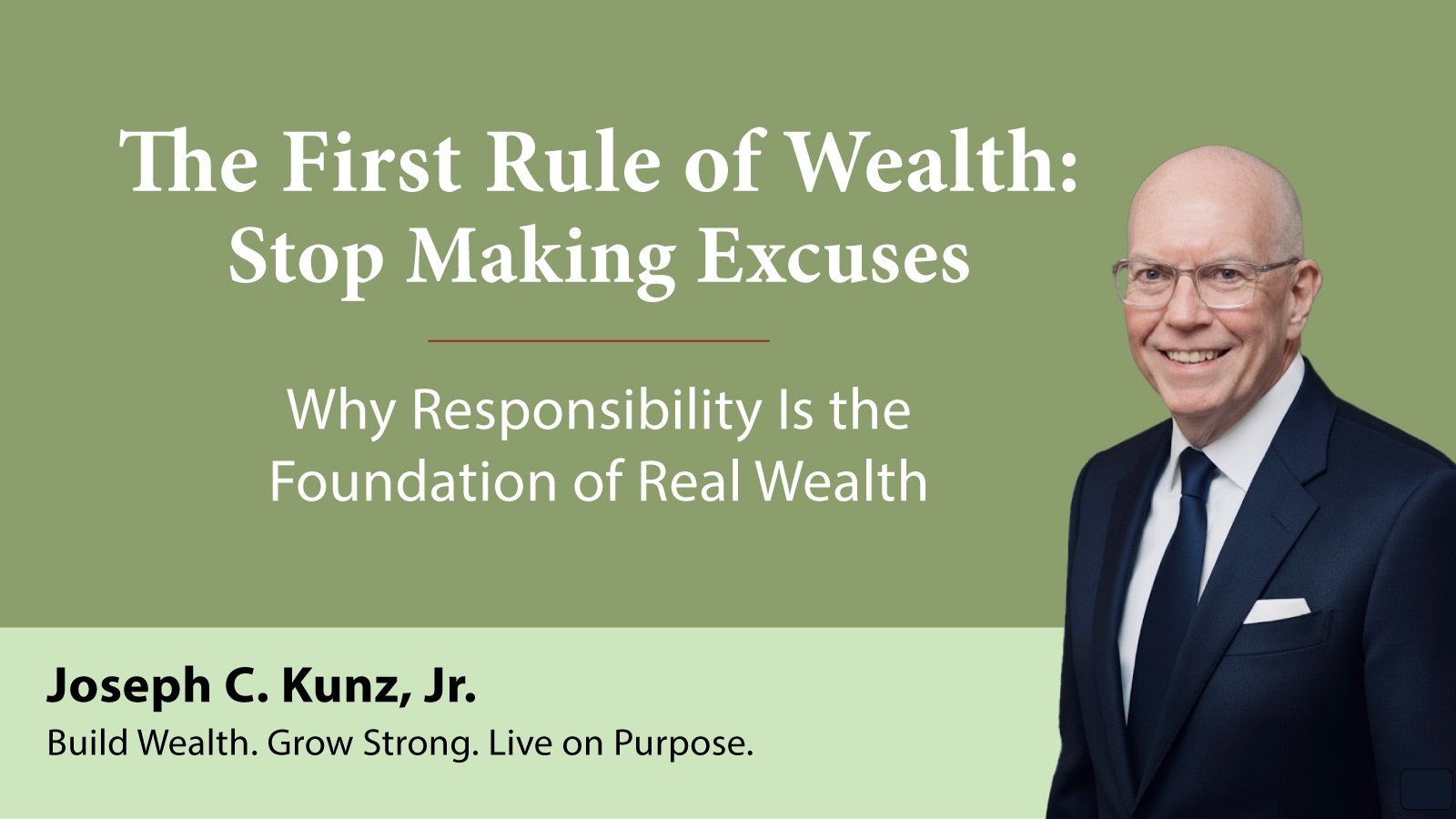
Wealth doesn’t begin with money—it begins the moment you stop blaming your past and start taking full responsibility for your future. —Joseph C. Kunz, Jr.
Why Responsibility Is the Foundation of Real Wealth
By Joseph C. Kunz, Jr.
Synopsis
This isn’t a budgeting lecture or a motivational “you got this” pep talk. In this essay, Joseph C. Kunz, Jr. argues that the first rule of wealth has nothing to do with income level, stock picks, or secret strategies—it starts with one decision: kill your excuses. Excuses feel like protection, but they function like shackles; they keep you passive, bitter, and permanently “about to start.”
Kunz explains why the marketplace doesn’t reward explanations—it rewards results—and why that’s actually good news: it means your past doesn’t get the final vote unless you keep handing it the microphone. He draws a sharp line between a reason (a constraint you plan around) and an excuse (a story you hide behind), then lays out the turning point: own every result—especially the ugly ones—and convert blame into action. The essay closes with a simple builder’s protocol to reclaim momentum, rebuild discipline, and start earning freedom the only way it comes: through responsibility.
Excuses are expensive. They cost you time, momentum, confidence—and ultimately, freedom. —JCK
I. Introduction: Wealth Is a Mindset Before It’s a Bank Balance
You can read every finance book, follow every wealth guru, and memorize every “money hack”—but if your mindset is stuck on blame, you’re building on sand.
Here’s the truth most people don’t want: you don’t lose financially because you lack information. You lose because you keep giving yourself permission to stay the same. You keep a stable of excuses on standby—ready to trot out the moment you feel pressure, discomfort, or responsibility.
Wealth starts when the finger-pointing stops. No more “if only.” No more “someday.” No more waiting for the perfect time, the perfect market, or the perfect mood. The moment you say, “It’s on me,” is the moment you take back the power to change your financial future.
II. Excuses Are the Enemy of Ownership
Most people don’t fail because they lack money—they fail because they defend their limitations. They build an entire identity around why they can’t win.
And yes—life is unfair. People start in different places. Some people get tailwinds and others get punched in the mouth. But here’s the problem: excuses don’t protect you from reality. They protect you from responsibility. And responsibility is the only thing that produces momentum.
Here are the most common excuses that quietly keep people broke—along with the builder’s response:
• “I didn’t grow up with financial role models.” Builder response: Then become your own model. Learn it. Practice it. Break the chain.
• “The system is rigged.” Builder response: Maybe. But the market still pays for value. Stop arguing with reality—start mastering it.
• “I’m too late to the game.” Builder response: Late is not dead. Start where you are. Compounding still works for people who actually start.
• “I don’t make enough.” Builder response: Then your first job is to raise your value—skills, output, reliability, negotiation, side income.
• “I’m too busy.” Builder response: Busy is not the same as building. Audit your time. Cut the leaks. Protect your priorities.
• “I’m just not a money person.” Builder response: That’s not a personality trait. That’s avoidance wearing a costume.
Every excuse is a mental escape hatch from ownership—and every time you use one, you abandon your shot at real progress.
III. Reasons vs. Excuses: The Line Most People Refuse to Draw
Here’s where adults separate themselves from victims: they learn the difference between a reason and an excuse.
• A reason is a constraint you plan around. It informs strategy.
• An excuse is a story you hide behind. It replaces strategy.
A reason says, “I have student debt, so I need a tighter plan, extra income, and a longer runway.” An excuse says, “I have student debt, so I’ll never get ahead anyway.”
A reason says, “My family needs me right now, so I’m going to build slowly and consistently.” An excuse says, “My family needs me, so I don’t have time to build at all.”
A reason produces a plan. An excuse produces a speech.
If you want a fast test, use this one: If your explanation ends with resignation, it’s an excuse. If it ends with a next step, it’s a reason.
IV. The Marketplace Doesn’t Care — And That’s a Gift
The economy doesn’t care where you came from. The market rewards results, not reasons. That’s not cold—it’s liberating. Because it means you’re not trapped by your biography unless you keep chaining yourself to it.
The marketplace is an impartial judge. It doesn’t care how emotional your story is. It doesn’t care how unfair your starting point was. It responds to what you can do, what you can solve, what you can produce, and what you can reliably deliver.
That reality offends people who want life to be a therapy session. But it empowers people who want freedom—because it means anyone can win if they stop negotiating with themselves and start building value.
Mirror Moment: Two people are dealt a bad hand. One turns it into a lifelong explanation. The other turns it into a lifelong motivation. One keeps talking about the system. The other keeps learning the system—then using it. Ten years later, the first person still has a speech. The second person has options.
That’s the gift: the market doesn’t care about your excuses, which means it can’t be manipulated by them either.
V. The Turning Point: Own Every Result — Even the Ugly Ones
Want to build wealth? Start here: everything in your financial life is your responsibility. Even the stuff that wasn’t your fault. Why? Because no one else is going to fix it.
This is where people get confused. Ownership isn’t saying, “Everything that happened to me is my fault.” Ownership is saying, “Everything that happens next is my responsibility.”
Own your debt. Own your spending. Own your lack of savings. Own your habits. Own your skills—or your lack of them. Own the fact that you knew better and still didn’t do it.
Because the more you own, the more control you regain. And control is where freedom starts.
Here’s the brutal truth: blaming the past feels good for five minutes. Owning your future pays dividends for fifty years.
And if you want wealth, you’re going to need the one trait excuses destroy: self-trust. You can’t build a strong financial life when you don’t trust yourself to follow through. Excuses train you to flinch. Ownership trains you to execute.
VI. The No-Excuses Protocol: A Builder’s Way to Start Today
No more theory. Here’s how you turn “stop making excuses” into a real-world system.
1. Write Your Top 5 Excuses Down Not the pretty ones. The real ones. Put them on paper so they can’t hide in your head.
2. Convert Each Excuse Into a Responsibility Statement.
• “I don’t make enough” therefore “I must increase my value and income.”
• “I’m too busy” therefore “I must eliminate low-value commitments.”
• “I’m too late” therefore “I must start now and stay consistent.”
3. Choose One Non-Negotiable Financial Action. Something small but real: auto-transfer $25/week, pay down one debt aggressively, track spending daily for 14 days, or set up an investing automation. Small is fine. Non-negotiable is the point.
4. Build a System That Doesn’t Rely on Motivation. Automation beats inspiration. Put it on autopilot. Remove decision-making where possible. Winners don’t “feel like it.” They set it up once and let discipline run the program.
5. Track Proof, Not Feelings (30 Days). Your emotions will lie. Your data won’t. Track the action for 30 days and let the proof rebuild your identity.
6. Upgrade the Standard Once the Habit Is Stable. Once you can keep the promise, raise the bar—slightly. Wealth is built by kept promises that compound.
That’s it. No magic. No lottery thinking. Just a builder’s process: clarity leads to ownership which leads to action which leads to compounding.
VII. Conclusion: Your Excuses Are Someone Else’s Advantage
While you’re busy explaining why you’re stuck, someone else is out-learning you, out-working you, and out-risking you. Not because they had more—it’s because they decided to do more with what they had.
Don’t get bitter. Get moving. The wealth you want doesn’t care about your excuses. It only responds to your actions, your skills, your discipline, and your ability to carry responsibility without whining.
Excuses purchase temporary comfort at the price of permanent limitation. Ownership feels heavy at first—but it’s the weight that builds strength.
Stop explaining why you can’t. Start showing the world why you will. —JCK
Related Essays: For the Ambitious Individual Ready to Go Deeper
If this essay hit a nerve, these will punch even harder.
1. Why Rich People Think in Terms of Systems, Not Paychecks
Learn how the wealthy escape the time-for-money trap by building income-producing machines.
Reader Comment: This essay flipped a switch for me—I finally understood why I was stuck trading hours for dollars.
2. What Independent Thinkers Do Before 9 A.M.
Discover the habits that separate leaders from followers—and set the tone for wealth-building days.
Related Book: Stop Whining. Start Winning.
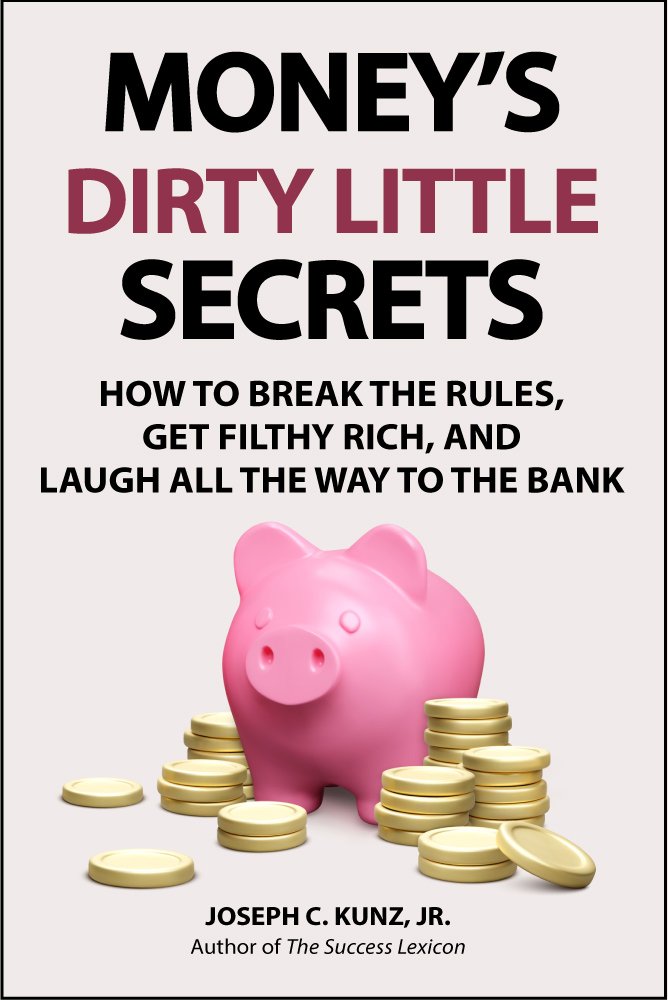
Money’s Dirty Little Secrets
Excuses don’t pay bills. They don’t build businesses. And they sure as hell don’t create freedom for your family.
Every time you let yourself off the hook, you’re signing a lifetime contract with mediocrity. That’s the ugly truth.
That’s why I wrote Money’s Dirty Little Secrets. I poured decades of scars, wins, and wake-up calls into this book because I was sick of watching good people stay broke—not because they weren’t smart enough, but because they bought into the lies.
Inside, I rip the mask off the system, call out the myths, and hand you the tools to flip the game in your favor.
If you’ve got the guts to stop making excuses and start making moves, this is your playbook. If not, put it back on the shelf and enjoy your “someday” fantasy.
But if you’re done playing small, grab Money’s Dirty Little Secrets now.
Excuses won’t build your legacy—but action will.