What Independent Thinkers Do Before 9 A.M.
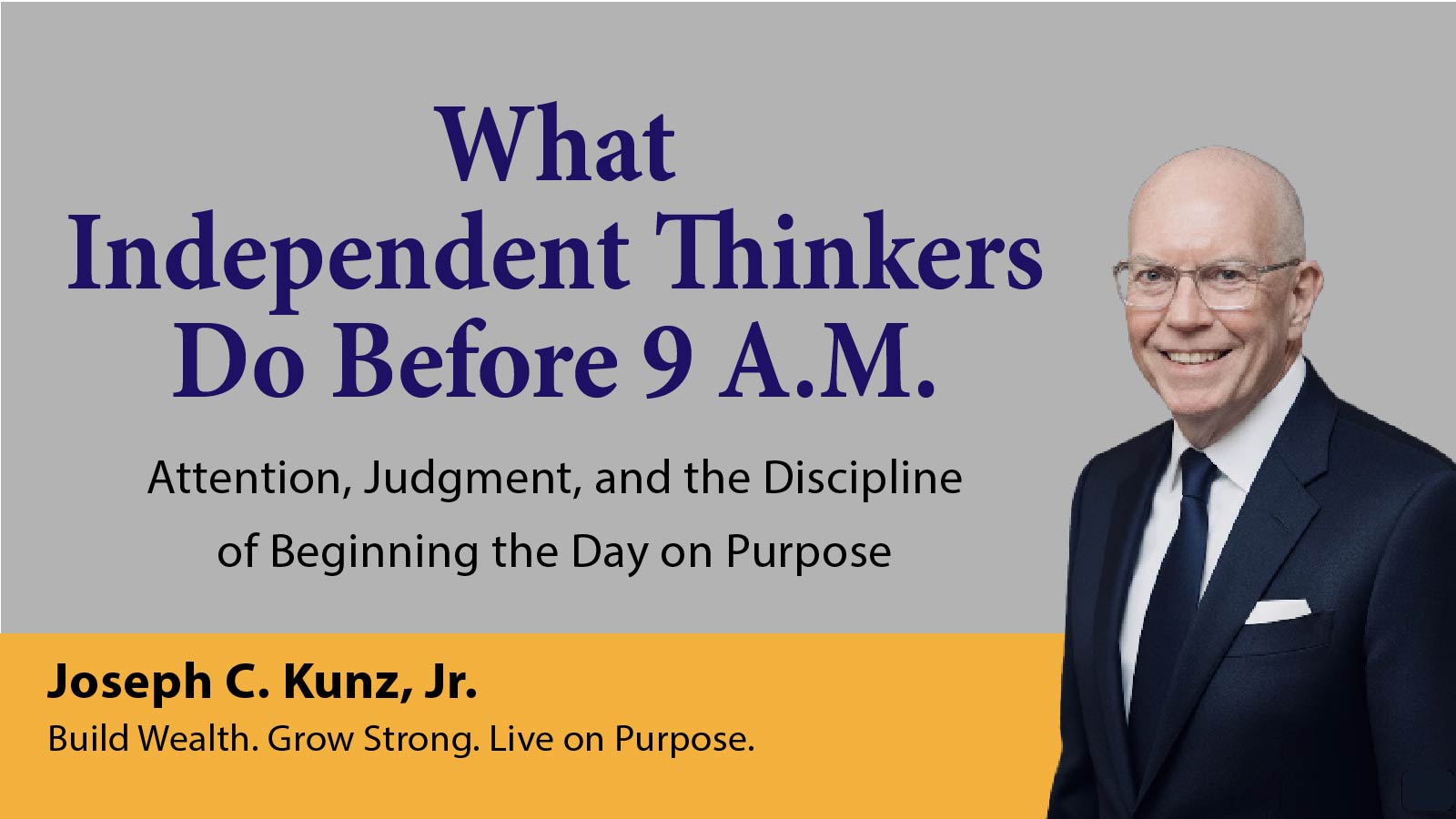
The first act of independent thought is deciding what deserves your attention before the world decides for you. —Joseph C. Kunz, Jr.
Attention, Judgment, and the Discipline of Beginning the Day on Purpose
By Joseph C. Kunz, Jr.
Synopsis
This isn’t an argument for waking at five in the morning, following a fashionable morning routine, or measuring personal worth by how much gets accomplished before breakfast. In this essay, Joseph C. Kunz, Jr. argues for something more fundamental: the first responsibility of an independent mind is to govern its own attention. Before we can think clearly, choose wisely, or resist the pressure of the crowd, we must first decide what deserves access to our minds.
Kunz makes the case that independent thinking is not contrarianism, isolation, or the arrogant belief that we need no teachers, experts, traditions, authorities, or other people. It is the disciplined ability to receive influence without surrendering judgment. The morning matters because it provides a small but revealing training ground. When the first moments of consciousness are repeatedly surrendered to messages, headlines, demands, feeds, and other people’s priorities, we practice reaction before reflection. When we deliberately choose what enters our minds, what deserves our effort, and what matters most, we practice self-government.
The conclusion is simple: the point is not 9 A.M. The point is order. Before the world makes its legitimate claims on our time and attention, we should practice making at least one deliberate claim of our own. A person who learns to govern attention in small things becomes better prepared to exercise judgment when the stakes are much larger.
An independent mind does not refuse influence. It refuses unconscious surrender. —JCK
I. Introduction: Before the World Gets the First Word
There is a moment every morning when the world has not yet fully arrived.
Then the phone lights up.
A message.
An email.
A headline.
A notification.
Someone needs an answer.
Something happened overnight.
Somebody somewhere is angry about something.
And within minutes, a mind that was quiet is occupied.
This is so ordinary that we rarely stop to examine what has happened.
We think we have merely checked our phones.
But something more important has occurred.
Someone else has chosen the first subjects of our attention.
That does not mean we have surrendered our minds. It does not mean reading the news makes us conformists. It does not mean technology is evil or that responsible adults should ignore messages, work, family, or the outside world.
The problem is subtler.
Attention comes before judgment.
Before I can decide what I think about something, I must first encounter it. Before I can weigh a question, the question must somehow enter my mind. And whoever repeatedly determines what receives my attention gains at least some influence over what I spend my mental life considering.
That is why the first part of the day matters.
Not because 6 A.M. is morally superior to 9 A.M.
Not because successful people possess some mystical knowledge about sunrise.
And certainly not because everybody should live according to the same schedule.
The point is not the clock.
The point is who gets the first claim on your attention.
That is a question of self-government.
And self-government begins much closer to home than politics.
It begins inside the person.
II. Attention Comes Before Judgment
We speak constantly about independent thinking, but we usually begin too late in the process.
We ask:
What do you believe?
What is your opinion?
Whose argument do you accept?
Those are important questions.
But there is an earlier question:
What have you been trained to notice?
Human beings cannot consciously consider everything at once. Every day presents more information, demands, problems, ideas, arguments, opportunities, fears, pleasures, responsibilities, and distractions than any person could possibly examine.
So attention selects.
It tells the mind, in effect:
Look here.
Think about this.
Worry about this.
Respond to this.
Ignore that.
Attention does not determine what we will ultimately believe. We remain capable of reflection, reconsideration, resistance, and change.
But attention helps determine the material from which judgment begins.
That distinction matters.
If my first encounter with an issue comes wrapped inside someone else’s assumptions, I can still question those assumptions.
But I must notice them first.
If everyone around me is discussing the same controversy in the same vocabulary, I can still think differently.
But doing so requires effort.
If I spend the first hour of every day entering other people’s arguments before I have spent five minutes examining my own priorities, I should not be surprised when my mental life begins to feel crowded.
This is why attention deserves to be treated as something more serious than time management.
Attention is one of the raw materials of judgment.
And judgment is one of the raw materials of freedom.
III. Independent Thinking Is Not Contrarianism
There is also a vanity hidden inside the phrase independent thinker.
Almost everyone likes to imagine that he is one.
Calling yourself independent proves nothing.
A man who automatically agrees with the crowd is not thinking independently.
But neither is the man who automatically disagrees with it.
The conformist and the reflexive contrarian appear to be opposites, but intellectually they can suffer from the same weakness.
Both are reacting.
One asks:
What does the crowd believe? I will believe that.
The other asks:
What does the crowd believe? I will believe the opposite.
Neither has necessarily done the harder work:
What is true?
That is the question of the independent thinker.
Sometimes serious judgment will lead him to agree with experts, institutions, tradition, or the majority.
Sometimes it will lead him to dissent.
Sometimes the responsible answer will be:
I do not know yet.
That may be the most independent answer of all in a culture that demands instant opinions.
Independent thought requires the humility to learn, the patience to investigate, the courage to disagree, and the maturity to change your mind when reality proves you wrong.
It is not independence from wisdom.
It is independence for the sake of finding it.
That is a much higher standard.
IV. Self-Government Is Not Self-Sovereignty
There is another distinction I need to make because the phrase “thinking for yourself” can easily go too far.
I do not believe a serious life should be built entirely “on my own terms.”
That phrase appeared in the earlier version of this essay.
I no longer think it says what I mean.
A person who answers to nothing beyond himself is not necessarily free. He may simply be governed by appetite, ego, resentment, fashion, fear, or whatever desire happens to be loudest at the moment.
Self-government is not self-worship.
For a Christian, this distinction is especially important.
I want independence from manipulation.
I want independence from crowds.
I want independence from fashionable nonsense, ideological pressure, intellectual laziness, and the fear of standing apart.
But I do not want independence from truth.
I do not want independence from conscience.
I certainly do not want independence from God.
Freedom properly understood is not the power to make reality obey me.
It is the capacity to govern myself well enough to live truthfully within reality.
That requires listening.
Learning.
Correction.
Humility.
Authority rightly understood.
Tradition when it has earned trust.
Expertise when it is competent.
Scripture.
Prayer.
The experience of people wiser than I am.
Independent thinkers do not reject these things.
They refuse to turn any human source into a substitute for judgment.
There is a difference between receiving guidance and surrendering responsibility.
A mature person knows he needs the first.
He refuses the second.
V. What Independent Thinkers Actually Do in the Morning
Once the principle is clear, the practical habits make more sense.
They are not magic rituals.
They are exercises in self-government.
1. They Protect Their First Attention from Unchosen Inputs
The important distinction is not really between screens and no screens.
It is between chosen input and unchosen input.
Reading something you deliberately selected is different from opening a feed to discover what has been selected for you.
Answering an urgent message from your child is different from checking notifications because silence makes you uncomfortable.
Using a phone as a tool is different from asking the phone what deserves your attention.
That is why I prefer a simple morning rule:
Do something chosen before doing something merely presented.
Pray.
Read.
Write.
Walk.
Think.
Make coffee and sit quietly.
Look over the work that actually matters.
The activity itself is less important than the act of choosing it.
You are reminding yourself, before the day becomes crowded:
I am responsible for where my attention goes.
2. They Choose a Higher Input Before a Louder One
The first thing you put into your mind matters.
Not magically.
Formatively.
A serious book asks something different of you than a scrolling feed.
Scripture asks something different of you than a headline.
A page of history asks something different of you than gossip.
Writing in a notebook asks something different of you than reading comments from strangers.
One requires participation.
The other often encourages reaction.
The goal is not to consume more information.
Most of us already have more information than we know how to use.
The goal is to encounter something worth thinking about before encountering everything demanding to be thought about.
There is a difference between information and formation.
Information gives you something to know.
Formation changes the kind of person doing the knowing.
A well-chosen morning input can do the second.
3. They Put the Body Under Deliberate Command
Exercise does not make someone an independent thinker.
Plenty of foolish men are in excellent physical condition.
But physical discipline teaches a useful lesson.
The body makes requests.
Stay in bed.
Remain comfortable.
Do it later.
Skip today.
There is nothing mysterious about overcoming those requests.
You simply decide that another good matters more.
Walk.
Stretch.
Lift.
Ride.
Move.
The deeper point is not fitness.
It is practicing the gap between what I feel like doing and what I have decided is worth doing.
That gap is where much of character is built.
A person incapable of saying no to minor discomfort will eventually find larger acts of self-command more difficult.
Again, there is no magic in doing this before breakfast.
The morning simply gives many people an early opportunity to rehearse the habit.
4. They Name One Load-Bearing Priority
The world is very good at producing urgent things.
It is less reliable at identifying important ones.
Those categories overlap sometimes.
But not always.
A message can demand an immediate answer while contributing almost nothing to the life you are trying to build.
Meanwhile, the book that needs writing, conversation that needs having, financial decision that needs making, skill that needs developing, prayer that needs praying, or problem that needs solving sits quietly.
Important things are often badly behaved competitors for attention.
They do not flash.
They do not buzz.
They do not shout.
They simply wait.
That is why I like identifying one load-bearing priority early.
Not twenty.
One.
Ask:
If I move one meaningful thing forward today, what should it be?
That question does not eliminate ordinary responsibilities.
It establishes hierarchy among them.
A serious life requires hierarchy.
If everything is important, nothing is.
If everything is urgent, someone else will eventually decide your priorities for you.
5. They Leave Some Space Unoccupied
This may be the most neglected habit.
Do nothing for a few minutes.
Not literally nothing.
Think.
Pray.
Look out the window.
Write a question down.
Sit with a problem before rushing toward an answer.
Let an idea remain unfinished.
Modern life has become remarkably efficient at filling empty mental space.
The car.
The kitchen.
The waiting room.
The walk.
The first five minutes after waking.
There is always something available to watch, hear, read, answer, check, or scroll.
Convenience has solved boredom remarkably well.
I am no longer sure that was entirely a victory.
Boredom sometimes opens a door.
On the other side is reflection.
A person who never experiences unoccupied attention has fewer opportunities to discover what his mind does when nobody else is feeding it material.
That matters for anyone who claims to value independent thought.
Because eventually a serious thinker must encounter a question without immediately reaching for someone else’s answer.
VI. The Morning Is a Training Ground, Not a Religion
Morning routines can become ridiculous.
Wake at 4:37.
Drink something unpleasant.
Take a freezing shower.
Journal for exactly eleven minutes.
Read thirty pages.
Meditate.
Run.
Lift.
Build a company before breakfast.
Apparently civilization hangs in the balance.
I am not interested in turning waking early into another status competition.
Plenty of bad decisions have been made before sunrise.
A man can wake at five, exercise for an hour, read Marcus Aurelius over black coffee, and remain completely governed by vanity.
The clock proves nothing.
The morning matters because repeated behavior forms us.
What we repeatedly practice becomes easier to repeat.
If I begin every day reacting, I become practiced at reaction.
If I begin every day avoiding discomfort, I become practiced at avoidance.
If I begin every day consuming other people’s thoughts, I may become less practiced at developing my own.
And if I repeatedly practice choosing, prioritizing, reflecting, praying, reading carefully, and directing attention deliberately, I strengthen those capacities.
None guarantees wisdom.
They make wisdom easier to pursue.
That is a very different claim.
The morning is not sacred because it is morning.
It is useful because it is a recurring place to practice formation.
VII. What If Your Morning Is Not Yours?
A serious argument must account for real life.
Some people do not awaken into silence.
They awaken into duty.
A crying child.
An elderly parent who needs help.
A patient.
A job that begins before sunrise.
A business problem that cannot wait.
A household already in motion.
A long commute.
A genuine emergency.
There are mornings when responsibility gets the first claim.
That is not failure.
In fact, it reveals an important distinction between reaction and responsiveness.
Reaction means allowing whatever appears first to govern you simply because it appeared.
Responsiveness means recognizing that something has a legitimate claim on you and answering it because duty requires it.
Those are not the same.
A parent who rises to care for a child is not surrendering self-government.
He is exercising it.
A nurse responding to a patient is not allowing someone else’s priorities to hijack her morning.
She is carrying a responsibility she chose and accepted.
A businessman addressing a genuine emergency is not necessarily living reactively.
He may simply be doing his job.
So the principle cannot be:
My first hour belongs only to me.
That would turn self-government into selfishness.
The better principle is:
Learn to distinguish between demands you owe and demands that merely intrude.
That distinction is useful far beyond mornings.
It is one of the disciplines of adulthood.
And when life leaves no quiet hour at the beginning of the day, take the first available margin.
Ten minutes may be enough.
The point is not protecting a ritual.
The point is protecting the faculty of deliberate thought.
VIII. From Private Attention to Public Judgment
This is where a morning essay becomes something larger.
I do not believe that putting your phone away for thirty minutes will make you a wise citizen.
That would be silly.
Nor does exercising, reading, or journaling guarantee moral courage.
But the same human capacities are involved at different scales.
A free person must be able to pause before reacting.
He must be able to distinguish information from persuasion.
He must be able to hear an argument without automatically joining it.
He must be able to tolerate uncertainty.
He must be able to resist appetite.
He must be willing to examine his own assumptions.
He must be able to say:
That may be popular, but is it true?
Or:
That may be unpopular, but is it false?
Or sometimes:
I need more time before I know.
Those are habits of judgment.
And judgment is necessary for self-government.
This is why private formation eventually matters publicly.
The bridge is not complicated:
A society asking people to govern themselves must contain people capable of governing themselves.
We cannot demand independence in public while training constant reactivity in private.
We cannot complain that people are manipulated by slogans while spending our lives practicing instant emotional response.
We cannot condemn herd thinking while refusing the quiet work required to examine what we ourselves believe.
The public square does not begin when we enter a voting booth.
It begins much earlier.
It begins in the kinds of people we have become before the larger questions arrive.
And those people are formed partly through ordinary habits nobody sees.
Including what happens before 9 A.M.
IX. Conclusion: Own the First Claim
Eventually, the world should get your attention.
Your spouse deserves some of it.
Your children deserve some of it.
Your work deserves some of it.
Your customers, patients, employees, friends, church, community, and responsibilities may deserve some of it.
A meaningful life is not built by guarding your attention so obsessively that nobody else can make a claim upon you.
Responsibility requires giving yourself away.
But there is a difference between giving your attention deliberately and having it taken indiscriminately.
That is the distinction I want to preserve.
So this essay is not really about 9 A.M.
It is about the first claim.
Before opening the door to the noise, establish some order inside.
Before consuming, choose.
Before reacting, think.
Before answering everyone else’s questions, remember your own.
Before urgency crowds the day, identify what matters.
Before entering the argument, know what principles you are bringing with you.
Read something worthwhile.
Pray.
Move.
Write.
Think.
Sit quietly.
Do one difficult thing because you decided it deserved doing.
Then enter the world.
Answer the messages.
Do the work.
Carry the responsibilities.
Listen to people wiser than you.
Change your mind when the truth requires it.
But do not confuse openness with surrender.
Do not confuse influence with authority.
Do not confuse noise with importance.
And do not confuse independence with the arrogant belief that you answer only to yourself.
The independent thinker is not the man nobody influences.
Such a man does not exist.
The independent thinker is the man who knows how he is being influenced, tests what enters his mind, governs what deserves his attention, and remains answerable to truth when the crowd moves in another direction.
That is why mornings matter.
Not because winners wake up earlier.
Because every morning gives us another small opportunity to practice the much larger work of governing ourselves.
The morning is not valuable because the world is quiet. It is valuable because, for a few moments, you can decide what kind of mind will meet the noise. —JCK
Related Essays: From Attention to Judgment to Self-Government
The morning is only the training ground. These essays carry the same argument into larger questions of judgment, authority, responsibility, and freedom.
1. Don’t Outsource Your Thinking — Even to “Experts”
Independent judgment does not require rejecting expertise. It requires listening, learning, questioning assumptions, and refusing to hand another person the final responsibility for what you believe and how you live.
Reader Comment: Read this next if you want to take the idea of independent thought beyond the morning and into the harder question of how to learn from experts without surrendering your own judgment.
Quote: Advice should enlarge your judgment, not replace it. —JCK
2. The Public Square Is Downstream
The habits by which individuals govern—or fail to govern—themselves do not remain private forever. Families, institutions, communities, and ultimately public life are populated by the people those private habits have formed.
Reader Comment: This essay takes the argument one step further by showing why self-government is never merely private: the character formed in ordinary life eventually enters the family, the workplace, the community, and the public square.
Quote: Public self-government cannot be built indefinitely on private habits of surrender. —JCK
Related Book: Before You Fix the World, Build the Person Who Has to Live in It
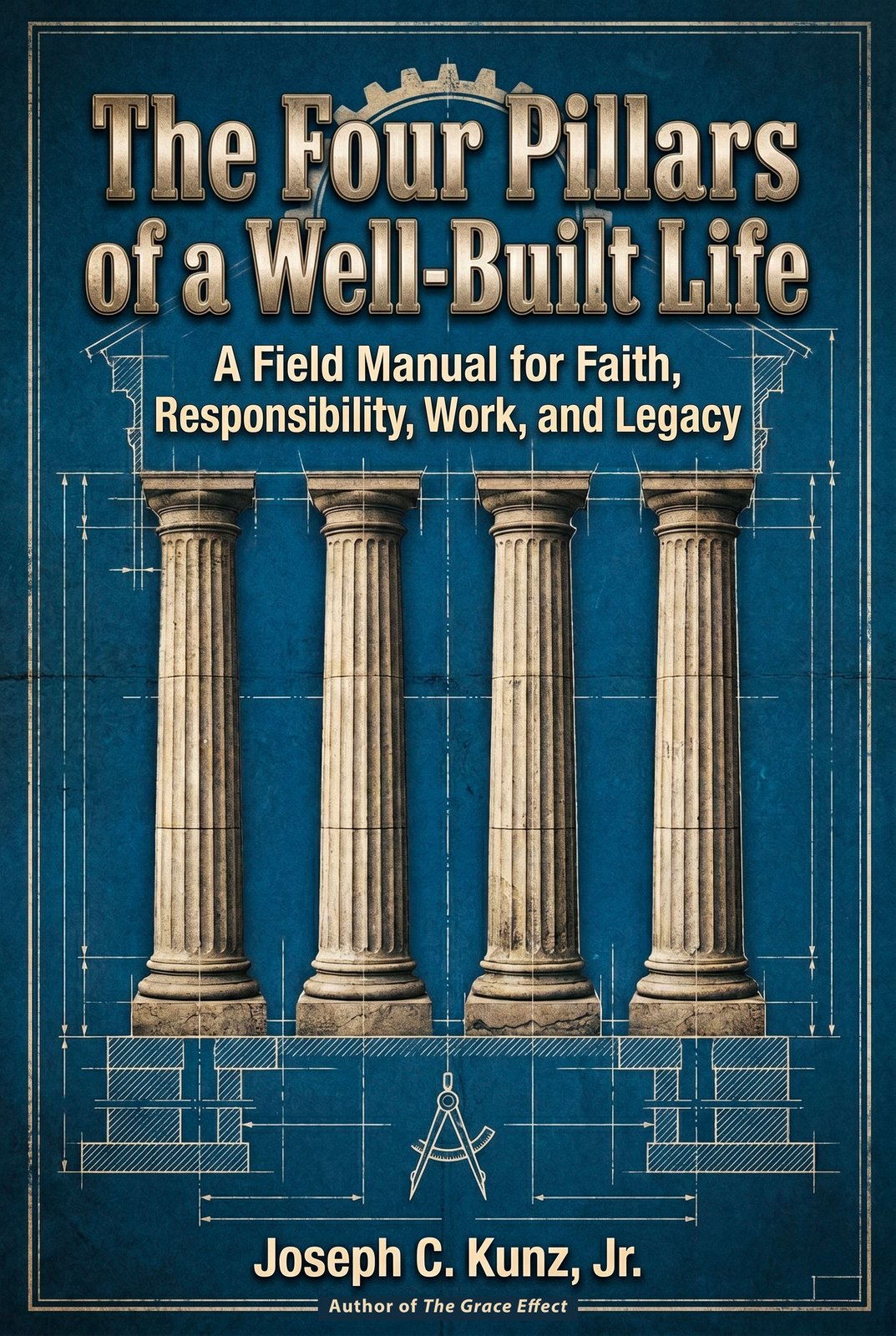
The Four Pillars of a Well-Built Life
There is no shortage of advice about productivity.
Wake earlier.
Work harder.
Optimize everything.
Win the morning.
But a human life is not a productivity contest.
The deeper question is whether the person doing all that work is being formed into someone capable of carrying responsibility, governing himself, building useful things, standing on something true, and handing something worthwhile forward.
That is why The Four Pillars of a Well-Built Life is the natural book behind this essay.
Faith asks what you stand on.
Responsibility asks whether you can govern yourself.
Work & Wealth asks what you are building with the strength you have developed.
Legacy asks what all of it will leave behind.
The morning matters because it gives us another ordinary place to practice that architecture.
Not perfectly.
Not theatrically.
Daily.
If you are tired of drifting from demand to demand…
If you want greater command of your attention without becoming closed-minded…
If you want discipline without worshiping productivity…
If you want freedom grounded in responsibility rather than appetite…
If you are trying to build a life sturdy enough to remain your own while still answering to truth, duty, family, faith, and reality…
…this is the larger framework behind the work.