Why Rich People Think in Terms of Systems, Not Paychecks
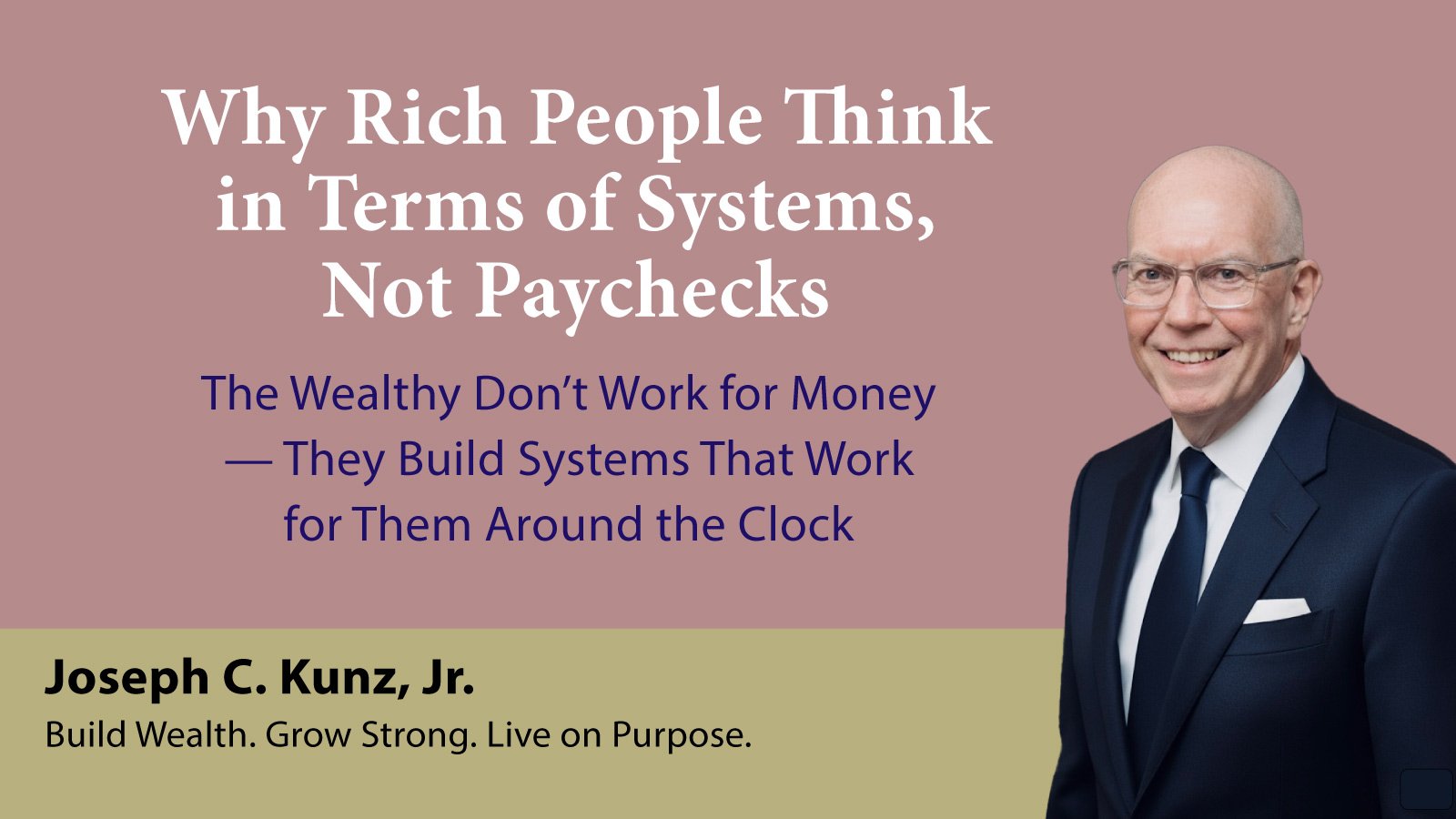
If you think like an employee, you’ll live like an employee. If you think like a system builder, you’ll live like the one signing the paychecks. —Joseph C. Kunz, Jr.
The Wealthy Don’t Work for Money — They Build Systems That Work for Them Around the Clock
By Joseph C. Kunz, Jr.
Synopsis
Most people think in terms of hours and paychecks. Rich people think in terms of systems—self-sustaining, income-producing machines that work whether they’re present or not. This essay pulls back the curtain on why wealthy thinkers reject the paycheck trap, how they design systems that compound, scale, and buy freedom, and how you can start shifting from trading time for money to building assets that pay you for life.
I. Introduction: The Two Economies You Live In
Every dollar you’ve ever earned came from one of two places: your time or your systems. If you’re like most people, almost all your income comes from your time—you show up, you work, you get paid. Stop showing up, and the money stops too. That’s the paycheck economy, designed to keep you comfortable just long enough to keep you from noticing you’re trapped.
Rich people live in the second economy—the systems economy. They don’t trade hours for dollars; they build machines that make money whether they’re working, sleeping, or gone for six months. Their money makes more money. Their ideas run on autopilot.
If you’ve ever wondered why some people get richer while working less, it’s because they’re playing a different game. If you want to change the score, you need to change the game.
II. The Paycheck Mindset Keeps You Chained to the Clock
Most people treat a paycheck like it’s oxygen—miss one and you’re gasping for air. The problem? That oxygen comes from someone else’s tank, and they can turn it off anytime.
The ugly truth: A paycheck is comfort food for the financially insecure. It’s predictable, steady, and wrapped in a warm blanket of “job security” that can disappear faster than your boss can say “budget cuts.”
A. Trading Time for Money Has a Hard Ceiling
1. You only have so many hours in a day. You can’t work 25 hours no matter how many motivational posters you have taped to your cubicle.
2. Your boss decides what you’re worth, and trust me—they’re not lying awake at night worrying you’re underpaid.
B. It Encourages Short-Term Thinking
1. Paychecks focus your brain on “Can I make rent this month?” not “Can I retire in ten years?”
2. Raises are like tips at a bad restaurant—you’re still at the mercy of the guy holding the checkbook.
III. The Wealth Mindset Is Built on Systems
Rich people aren’t chasing hours—they’re building machines that spit out cash whether they’re working, golfing, or binge-watching Yellowstone.
A. What’s a system? A repeatable process that generates income without requiring your constant presence.
It could be:
1. A business that runs on processes, not panic.
2. An investment portfolio that throws off dividends.
3. A piece of intellectual property—like a book or course—that keeps selling long after you created it.
What it’s NOT:
1. “Getting more hours” at work.
2. Side hustles that keep you chained to a laptop at 2 a.m.
IV. Why Systems Crush Paychecks
A. They Compound
1. A paycheck is a flat road. A system is a snowball rolling downhill—it gets bigger without more effort.
2. Example: Amazon doesn’t get paid more for every extra customer—it just builds a bigger, faster system to handle them.
B. They Scale
1. Serve 10 customers or 10,000—same system.
2. That’s why a YouTube channel with one video can still earn while the creator is asleep.
C. They Buy You Freedom
1. With a system, your time belongs to you. You can spend it growing your wealth instead of asking for permission to take a long weekend.
V. How Rich People Think About Systems
They’re not just “lucky” or “born into it”—they play a different game.
A. They Build Assets, Not Just Skills
1. Skills make you valuable to others. Assets make you valuable to yourself.
2. Example: You can be the best writer in the world, but until you own the publishing rights to your work, you’re still working for someone else’s system.
B. They Obsess Over Leverage
1. Time leverage: Delegating and automating so the business runs without them.
2. Money leverage: Using capital to create more income streams.
3. Network leverage: Partnering with the right people so opportunities multiply.
C. They Think in Decades, Not Days
1. Employees think: “What’s my paycheck Friday?”
2. System builders think: “What’s my system worth in 2035—and how many zeros will that have?”
VI. Your First Steps from Paycheck to System Builder
You don’t need to quit your job tomorrow, sell everything, and start a llama farm in Peru. But you do need to stop thinking in paycheck mode.
A. Audit Your Income
1. How much comes from your own effort?
2. How much comes from systems or investments?
3. If the answer is 100% “my own effort,” you’ve got work to do.
B. Start Small
1. Build one tiny income-producing system:
2. A digital product.
3. An online service that can run without you.
4. A small dividend portfolio.
C. Automate and Delegate Early
1. Stop doing $10/hour work if you want a $1,000/hour life.
2. Use software, freelancers, and processes to replace your hands-on involvement.
D. Reinvest Before You Reward Yourself
1. The rookie mistake: spending system profits like it’s extra “fun money.”
2. The pro move: reinvesting those profits so the system grows faster.
VII. Why This Shift Changes Everything
The day you stop relying solely on a paycheck is the day you stop living in financial fear.
1. You Control Your Time: no one tells you when you can clock out.
2. You Multiply Your Efforts: the same work creates more output.
3. You Build True Security: your income survives even if you can’t work.
VIII. Conclusion: Stop Playing the Wrong Game
If you’re still thinking about money in terms of hours worked and Fridays paid, you’re playing the paycheck game—and in that game, the best you get is comfort, not freedom.
Rich people win because they stop playing early. They build systems that compound while they sleep, scale without them, and survive long after they stop working.
Your job is to stop chasing paychecks and start building systems. Do that, and you’ll discover the real secret of wealth: it’s not about working harder—it’s about making sure you’re the one signing the checks, not cashing them.
Start building. Start owning. Start winning.
Paychecks pay the bills. Systems pay for freedom. —JCK
Related Essays: For Builders Who Want Money Working for Them
If this essay opened your eyes, these will show you how to start creating systems that last.
1. Which Income Stream Should You Start First?
Learn how to prioritize your first income stream so you can build momentum without stalling.
Reader Comment: This essay made it click for me—I finally saw where to start instead of trying to do everything at once.
2. The Dirty Truth About Income Streams
Why “multiple streams of income” is often a distraction—and how to focus on what actually builds wealth.
Related Book: Want to dig deeper into building systems and escaping the paycheck trap?

Money’s Dirty Little Secrets shows you exactly how to flip the script, grow wealth faster, and make money work harder than you do.
I poured my heart and soul into this book—every word and every concept came straight out of my own lived experiences, the wins and the scars.
Nothing is theory. It’s the hard-won truth I learned the long way, handed to you the short way.
If you’re ready to hustle smarter—not longer—this book’s your launchpad.
If you’re ready to hustle smarter—not longer—this book’s your launchpad. Check it out here.