Grace Is Not a Prize
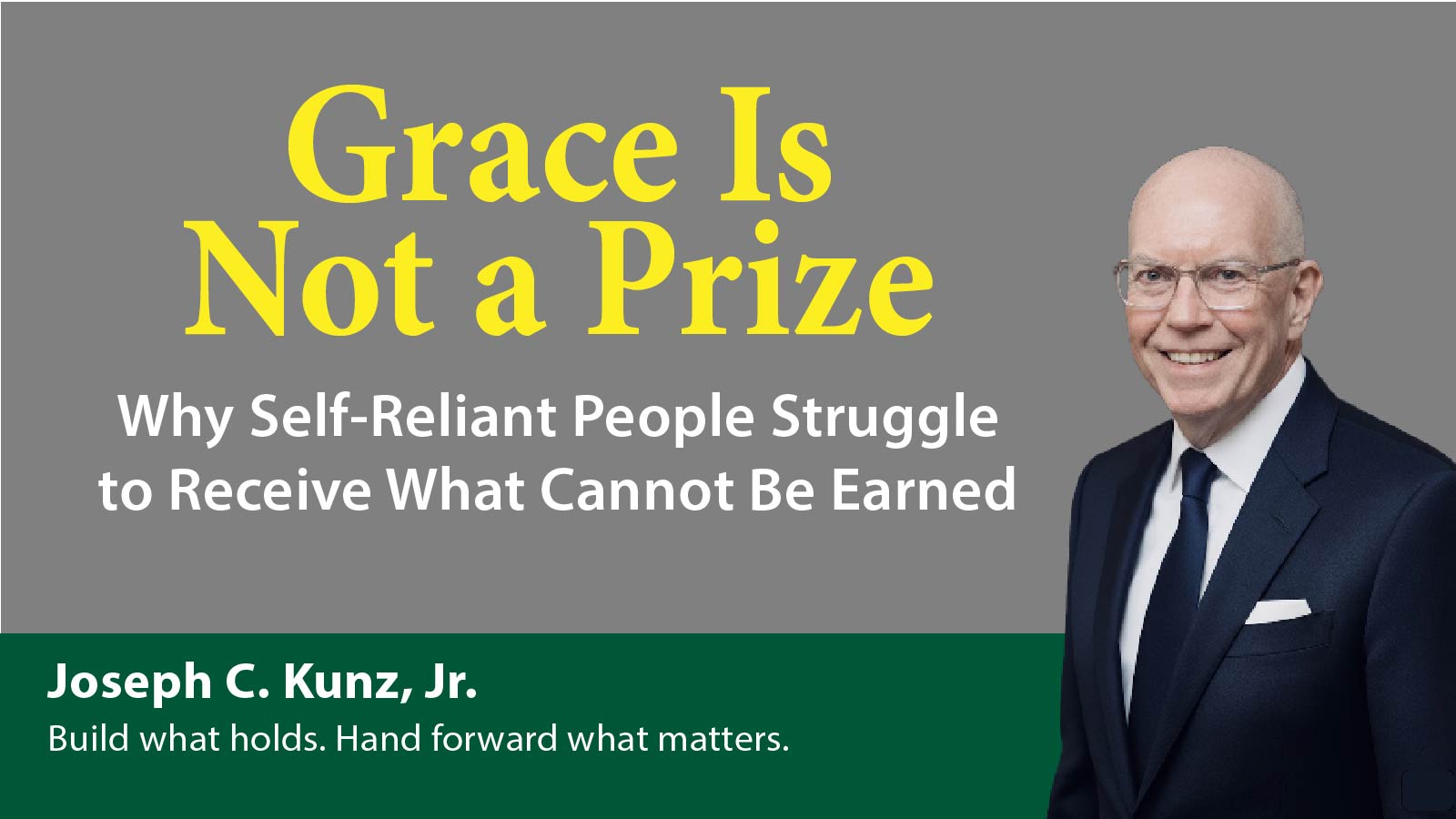
A man can spend his life learning how to earn, repay, provide, and carry—and still arrive before God with empty hands. —Joseph C. Kunz, Jr.
Why Self-Reliant People Struggle to Receive What Cannot Be Earned
By Joseph C. Kunz, Jr.
Synopsis
This isn't an argument against work, discipline, virtue, obedience, or personal responsibility. Those things matter. This essay asks what happens when the habits that help us build a responsible life are carried into a relationship with God, where the deepest gift cannot be earned at all.
Self-reliant people learn to work, provide, solve problems, repay debts, and connect effort with results. Those habits can build strong lives. But they can also create a hidden spiritual accounting system in which goodness becomes payment, faithfulness becomes leverage, and God quietly becomes someone who owes us the outcome we believe we have earned.
Grace does not erase responsibility. It puts responsibility in its proper place. And the essay ends with a question the self-reliant man rarely thinks to ask: whether the search for God was ever entirely his own.
The self-reliant person may find grace difficult not because he rejects God, but because he has spent a lifetime learning not to need anyone. —JCK
I. The Lesson That Worked Everywhere Else
When I was about fifteen years old, our house needed heat.
My father was gone. Money was scarce. There was no dependable adult standing nearby waiting to solve the problem. I learned enough about the oil burner to keep it operating, and when necessary I bought No. 2 diesel and carried it home in two five-gallon cans so we could put fuel in the tank and keep the house warm.
I did not think of any of this as philosophy. I was trying to solve a problem.
But experiences like that teach lessons long before we have language for them. When something breaks, learn how it works. When something must be done, do it. When money is short, find a way. When people depend on you, become more dependable. Do not build your life around the assumption that somebody else will eventually arrive and carry what belongs to you.
That lesson served me well.
It followed me into work, business, marriage, fatherhood, money, publishing, and almost every other part of adult life. If I lacked knowledge, I could study. If I lacked skill, I could practice. If a business problem appeared, I could analyze it. If financial weakness frightened me, I could save, invest, diversify, and build margin. If I made a mistake, I could correct it and try not to make it again.
Reality often rewards this way of living. Preparation, competence, discipline, and character matter, and people who refuse to see the connection between actions and consequences usually pay for the lesson eventually.
Over time, a powerful equation can settle deeply into the mind:
Effort produces results.
Then Christianity places one word in front of that equation that does not fit neatly inside it.
Grace.
Not wages. Not compensation. Not return on investment. Not God's recognition that I finally performed well enough.
Gift.
That sounds comforting until a self-reliant person begins to understand what a gift actually means.
A gift cannot be demanded. It cannot be invoiced. It cannot be produced by becoming useful enough to the giver. And if the gift is truly grace, I cannot make God owe it to me.
That is where the difficulty begins.
II. Grace Breaks the Equation
There is nothing wrong with earning what properly can be earned.
A paycheck should correspond to work. Trust should develop through trustworthy behavior. Skill grows through practice. Financial strength usually requires years of restraint and intelligent decisions. A marriage does not become strong because two people merely believe marriage is important; fidelity, patience, forgiveness, and sacrifice must be lived.
Much of civilization itself depends upon the relationship between conduct and consequence.
The mistake is not believing in that relationship. The mistake is assuming that because the principle governs so much of ordinary life, it must govern everything.
Eventually the earned-life mentality can move from prudence into identity. I work, therefore I deserve. I perform, therefore I acquire standing. I meet my obligations, therefore nobody has a claim against me. I remain useful, therefore I remain valuable.
Then, often without realizing it, we carry the accounting system into faith.
Catholic Christianity interrupts it.
The Catechism calls grace the “free and undeserved help” God gives us and teaches that the supernatural life depends upon God's initiative. It even says that our preparation to receive grace is itself already a work of grace. (Catechism of the Catholic Church, 1996–2001.)
That does not mean the human person is passive. It means the order is different from the order the self-made mind instinctively expects.
God does not wait at the finish line while I construct a sufficiently worthy version of myself and present the finished product for approval. If I could do that by myself, grace would become strangely unnecessary.
The Christian claim is more unsettling.
God acts first.
I respond.
Even my response occurs within a life, a creation, a capacity for freedom, and a possibility of relationship that I did not create.
I can build many things. I cannot build myself into someone who has a claim on God.
III. Why Receiving Can Feel Like Losing Ground
Self-reliant people are often comfortable giving.
We provide, solve problems, offer advice, lend money, pay our bills, and return favors. We try not to burden other people with problems we can handle ourselves.
Much of that is admirable. I would rather be capable of helping another person than incapable of helping myself.
But underneath healthy independence another instinct can quietly develop:
I do not want to owe anyone.
Sometimes that is simply honor: repay the loan, keep your word, do not exploit another person's generosity.
But carried farther, the instinct can become a discomfort with dependence itself. Receiving becomes harder because receiving changes the position we occupy. For a moment I am not the provider, fixer, lender, protector, teacher, employer, or man with the answer.
I am the person who needs something.
Christianity makes that problem impossible to avoid because receiving is everywhere in the Christian story. Life is received. Creation is received. Christ is given. Mercy is received. Forgiveness is received. Grace is received.
I cannot hand God a check large enough to settle the account and announce that we are even.
Perhaps this is one of grace's deepest offenses against self-sufficiency. A commercial transaction can end with both parties satisfied that the account is closed and neither owing the other anything more.
But our relationship with God was never commercial.
Grace leaves gratitude where self-sufficiency would prefer settlement.
Gratitude requires a different posture. It requires me to acknowledge that I received something I did not create, needed something I could not supply, and was given something before I could establish a claim to it.
For the person who has spent decades learning how not to need anyone, that can be much harder than saying he believes in God.
IV. Two Sons Who Misunderstood Their Father
The parable usually called the Prodigal Son becomes more interesting to me the longer I think about it because both sons misunderstand their father.
The younger son's failure is obvious. He takes his inheritance, leaves, wastes what he has been given, and eventually finds himself ruined. When he decides to return, however, notice the plan he develops. He no longer thinks he deserves to be treated as a son, so he will return as a hired worker.
There is a certain logic to that. He failed; now perhaps he can work. Work produces wages, wages can repay something, and an account that has gone badly negative might begin moving toward even.
But the father does not receive him merely as an employee who has returned to work off a debt. He restores the relationship before the son can execute the repayment plan he has constructed in his own mind.
Then there is the older brother.
He never left. He worked. He obeyed. He stayed in the father's house. Yet when mercy is shown to his brother, anger exposes an accounting system of his own. He points toward his years of service and, in effect, asks why his performance has not produced the reward to which he thinks it entitles him.
The two brothers look completely different. One squandered what he had; the other stayed. One failed; the other performed. But underneath those different lives sits a remarkably similar assumption.
I failed. Let me earn my way back.
I performed. Where is what I earned?
One son wants to become an employee because he believes he is no longer worthy to be a son. The other has remained a son while thinking like an employee.
Grace does not merely confront the bad son's failure.
Grace also confronts the good son's bookkeeping.
That may be the more uncomfortable part of the parable for responsible people. I understand the older brother better than I would like to admit. I showed up. I worked. I carried what was expected of me. Surely that counts for something.
It does.
But if I turn faithfulness into leverage against the Father, I have misunderstood the relationship even while remaining in the house.
V. When Faith Becomes a Contract
Most Christians would never consciously write a contract with God. But I suspect many of us carry one around anyway.
The terms may remain unspoken. I work hard. I provide. I try to be honest. I remain faithful to my wife. I care for my family. I pray. I give. I try to avoid serious sin. I try to be a decent man.
And somewhere beneath all of that comes the unspoken therefore:
Therefore my family should remain safe.
Therefore my health should hold.
Therefore my children should turn out well.
Therefore the business should survive.
Therefore the prayer should be answered in a recognizable way.
Therefore the worst things should happen somewhere else.
Therefore, if suffering comes, God should at least explain Himself.
We may never state the bargain so plainly because once we do, it begins to sound less like faith and more like an insurance policy.
Hidden contracts often become visible only after reality violates them.
Something happens that does not fit the bargain we thought we had made. A person becomes sick. A child chooses badly. A prayer seems unanswered. A responsible person loses what he spent years building. Something breaks that competence cannot repair.
Then comes a very human question:
Why? I did everything right.
Sometimes that question is grief. Sometimes bewilderment. Sometimes anger in the face of something genuinely terrible. Christianity does not require us to pretend those reactions do not exist.
But another question may be hiding underneath them:
Wasn't my faithfulness supposed to purchase a different outcome?
If obedience has become payment, God has become a debtor. If prayer has become leverage, Providence has become a transaction. If goodness means I am entitled to protection from everything I fear, grace has quietly turned into a benefits package for proper behavior.
Christianity promises nothing so simple.
Our faithfulness matters enormously. But faithfulness does not give us sovereignty over the outcome.
The contract we thought we signed may never have existed.
That realization can feel like faith collapsing.
Sometimes, perhaps, it is the bargain we mistook for faith that is finally collapsing.
VI. Grace and Responsibility Belong Together
At this point an obvious objection must be confronted. If grace cannot be earned, why does effort matter? Why repent? Why obey? Why resist sin, practice virtue, perform works of mercy, or try to become better?
Any account of grace that makes human responsibility irrelevant would contradict not only my experience of life but Catholic teaching.
Catholicism does not solve the problem by choosing between grace and human freedom. It insists upon both. Grace precedes and enables our response, but the response is genuinely ours. The Church describes grace as calling for our cooperation and leading human freedom toward its fulfillment. (Catechism of the Catholic Church, 2001–2002.)
The Church even uses the word merit, which can sound contradictory until we understand what it means. It does not mean that an unaided human being builds up enough spiritual credit to make God owe him salvation. The Catechism says we have no strict claim of merit before God, because we have already received everything from Him, and that no one can merit the initial grace of forgiveness and justification. Merit becomes possible only because God freely associates us with the work of His grace. His action comes first; our free cooperation follows. (Catechism of the Catholic Church, 2007–2011.)
That balance matters. It refuses one error, I save myself through my goodness, and the opposite error, nothing I do matters because grace is free. Neither is Christianity.
I still must choose, repent, obey, forgive, resist sin, repair what I damage, and do the good placed before me. Grace does not release me from responsibility. It releases responsibility from a burden it was never designed to carry.
My actions matter.
They simply do not make God my debtor.
VII. Gratitude Instead of Settlement
This may be where the argument becomes most personal for me.
A responsible person likes accounts in order. Bills paid. Debts satisfied. Promises kept. Damage repaired. Obligations met. There is something morally healthy about that instinct.
But grace confronts us with a relationship that cannot finally be settled.
I did not create myself. I cannot repay existence. I cannot reimburse God for Christ. I cannot transform repentance into a spiritual payment plan.
Confession makes this particularly difficult to avoid.
I do not walk into confession carrying a résumé. I do not explain how productive I have been. I do not list my virtues and ask that they be credited against my failures according to a formula of my choosing.
I say what I did.
I acknowledge that it was wrong.
I ask for mercy.
That posture differs profoundly from the posture of the repairman.
I understand repair. Find the failure. Determine the cause. Replace what is broken. Test the system. Put it back into service.
Repentance may certainly require repair: an apology, restitution, the correction of a lie. Grace is not a religious exemption from consequences.
But repair alone cannot absolve me.
There remains something I must receive.
Forgiveness.
That may explain why grace can be hardest to receive precisely for the person who has spent a lifetime becoming capable. Capability, usefulness, providing, and paying his own way are not merely things he does. They are who he is.
Then Christianity tells him that at the deepest level he cannot become the party with the stronger claim.
There will never be a final day when he can stand before God and say:
Everything you gave me has now been repaid. We are even.
Perhaps that sounds humiliating only because we are still thinking commercially.
Love does not always seek settlement. A child does not repay a good mother's love by calculating an hourly rate for twenty years of care. A husband does not settle decades of fidelity as though closing a business account. Some gifts are answered not by repayment but by gratitude, fidelity, love, and the transformation of the person who received them.
Christian maturity, then, cannot mean becoming so spiritually competent that grace is eventually unnecessary. That would simply reproduce self-sufficiency in religious form.
Holiness is deeper dependence upon God, not successful independence from Him.
That inversion does not come naturally to me.
The goal is not to become useless. The goal is to understand more truthfully what our usefulness can and cannot do.
VIII. What If the Search Is Already Grace?
There is one more thing the self-reliant man may not be able to claim as his own, and I did not see it until I had been working on this essay for some time.
For a while now I have been examining my faith more seriously than I once did. I have wanted to understand grace, Providence, surrender, and the limits of self-reliance, not merely as doctrines I can define but as truths that might require something of me. My natural way of describing that is simple. I became interested. I started asking questions. I began to read and think. I decided to search. None of that is false. The questions are mine, the reading is mine, and I am choosing to examine and to respond.
But the Church's teaching about grace forces me to consider something my usual method would overlook. The Catechism says that even our preparation to receive grace is already a work of grace, and it speaks of actual grace, particular helps from God that enlighten the mind and move the will toward Him. (Catechism of the Catholic Church, 2000–2001.) If that is true, then I cannot assume the story begins with me. I cannot say: first I became interested in God entirely on my own, then I searched, then I understood enough, and only afterward did grace enter. Christianity places God's initiative further back than that.
What if the desire to search is already part of what I am searching for?
This does not mean that every passing religious curiosity is a supernatural intervention, or that reason, study, and effort are illusions. Grace can enlighten a mind without doing its thinking for it and strengthen a will without eliminating its freedom. It invites; it does not coerce. And an invitation can be declined. That is also the honest answer to an obvious objection: if seeking is itself grace, why do some people never seek? Because grace can be resisted. God's initiative does not erase human freedom; it is what makes the exercise of that freedom possible.
Still, the implication is disorienting for a man whose habit is to identify the problem, study it, and act. While I am trying to understand God, God may already be doing something in me. I may believe I am standing outside the subject, examining it. Christianity suggests I may already be standing inside an encounter.
It is one thing to admit that I cannot earn salvation. It is another to admit that I may not be able to take full credit for wanting to seek the God who saves. The search remains real. So do my questions, and so does my responsibility to think carefully and decide what I believe. But I may not be able to claim absolute authorship of the first movement.
Perhaps grace is not merely what I hope to find at the end of the road.
Perhaps grace is one reason I started walking.
IX. Conclusion: The Hands That Carry Must Also Learn to Receive
I am still learning this.
That sentence matters because I do not want to write about grace as though I have climbed above the problem and can now explain it to everyone beneath me.
I still believe in work. I still believe a man should provide, prepare, develop competence, tell the truth, pay his debts, repair what he damages, and carry what belongs to him. Those convictions have not weakened.
What I am beginning to understand more clearly is where they stop.
I cannot work hard enough to place God in my debt. I cannot become useful enough that mercy becomes unnecessary. I cannot prepare so thoroughly that Providence must obey my plan. I cannot accumulate enough good behavior to convert grace into wages.
And perhaps most difficult of all, I cannot truly receive grace while secretly insisting that I would rather earn it.
That may be the final pride of the self-reliant man. Not necessarily that he rejects God. That would be easier to recognize. The subtler temptation is that he wants God on terms compatible with self-sufficiency.
He wants guidance he can evaluate, help he can repay, protection he can justify, mercy that leaves his independence untouched—a God who strengthens the structure without challenging who owns it.
Christianity offers something more demanding.
It asks the man who knows how to grip the tools to open his hands. Not to abandon the tools, not to stop working, not to become helpless. To open his hands long enough to receive, and then return to the work differently.
Work because work is good, not because achievement can save you. Provide because people have been entrusted to your care, not because usefulness determines your worth. Repent because truth matters, not because repentance purchases mercy. Obey because God is God, not because obedience gives you control over what happens next. Build because building is an act of stewardship, not because the builder is the foundation.
When I was fifteen, carrying those two cans home was exactly what responsibility required. The house needed heat. Somebody had to act. I would not unlearn that lesson even if I could.
But faith has been teaching me another one.
There are things I cannot carry home in two cans. There are problems I cannot repair, debts I cannot settle, outcomes I cannot secure, and gifts I cannot earn.
The hands that know how to carry must also learn how to receive.
That does not make the first lesson false.
It completes it.
The order matters.
God acts.
Grace comes first.
Then we respond. We cooperate. We work. We repent. We love. We build. We carry what is ours to carry.
But we do all of it inside something we first received.
Even the search, I am beginning to suspect, was received. I thought I was studying grace. Perhaps grace was already at work in the studying.
Grace is not the prize you receive after you have made yourself worthy of it.
It is the gift that teaches you why strength was never meant to make God unnecessary.
And perhaps that is what the self-reliant man must eventually discover: the deepest maturity is not becoming the man who needs nothing.
It is becoming the man who knows what he must carry—and what he must finally receive.
The lesson of self-reliance was true. Grace does not erase it. Grace completes it. —JCK
Related Essays: When Strength Reaches Its Limit
These two essays approach the same spiritual problem from different directions: why the strengths that help a serious person build a life can also make surrender, dependence, and grace more difficult.
1. When Strength Becomes a Barrier
Strength, structure, and self-reliance can point a man toward God, but they can also become obstacles when competence hardens into resistance to dependence, surrender, and grace. This is the closest companion to Grace Is Not a Prize because it examines the point at which a genuine strength begins carrying a burden it was never meant to carry.
Reader Comment: Read this next if “Grace Is Not a Prize” made you wonder whether some of the qualities you are proudest of may also contain a spiritual danger.
Quote: Strength is a gift when it serves God. It becomes a wall when it keeps grace outside. —JCK
Many self-reliant men recognize that Christianity explains reality, responsibility, suffering, guilt, order, and meaning better than the alternatives long before they know how to surrender themselves fully to Christ. The dilemma is not whether Christianity deserves respect, but whether the builder is willing to live under the authority of the Architect.
Reader Comment: This essay moves one step earlier in the journey: from recognizing that Christianity has weight to confronting the difference between admiring its structure and yielding to its claims.
Related Book: What Comes After Self-Reliance?
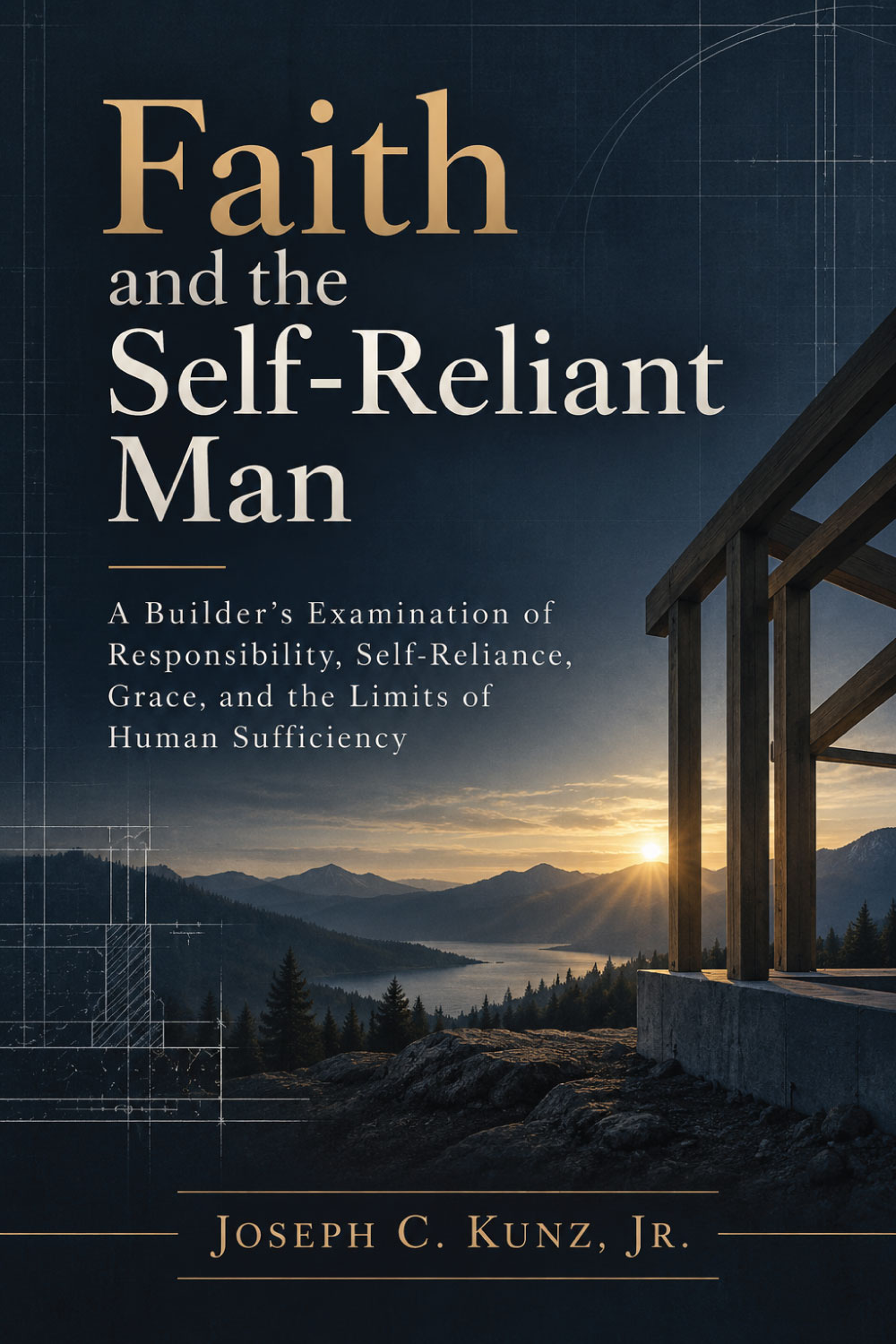
Faith and the Self-Reliant Man
A Builder’s Examination of Responsibility, Self-Reliance, Grace, and the Limits of Human Sufficiency
Some men come to faith from weakness. Others arrive carrying a lifetime of competence.
They know how to work, provide, solve, endure, prepare, earn, protect, and recover. Those abilities are not defects. They are often virtues. But eventually the self-reliant man encounters questions his competence cannot settle: What happens when preparation cannot guarantee the outcome? What does responsibility mean when something cannot be fixed? What does it mean to trust God without first understanding what God is doing? And how does a man receive grace when nearly everything else in his life has taught him to earn what he needs?
Faith and the Self-Reliant Man is being developed around those questions. It examines the meeting point between Christian faith and the habits of a builder: responsibility without sovereignty, strength without self-sufficiency, work without entitlement, preparation without the illusion of control, and grace that cannot be reduced to another achievement system. The book is currently identified on JosephKunz.com as an in-development examination of Christian dependence for people who have spent their lives learning to work, provide, prepare, and solve problems.
This essay belongs near the center of that project because it addresses one of its hardest questions:
What happens when the man who has learned how to carry almost everything finally encounters something he can only receive?
If you have spent years becoming dependable but still struggle with dependence on God, this book is for you.
If responsibility has sometimes become control, this book is for you.
If you believe in God but are still trying to understand surrender, grace, Providence, and the limits of human sufficiency, this book is being written for that journey.
In Development: Faith and the Self-Reliant Man