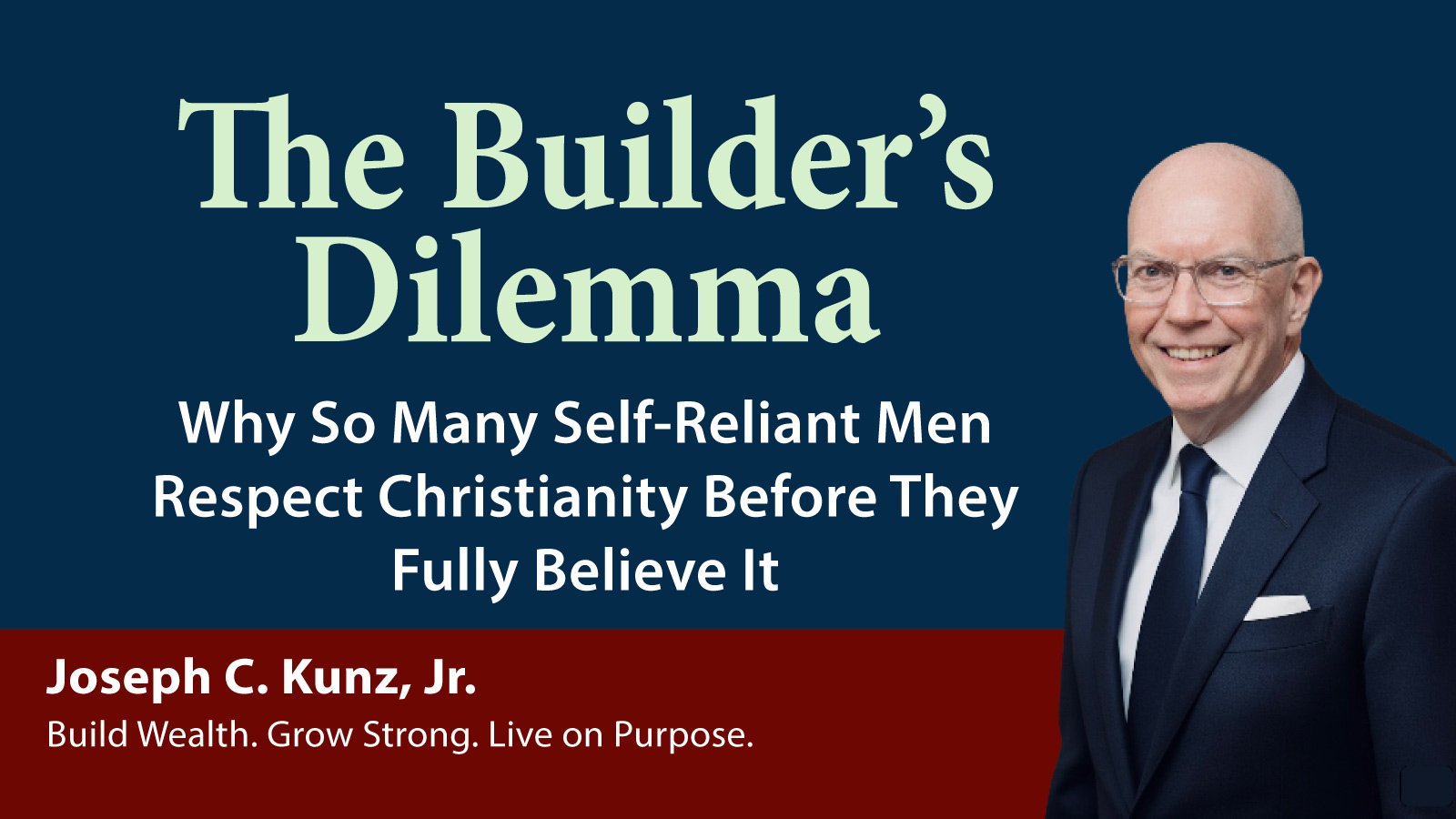
The Builder’s Dilemma
Many self-reliant men come to Christianity by first discovering that it explains reality better than anything else—and then by confronting the harder truth that respect is not the same as surrender. —Joseph C. Kunz, Jr.
Why So Many Self-Reliant Men Respect Christianity Before They Fully Believe It
By Joseph C. Kunz, Jr.
Synopsis
This isn’t another soft testimony about “finding faith,” nor is it a polished theological essay written from the safety of abstract certainty. In this essay, Joseph C. Kunz, Jr. argues that many serious, self-reliant, builder-type men come to Christianity through a hard and unsettling path: they first recognize its necessity, moral structure, and truthfulness about life long before they know how to fully yield themselves to its authority.
Kunz makes the case that these men are often drawn to Christianity not by religious sentiment or church culture, but by the brute fact that it explains reality better than the alternatives. It tells the truth about suffering, pride, guilt, responsibility, sacrifice, discipline, order, and meaning. Yet he also argues that this very strength can become a barrier. A builder-type man may admire Christianity for what it produces without yet submitting to Christ for who He is. He may respect the architecture of faith while still refusing to live under the authority of the Architect.
The conclusion is simple: a man does not need to erase his builder instincts to become a Christian, but he does need to stop making his self-reliance the final authority over truth. Christianity does not ask him to become soft. It asks him to step down and kneel.
Many serious men do not first meet Christianity as comfort. They meet it as the one thing that keeps telling the truth about life. —JCK
I. Introduction: The Men Nobody Writes To
There is a certain kind of man Christian writing often fails to reach.
He is not cynical in the fashionable sense. He is not unserious. He is not floating through life on irony, appetite, and slogans. In many ways, he is the opposite of all that. He works. He carries weight. He builds things. He takes responsibility. He understands consequence. He has spent decades learning that reality does not care about excuses, moods, or carefully worded intentions. It cares what holds.
So he learns to trust what holds.
He trusts the disciplined man over the dramatic one. He trusts the husband who stays, the father who provides, the businessman who honors his word, the craftsman whose work can stand inspection, the friend who shows up, the conviction that survives pressure. He has little patience for vague language, emotional inflation, or fragile ideas that collapse on contact with real life.
That kind of man often sees something important about Christianity before he knows what to do with it.
He sees that it is not merely comforting. It is structurally honest. It tells the truth about man in a way modern slogans do not. It understands pride better than pop psychology, suffering better than self-help, and moral failure better than politics. It speaks with unusual force about guilt, sacrifice, duty, forgiveness, restraint, weakness, and hope. It sounds less like decoration and more like load-bearing truth.
He may not know exactly how to say all that. But he can feel that Christianity has weight.
And that is where the dilemma begins.
Because seeing that Christianity has weight is not yet the same as surrendering to its claims.
A man can respect it, borrow from it, and even live under its influence for years without fully crossing the line faith finally requires. He can say, “This is necessary. This is serious. This names reality. Civilization falls apart without it. Men fall apart without it.” And still stop short of saying, “Therefore, I am under it. Therefore, Christ is Lord. Therefore, I do not stand above this as its evaluator.”
That is the man I am writing to here.
Not the mocker.
Not the sentimentalist.
Not the religious performer.
The serious man standing somewhere between respect and surrender.
II. Why Builder-Type Men Often Arrive at Faith Backwards
Many builder-type men do not come to Christianity the way Christian subculture often imagines.
They do not begin with spiritual language. They do not begin with emotional ease. They do not begin with polished certainty. They begin with reality.
They begin by noticing that life without moral structure decays. They begin by seeing that freedom without restraint becomes self-destruction. They begin by learning that appetite is a terrible master, that pride blinds, that guilt does not vanish because a culture changes the vocabulary, that discipline matters, that sacrifice matters, that meaning matters, that family cannot survive on slogans, and that success without inner order turns rotten from the inside.
In other words, they begin by discovering that Christianity is right about things.
Right about human nature.
Right about temptation.
Right about weakness.
Right about responsibility.
Right about what happens when men refuse limits.
Right about what happens when suffering enters the room.
Right about the fact that a life needs more than pleasure, more than career, more than money, more than autonomy, and more than self-expression.
These men often come to faith through collision.
A marriage under strain.
A business problem that exposes character.
The weight of fatherhood.
The shock of illness.
The sight of their own pride.
The realization that achievement does not answer the deepest questions.
The slow discovery that competence is not redemption.
They do not first ask, “What gives me a warm religious feeling?” They ask, “What actually explains life?”
And that question can bring them very close to Christianity.
It can bring them to respect. To reverence. To church. To Scripture. To prayer. To moral seriousness. To the recognition that the Christian vision of reality is not decorative, but load-bearing.
But here is the hard truth: arriving at Christianity through reality is not the same as arriving at Christianity through surrender.
A man can come very near the kingdom while still trying to keep one last seat of authority for himself. He can live as though Christianity is the truest framework available without fully giving up the right to stand above it and judge it by usefulness.
That is the hidden line.
III. The Strength That Helps Him See—and the Strength That Blinds Him
The builder in a man is not the enemy. In many ways, it is part of what helps him recognize Christian truth in the first place.
The builder sees order. He sees cause and effect. He sees structure. He sees that some materials crack and some bear weight. He sees that bad foundations do not become good foundations because the language around them grows softer.
That way of seeing can serve faith well.
It can make a man allergic to religious theater. It can make him distrust sentimental performance, theological fluff, and all the decorative language people use to hide from repentance, discipline, and truth. It can make him serious about vows, stewardship, moral reality, and the long consequences of small decisions.
But the builder’s strength has a shadow.
The same man who respects what holds can become suspicious of what he cannot master. The same instincts that helped him survive, provide, produce, and endure can harden into a quiet refusal to kneel. He can become so trained to test everything that he never allows himself to be claimed by anything. He can become so used to judging results that he reduces truth itself to function.
Then Christianity becomes dangerous in a subtle way.
Not because he rejects it.
Because he domesticates it.
He keeps the parts that explain life well. He keeps the moral architecture. He keeps the language of duty, discipline, sacrifice, and meaning. He keeps the civilizational usefulness of Christian belief. He keeps what helps him live better, lead better, build better, and endure better.
But he does not fully yield.
He still stands above it. He still treats the faith as something he has wisely selected rather than something before which he must bow. It looks respectful. It sounds intelligent. It can even appear devout. But underneath it sits an old instinct: I will decide what is finally acceptable. I will keep what proves useful. I will remain the judge.
That is not faith. That is management.
And Christianity cannot be managed forever without being hollowed out.
IV. When Christianity Is Respected but Not Yet Believed
This is where many serious men live for years.
They are not mocking Christianity. They may defend it. They may admire it deeply. They may believe the world is unlivable without it. They may know in their bones that men need God, that families need moral law, that society collapses when Christian structure is abandoned. They may see with unusual clarity that the alternatives are shallow, chaotic, narcissistic, and finally destructive.
But the question beneath all that remains unsettled:
Do I believe this because it works, or because it is true?
That is not a small distinction. It is the distinction.
A man may believe in the value of Christianity without yet fully believing in the reality of Christianity. He may say, “Even if I cannot settle every question, I know this is essential.” He may say, “Whether or not I can explain it all, I know men live better under God than under appetite.” He may say, “I know the Christian vision of life is deeper and truer than the alternatives.”
That man is not far away. In some cases, he may be closer to the truth than the polished religious man who says all the right things and lives under none of them.
But he is still standing at a threshold.
Because Christianity does not finally present itself as a noble moral system, a useful framework, or a civilizational necessity alone. It presents itself as truth about reality. It presents Christ not as a symbol of noble living, but as Lord. It presents grace not as a helpful emotional category, but as something real. It presents sin not as poor adjustment, but as rupture. It presents redemption not as therapeutic language, but as fact.
That means the man who respects Christianity because it works must eventually confront the part of Christianity that cannot be kept at a distance.
He must confront the Person at the center of it.
And that is where the pressure becomes personal. Moral structure is one thing. Surrender is another. Admiring Christian civilization is one thing. Being told you are not the final authority in your own life is another. Respecting the teachings of Christ is one thing. Bowing before Christ is another.
This is why the struggle feels so interior and so difficult to name. It is not merely intellectual. It is not merely emotional. It is not merely cultural.
It is a question of rule.
Who stands over whom?
V. The Strongest Men Often Resist at the Strongest Point
There is a reason this struggle often appears in strong men.
Weak men often collapse into drift. Builder-type men often do something more complex: they come near the truth by strength and then resist it at the precise point where strength must yield.
They do not usually stumble first over Christian morality. In many cases, they already respect it. They stumble over authority. Not crude external authority alone, but ultimate authority. They resist the idea that the deepest truths of life are not theirs to edit.
That resistance does not always sound rebellious. Often it sounds serious.
“I don’t want to fake certainty.”
“I need this to be real.”
“I can’t just switch off the way I’ve thought for sixty years.”
Some of that is honest. Some of it should be honored.
But serious men must also be careful here. Prudence can become delay. Reserve can become distance. Intellectual discipline can become a shield. A legitimate refusal to fake faith can quietly harden into a refusal to yield when truth has already become visible enough to demand a response.
At some point the issue is no longer, “Have I solved every question?”
The issue becomes, “Am I willing to remain above what I already know is naming reality better than anything else?”
That is the question that pierces.
And it is a question many builder-type men do not hear addressed plainly enough. They are either spoken to as though they should become soft and emotionally fluent overnight, or spoken to as though faith is just one more proposition to analyze from a safe distance.
Neither approach reaches the real tension.
The real tension is that a man may know Christianity is too true to dismiss while still fearing what full surrender will cost him. He may fear becoming sentimental. He may fear becoming intellectually dishonest. He may fear becoming passive. He may fear becoming less himself.
But Christianity does not ask him to become less real. It asks him to become rightly ordered.
He does not fear Christ because Christ is weak. He fears Him because Christ is Lord, and lordship is the one thing a self-reliant man does not surrender cheaply.
VI. What the Builder Must Learn
The builder does not need to disappear.
What must disappear is the builder’s claim to final sovereignty.
That is the turning point.
Christianity does not command a serious man to stop respecting reality, consequence, discipline, structure, or truth. In fact, it intensifies those things. It purifies them. It places them in their proper order. It gives them a center outside the ego.
What it removes is the illusion that self-reliance is enough.
And that is where the deepest struggle lies for many men like this. They have spent a lifetime building competence because competence mattered. They learned not to depend on moods, not to collapse under pressure, not to wait around for rescue, not to indulge weakness, not to live by wishful thinking. Much of that formed real strength in them.
But strength becomes a barrier when it refuses dependence on God. Discipline becomes a barrier when it replaces repentance. Competence becomes a barrier when it shields a man from surrender. Usefulness becomes a barrier when it outranks truth.
Then the very traits that helped build a life begin to obstruct the One thing that can save it.
That is why the strongest thing a builder-type man may ever do is not to prove, manage, optimize, or hold the line by himself.
It may be to kneel.
Not because kneeling is sentimental.
Because kneeling is true.
VII. Conclusion: The House Is Not the Architect
Many self-reliant men respect Christianity before they fully believe it because they can see, often with unusual clarity, that it describes the structure of life better than the alternatives. They can see that it tells the truth about the human condition, about moral order, about suffering, about pride, about meaning, and about the kind of inner architecture a man needs if he wants his life to hold.
That recognition is not false. It is often the beginning of wisdom.
But it is not yet the end of the matter.
A man can admire the house, study the structure, respect the design, and even live by many of its principles while still refusing the authority of the Architect. He can honor Christianity as useful without yet receiving Christ as Lord. He can stand near truth for a long time while quietly preserving himself as the final judge of what he will allow to rule him.
That position may feel stable for a season. It may even look mature.
It is not stable forever.
Sooner or later, every serious man must answer the deeper question. Not whether Christianity helps a man live well. Not whether it built civilization well. Not whether its teachings produce stronger families, steadier men, and more ordered lives.
But whether it is true.
And whether he is willing to live under it as truth.
The conclusion is simple: the builder-type man does not need to stop being strong, disciplined, or serious to become a Christian. But he does need to stop treating those strengths as the final authority in his life. Christ does not ask him to become softer, smaller, or less real. He asks him to come down from the judge’s bench. He asks him to surrender the one thing builder-type men guard most fiercely: the right to stand above what they already know is true.
The builder’s final test is not whether he can carry more weight, but whether he is willing to kneel before what is true.—JCK
Related Essays: For the Reader Who Knows This Struggle Is Deeper Than Doubt
If this essay put words to a battle you’ve carried quietly, these two push further into the cost of self-rule and the pressure of surrender.
1. When Strength Becomes a Barrier How disciplined self-reliance can point a man toward God yet still keep him from grace, surrender, and the new life found only in Jesus Christ.
Reader Comment: This essay hit me hard because it exposed how the very strength I trusted most could also be the thing keeping me from Christ.
Quote: The strength that helps a man build his life can become the very thing that keeps him from surrendering it. —JCK
2. Why Autonomy-First Men Flinch at Faith Why men who prize self-rule, control, and independence often resist faith at the precise point where truth demands surrender and the self can no longer remain sovereign.
Reader Comment: This one named the tension exactly—faith did not threaten my mind so much as my need to remain in charge.
Related Book: Still Want to Be Your Own God?
If this essay hit you in the chest, good. It was supposed to. Because there comes a point when a serious man has to stop congratulating himself for recognizing truth and decide whether he is actually willing to live under it.
Respecting Christianity is not the same as surrendering to Christ. Admiring faith from the outside is still a way of staying in control. And builder-type men are very good at staying in control while calling it discernment, caution, or “just being honest.”
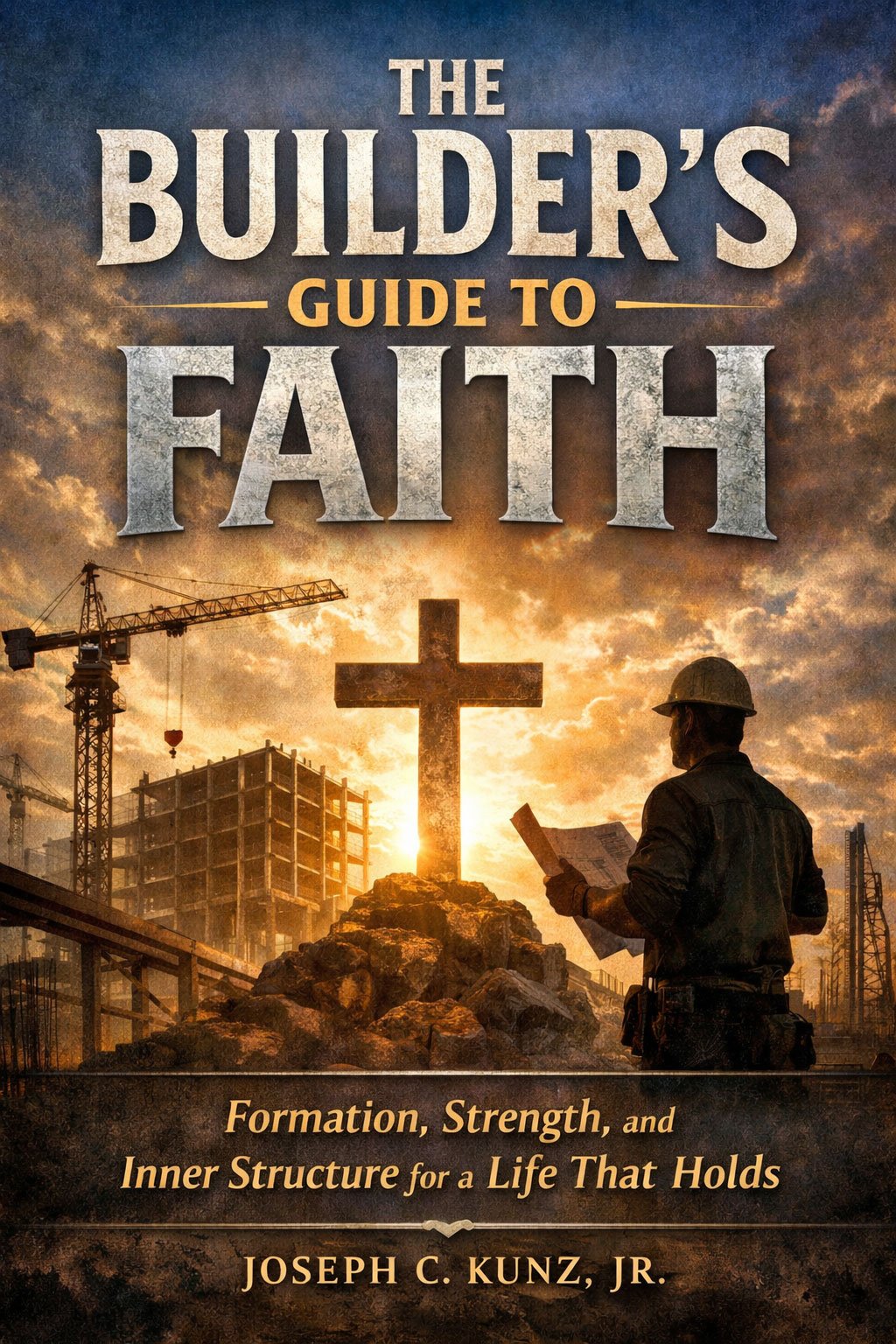
The Builder’s Guide to Faith was written for that man. Not for the soft, the trendy, or the spiritually theatrical. For the man who has built a life, carried weight, trusted strength, and now feels the deeper battle: how do you bring all that force, discipline, and self-reliance under God without becoming fake, passive, or hollow? This book is about formation, strength, surrender, and the inner structure of a faith that can actually hold.
You do not need another polished Christian sales pitch. You need a faith strong enough to survive reality, strip the ego down to the studs, and rebuild the man from the inside out. If you are tired of standing near the truth while still trying to manage it, this is where you stop hovering and start kneeling.
Step off the judge’s bench and start building a faith that can actually hold — The Builder’s Guide to Faith.
Now in the Works.