When Strength Becomes a Barrier
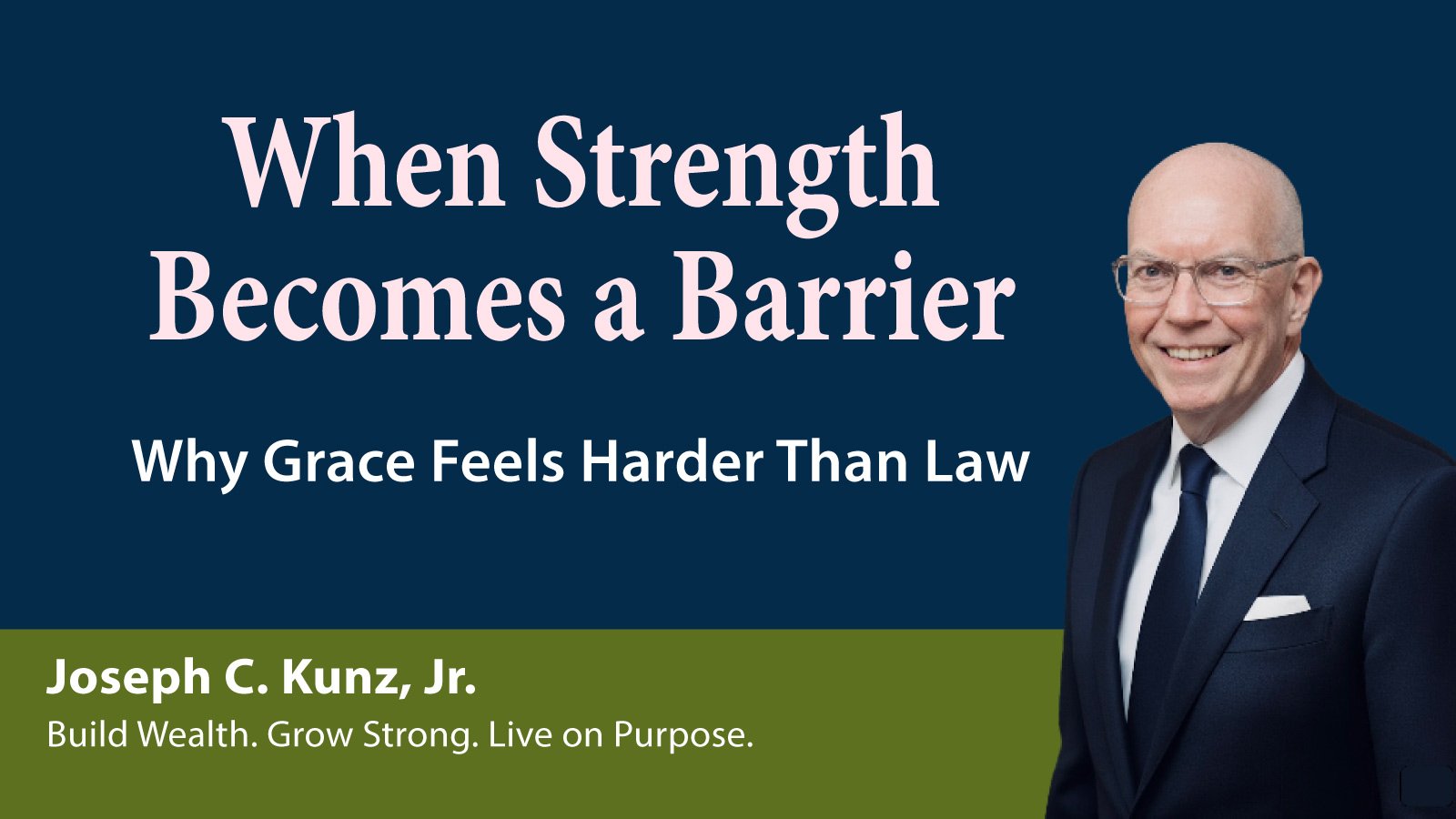
Strength, structure, and self-reliance can point a man toward God—but they can also keep him from the part of Christianity he needs most. —Joseph C. Kunz, Jr.
Why Grace Feels Harder Than Law
By Joseph C. Kunz, Jr.
Synopsis
This is not an essay against strength, discipline, responsibility, or the serious habits that help a man build a real life. In this essay, Joseph C. Kunz, Jr. argues that many self-reliant men grasp Christianity first through law, order, authority, consequence, and moral structure—but then struggle at the very place the faith becomes most personal: grace, surrender, and new life in Christ. What feels natural to a builder in relation to standards and structure can become deeply uncomfortable when the gospel moves from moral architecture to mercy.
Kunz makes the case that this difficulty is not mainly intellectual, but personal. The same qualities that help a man build a life—discipline, endurance, self-command, competence, and responsibility—can also harden into guarded self-reliance. A builder can admire Christian truth, respect Christian morality, and even live by Christian principles while still keeping Christ at a distance, because Christ does not merely reinforce the old man. He exposes pride, addresses wounds, asks for trust, and offers a kind of grace that effort cannot earn and control cannot manage.
The conclusion is simple: strength is not the enemy, but strength that refuses grace becomes a wall. Christianity does not stop at better rules, sharper habits, or a stronger frame for the old self. It moves toward surrender, rebirth, and inward transformation through Jesus Christ. The way forward is not abandoning discipline, but bringing it under the Savior who does more than instruct a man—He makes him new.
Some men can salute the standard long before they will surrender to the Savior. —JCK
I. Introduction: The Builder’s Pressure Point
There is a certain kind of man who has little trouble understanding authority.
He understands standards. He understands consequence. He understands that reality has structure, that life has rules, and that a meaningful life cannot be built on impulse, fantasy, and self-indulgence. He may not speak in soft language, and he may not sound polished when he talks about faith, but he knows in his bones that he did not invent the world and cannot negotiate with its deepest truths.
That part comes naturally.
What comes less naturally is grace.
What comes less naturally is mercy.
What comes less naturally is Jesus Christ not merely as teacher, but as Savior.
That is the pressure point.
Many self-reliant men can respect moral order, honor the law, and acknowledge God as authority. What they struggle with is the part of Christianity that will not remain abstract, structural, or safely impersonal. Christ does not merely present a standard. He asks for trust. He asks for surrender. He asks a man to receive what effort cannot produce on its own.
And that is where many strong men tighten.
Not because they are stupid. Not because they are unserious. Not because they are hostile to truth.
But because they have spent a lifetime learning how to stand up, carry weight, and not need much from anyone.
Christianity asks more than effort.
It asks a man to be remade.
II. Why Law, Order, and Authority Make Immediate Sense
Builders are drawn to what is load-bearing.
They respect what holds under pressure. They trust what proves itself against consequence. They understand that a structure stands or falls based on what it rests on. For that reason, the Christian view of reality often strikes them as sane long before it feels intimate.
They understand that chaos is not freedom. Chaos is collapse.
They understand that hierarchy is real. Some things answer to higher things.
They understand that moral cause and effect is not superstition. Weak foundations crack. Neglected duties compound. Lies spread. Character matters.
So when Christianity speaks about truth, order, judgment, responsibility, authority, and law, the self-reliant man is not usually offended. In many cases, he is relieved. The world finally sounds solid again. Life sounds weighty again. Reality sounds real again.
That is why serious men can often move toward Christianity through structure before they move toward it through grace. They recognize that the faith tells the truth about how the world works and what a human life requires.
So far, so good.
But there is a danger here.
A man can admire Christian structure while still keeping the center of Christianity at arm’s length. He can respect the blueprint while refusing the deeper claim the gospel makes on him. He can honor the code while resisting the Savior who says the problem is not merely that you need better instructions. The problem is that the old man, left to himself, is not enough.
That is where the real struggle begins.
III. Why Grace Feels Harder Than Law
A disciplined man can live under a law without feeling especially exposed.
He can measure himself against a standard. He can strive. He can improve. He can tighten up. He can correct his behavior. He can carry responsibility. All of that still leaves him, in some sense, in charge.
Grace is different.
Grace reaches the part of a man that competence can hide.
Grace says you are not merely tired. You are needy.
Grace says you are not merely underperforming. You are wounded.
Grace says you do not merely need better habits. You need mercy.
Grace says the deepest problem in a man cannot be solved by willpower, discipline, and self-command alone.
That is hard for builders.
A strong man can work hard, stay sober, keep his word, show up under pressure, pay his bills, and still remain guarded against the part of Christianity he needs most. He can respect Jesus as a moral teacher and still resist what Christ actually requires. Because it is one thing to respect a standard. It is another thing to receive mercy you cannot earn, cannot repay, and cannot control.
That is why many self-reliant men are more comfortable with responsibility than with grace.
Responsibility still lets them lead with strength.
Grace reminds them they are not the source of their own rescue.
IV. The Trap of Reducing Christianity to Moral Architecture
There is a version of Christianity that appeals strongly to serious men because it leaves the basic self intact.
In that version, God provides the blueprint. Morality provides the rules. Discipline provides the muscle. Success is measured by how well a man holds himself together.
That version contains truth. It also contains a trap.
Because Christianity is not merely a system for producing better-behaved men. It is not a moral carpentry manual for reinforcing the old self. It is not self-improvement with God attached to it.
Real life exposes that weakness quickly.
A man can build a business, support a family, carry burdens, solve practical problems, and become known as dependable by everyone around him, yet still be ruled inwardly by pride, resentment, fear, control, emotional distance, or the inability to receive love without suspicion. He can be admirable in public and unavailable in private. He can be responsible in every visible sense and still not know what to do with guilt, failure, shame, tenderness, or the need for forgiveness.
That is where moral architecture starts to crack.
Because Christianity does not merely address visible conduct. It reaches motive. It reaches pride. It reaches wounds. It reaches the old self’s demand to stay in control. It says, in effect, that the human problem is not simply bad technique. It is deeper than that.
A stronger old man is still the old man.
That is why Christianity cannot be reduced to rules, reinforcement, and better performance. It does not stop at reform. It presses toward rebirth.
V. Reinforcement Is Not Rebirth
This is the distinction the essay has to make cleanly.
A builder understands reinforcement.
You shore up the weak spot. You strengthen the frame. You repair damage. You improve performance.
That logic makes sense. And at one level, it is part of maturity. If a man is irresponsible, he should become responsible. If he is undisciplined, he should tighten up. If he has damaged something, he should repair what he can.
But Christianity speaks more radically than that.
It speaks of new life. New creation. Renewal. Rebirth in Christ.
That is not decorative religious language. It is the heart of the claim.
Because some things in a man cannot be solved by reinforcement alone. A marriage strained by years of emotional distance does not heal merely because a husband becomes more efficient. A father does not become truly present merely because he works harder to provide. A man does not conquer pride simply by trying to act more humble. And a soul is not reconciled to God by becoming a more polished version of itself.
Jesus Christ does not come merely to reinforce the old man.
He comes to make a new man.
That is why He cannot be reduced to a moral example, a wise teacher, or the softer side of Christianity. A law can restrain you. An example can inspire you. A teacher can instruct you. But none of those can actually give you new life.
Christianity says Christ can.
And that is precisely the claim many self-reliant men resist at first, because it feels too personal, too dependent, too humiliating to the ego that wants to remain intact.
VI. The Strength It Takes to Surrender
Many men hear the language of surrender and immediately imagine weakness, passivity, or diminished manhood.
That is a mistake.
There is a cheap surrender that is cowardice, yes. But there is also a higher surrender that only strong men are capable of making. It takes strength to stop pretending you are self-sufficient. It takes strength to admit that effort is not the same as transformation. It takes strength to kneel without becoming small.
In fact, some of the strongest men struggle longest here precisely because they are not accustomed to needing help in a way that reaches beyond advice or instruction. They know how to work. They know how to endure. They know how to fix problems. They know how to keep going.
But Christianity eventually asks a question discipline alone cannot answer:
Who are you when effort is no longer enough?
That is where the builder must change.
He does not need to abandon strength. He needs to let strength be converted.
He does not need to stop respecting law. He needs to see that law cannot save him.
He does not need to become sentimental. He needs to become honest enough to let Christ address not only his conduct, but his pride, fear, guardedness, and need for grace.
That is the turn.
Not away from manhood. Not away from discipline. Not away from responsibility.
But away from the illusion that these things, by themselves, can complete the work.
VII. Conclusion: More Than a Blueprint
A self-reliant man can get very far by understanding Christianity as order, authority, justice, truth, and moral structure.
Farther than many people do.
That understanding can produce seriousness, courage, gratitude, discipline, and respect for reality. It can keep a man from drifting into nonsense. It can help him build a life with weight and shape.
But it is still not the whole of Christianity.
Because Christianity does not stop at structure. It moves toward surrender. It does not stop at law. It moves toward life. It does not stop at moral seriousness. It moves toward grace. It does not stop at reinforcement. It moves toward rebirth.
That is where many builders must do their deepest work.
Not learning how to admire the faith from a distance. Not using God to reinforce an already serious life. But letting Christ enter the work at the point where effort, structure, and self-command cannot finish the job.
And that matters in the real world, not merely in theology. It matters when competence does not save a marriage. It matters when success does not quiet a man’s restlessness. It matters when discipline does not cure the fear underneath striving. It matters when age, loss, failure, or suffering expose that the life looks strong from the outside but still does not know how to receive grace from within.
That is not a retreat from strength.
It is the purification of strength.
The conclusion is simple: you can respect the blueprint, honor the code, and work hard to hold yourself together, yet still miss the living center of Christianity. Christ is not the optional or softer part of the faith. He is the point where a man stops trying merely to reinforce the old self and begins receiving the new life he cannot build on his own.
You can respect the blueprint and still never enter the house. Christ is the door. —JCK
Related Essays: For the Ambitious Individual Ready to Go Deeper
If this essay exposed the cost of self-reliance, these two go straight for the nerve.
1. Why Autonomy-First Men Flinch at Faith See how autonomy worship turns the self into its own judge—and why faith always begins where self-rule finally ends.
Reader Comment: This one named a problem I had mistaken for strength. I did not realize how much of my “independence” was really resistance to surrender.
Quote: Autonomy feels powerful right up until it becomes a prison. —JCK
2. Belief in God Is Not Yet Christianity Why belief in God, moral seriousness, and reverence are not yet the full heart of Christianity until God is received through Jesus Christ as mercy, reconciliation, and new life.
Reader Comment: This essay drew a hard but necessary line for me — believing in God is not the same as receiving Christ, and I needed that distinction.
Related Book: Still Trying to Carry It All Yourself?
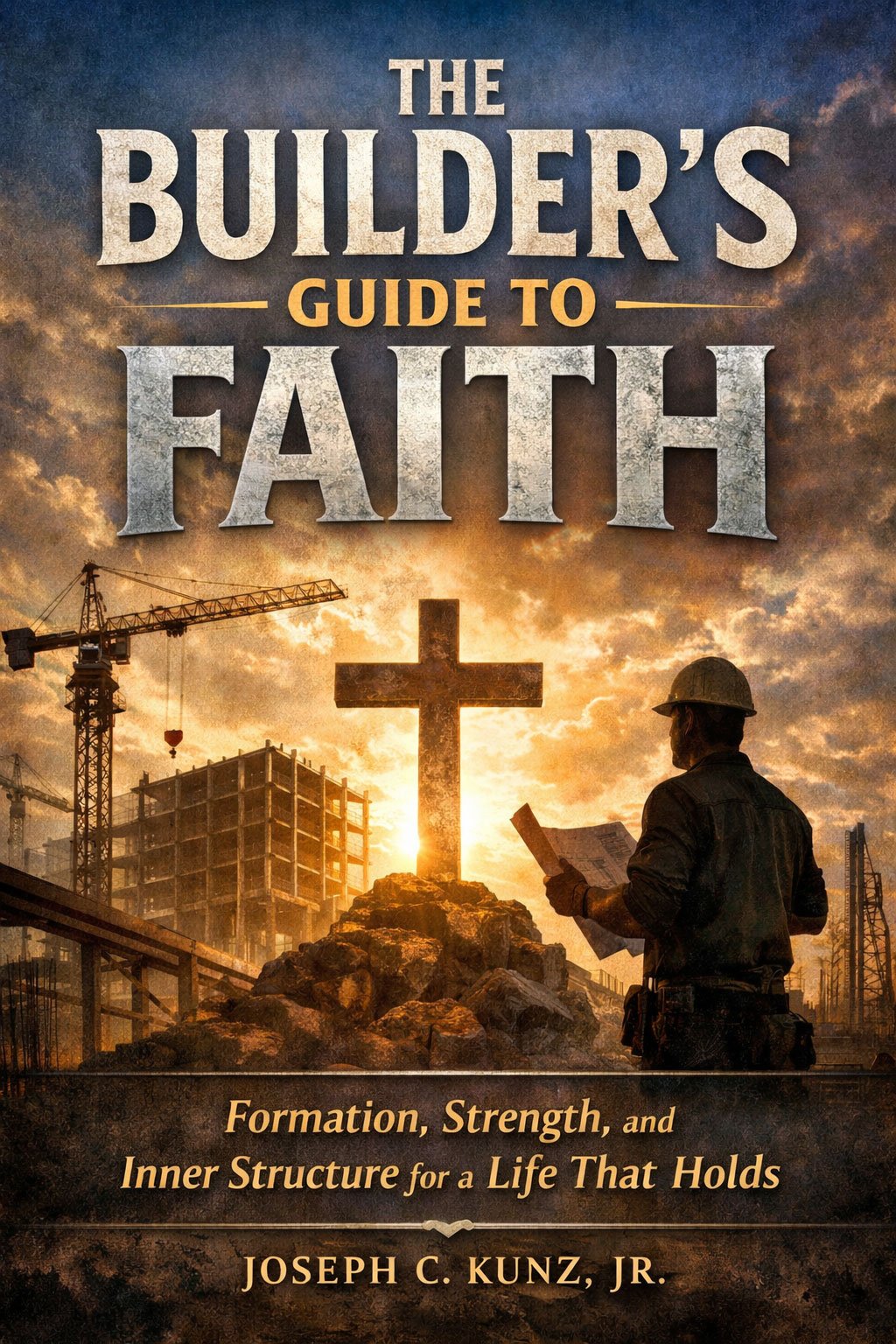
You can build a business, carry a family, survive pressure, and still be stuck at the one place that matters most: the part of you that refuses to kneel.
That is the brutal truth this essay points to. Strength can build a lot. It can build discipline, grit, competence, and respect. But when strength hardens into self-reliance, it stops being your asset and starts becoming your prison. A man can look solid to everyone around him while quietly starving the very part of himself that needs grace, surrender, and Jesus Christ most.
The Builder’s Guide to Faith was written for men and women who are tired of treating faith like decoration, theory, or emotional wallpaper. It is for builders. Strivers. Burden-carriers. People who know how to work, endure, and hold the line—but need something deeper than willpower to become whole. This book is about formation, strength, obedience, and inner structure for a life that does not just look strong, but actually holds.
If this essay hit you in the chest, don’t brush it off and move on like nothing happened. That’s what people do when truth gets too close. Step into the harder work.
Go deeper with The Builder’s Guide to Faith.
Formation, Strength, and Inner Structure for a Life That Holds
Step into The Builder’s Guide to Faith and start building the part of your life that effort alone cannot reach.
Under Construction.