Why I Respect New Polity’s Zeal — But Walk a Different Road
I owe a serious criticism more than a defense of the life I have already built. —Joseph C. Kunz, Jr.
A Christian Businessman’s Examination of Freedom, Responsibility, and Social Renewal
By Joseph C. Kunz, Jr.
Synopsis
This isn’t a blanket defense of modern society or a dismissal of New Polity, a Christian publishing project that challenges it. In this essay, Joseph C. Kunz, Jr. examines what freedom makes possible—and what it cannot provide on its own.
Kunz makes the case that personal responsibility and sound institutions belong together. Drawing on family, faith, and business, he examines particular freedoms and practices rather than treating an entire political tradition as something to accept or reject all at once. His experience matters, but it cannot answer every question.
The conclusion is simple: a serious criticism deserves a serious hearing, but recognizing a problem does not settle its remedy. The work is to understand what needs preserving, what needs correcting, and why.
Serious thought and lived experience should correct one another, not compete for the final word. —JCK
I. Introduction: A Challenge Worth Hearing
A contract can describe what a customer is buying. It cannot, by itself, make me care whether the work genuinely helps him. That requires something the contract cannot supply: a judgment about who this person is and what I owe him.
I can fulfill the written terms of an agreement and still fall short of treating someone well. The paperwork matters. But it is not the whole relationship.
That is one reason I take New Polity seriously.
New Polity is a Christian publishing project whose writers challenge the separation of faith from economic and public life. Their mission statement argues that liberalism gives priority to rights, property, and individual choice while treating our deeper commitments as private concerns. They propose beginning instead with our relationships to God and one another.
Here, liberalism is not simply a label for left-wing politics. The discussion concerns a broader understanding of freedom and how people live together. New Polity’s description of that tradition is a criticism to consider, not a definition everyone accepts.
The question becomes easier to recognize when brought closer to home. Is my business serving the life I am responsible for, or is everything else gradually being arranged around the business? Does my independence help me keep my commitments, or has it become a reason to resist them?
Those questions deserve more than a defensive answer. But they also leave another question open: what, exactly, needs to change?
II. What My Experience Can—and Cannot—Tell Me
For more than forty years, I have worked, served customers, and helped provide for my family. The freedom to own a business, make agreements, worship, and publish belongs to the life I have actually lived. These are not remote subjects to me.
It would be easy to stop there. I built a life within these circumstances. Therefore, the circumstances must be sound.
But that conclusion asks my experience to prove too much.
An honest business shows that honesty is possible in its setting. It does not show that every pressure surrounding the business encourages honesty. A faithful marriage does not establish that everything in the surrounding culture supports fidelity. Sometimes people flourish with help from their circumstances. Sometimes they flourish by resisting them.
I need to understand which is which.
The independence I sought was not freedom from everyone who might need something from me. It was the ability to provide, make decisions, do useful work, and carry my responsibilities. Self-reliance, as I have tried to practice it, means becoming more dependable—not convincing myself that I need nobody or owe nobody anything.
That remains an important distinction. But stating it does not answer every criticism of the society in which I live.
My experience gives me reasons to value certain freedoms. It also gives me responsibilities when someone points out problems I may have overlooked. I cannot answer every criticism with “It worked for me.” Neither must I accept an entire proposed remedy simply because someone has identified a genuine problem.
Experience belongs in the argument. It should not be used to end the argument.
III. Freedom Does Not Tell Me How to Live
The freedom to make a decision does not tell me whether the decision is right.
I may have considerable freedom in how I conduct my business. That does not settle whether I have been honest with a customer, fair in an agreement, or responsible toward my family. Being permitted to do something is not a complete explanation of whether I ought to do it.
Catholic teaching makes a related distinction about religious freedom. In Dignitatis Humanae, paragraphs 1–2, the Second Vatican Council affirms both the obligation to seek religious truth and the right to freedom from religious coercion, within due limits. It grounds that right in human dignity, not in the claim that all beliefs are equally true.
In other words, protecting a person’s freedom is not the same as saying that every choice he makes is right. Believing Christianity is true does not require treating someone who disagrees as though his dignity has disappeared.
John Paul II makes another useful distinction in Centesimus Annus, paragraph 42. He discusses business, markets, property, and economic initiative within a legal and moral framework serving the whole person. He distinguishes that arrangement from economic freedom detached from such a framework.
That brings me back to the customer. A transaction can be lawful and profitable while still requiring me to ask whether I have treated the person honestly. Profit tells me something about the business. It does not tell me everything about its conduct.
These distinctions do not settle the larger disagreement. They clarify it. We still have to ask whether the freedoms we value are being supported by habits and institutions that help people use them responsibly.
A society can give people room to choose without adequately preparing them for what their choices will require.
IV. People Form Institutions, and Institutions Form People
My instinct is to begin with the person. Keep your word. Do useful work. Care for those who depend upon you. Correct your mistakes instead of making somebody else carry them.
But personal responsibility is not the end of the discussion.
Consider a workplace that praises family life while rewarding employees for being available at every hour. The employer cannot place the entire burden on parents to make better choices while organizing the work in ways that punish those choices. The schedule, expectations, and rewards need attention too.
Now reverse the example. A company can adopt a thoughtful policy and still undermine it when the people in charge routinely make exceptions for themselves. The document cannot substitute for their conduct.
People need to act responsibly, and the institutions they inhabit need to support rather than contradict that responsibility.
In Spe Salvi, paragraphs 24–25, Benedict XVI holds these needs together. Good structures are necessary, but they cannot guarantee moral goodness. Each generation must freely take up responsibilities that earlier generations cannot fulfill on its behalf.
That distinction helps me avoid two easy answers. I cannot assume that everything will improve if individuals simply try harder. Nor can I assume that a revised policy will accomplish what requires honesty, restraint, courage, or repentance.
In the workplace example, responsible leadership would involve changing unreasonable expectations and then honoring the changes. Employees would still have obligations to their work. The correction would not eliminate responsibility; it would make the responsibilities clearer and less contradictory.
This is the kind of practical detail that a discussion about social renewal needs. Otherwise, “better people” and “better institutions” remain phrases we repeat without deciding what either requires.
V. Where My Road Differs
New Polity describes its project as thinking beyond liberalism’s categories rather than reforming liberalism from within. Its mission also emphasizes smaller communities and reduced dependence on the dominance of state and market. It should not be reduced to a proposal for taking control of centralized power.
My starting point is different. I begin with particular freedoms, protections, and practices, then ask what they help people do and where they cause difficulty. I do not treat everything gathered under the word liberalism as one thing that must receive one verdict.
That is an approach to the problem, not a claim that familiar arrangements are innocent.
The strongest objection to my approach is straightforward: what happens when the arrangements I value help produce the habits I am criticizing? What happens when the problem is not merely that people misuse their freedom, but that the surrounding incentives repeatedly encourage that misuse?
The workplace example shows why that objection matters. Telling parents to put their families first would be inadequate if their employer consistently penalized them for doing so. Some problems require changes in how an institution operates, not another speech about character.
I therefore cannot use reform as a comfortable word for leaving everything alone. Sometimes correction is modest. Sometimes it requires substantial change. The extent of the change should follow from an honest account of the problem and the likely consequences—not from my attachment to what is familiar.
Proposed alternatives deserve the same scrutiny. I want to know how authority would be exercised, how an abuse could be challenged, and how people outside the community’s faith would be treated. Those questions apply to existing institutions as well.
For me, walking a different road means beginning with that particular work. A familiar arrangement is not beyond correction, and an appealing alternative is not beyond examination.
VI. What Faithfulness Cannot Guarantee
Even after we decide what needs to change, another question remains: what are we expecting our efforts to guarantee?
This is where the discussion reaches a difficulty I have been examining in my own faith. I know how easily responsibility can become an unspoken bargain. I work, prepare, provide, and try to do what is right. Somewhere underneath those actions, an expectation develops that life should therefore turn out in a particular way.
The Catechism of the Catholic Church, paragraphs 1996 and 2001, places God’s gift before our achievement. Grace is freely given, and even our preparation to receive it is already a work of grace. Our response matters, but we did not create the relationship or set its terms.
I cannot reject the idea that God owes me a particular outcome and then quietly assume that He owes one to my society.
We may strengthen households, improve schools, build honest businesses, and take our faith more seriously. Those efforts matter. They may accomplish a great deal. But they do not place God under an obligation to preserve the social order we prefer.
Nor do I follow Christ merely because Christianity might produce more dependable customers, stronger families, or a more orderly community. Those would be welcome results. They cannot become the conditions under which I agree to remain faithful.
In Spe Salvi, paragraph 27, Benedict XVI locates the Christian’s deepest hope in God, whose love sustains that hope through disappointments—not in the uninterrupted success of our projects.
For me, that means an honest business can fail without making honesty a mistake. A worthwhile institution can struggle without making its work meaningless. Success deserves careful examination, but so does failure. Neither gives me a simple measure of someone’s faithfulness.
This is not permission to be careless. When something fails, I still need to ask whether I made a poor decision, ignored a warning, or refused a necessary correction. Trusting God does not exempt me from learning.
It does mean that I must distinguish responsibility for my work from control over everything that follows it.
VII. Conclusion: The Work Still Before Us
I respect New Polity’s zeal because its questions reach beyond public arguments into the way a person actually lives. For me, taking those questions seriously means allowing them to reach my own decisions—not merely the conduct of people with whom I already disagree.
I still begin with the responsibilities and freedoms I have known through family, faith, and work. But I cannot make my experience carry more weight than it can bear. Books and experience should help correct one another. So should conviction and a willingness to admit when something needs repair.
Walking a different road does not relieve me of that work. It requires me to be specific about what I value, honest about what is failing, and attentive to what a proposed change would actually do.
I return, finally, to the customer and the contract. The agreement matters, and so does the person standing behind it. Taking either seriously requires more than declaring my principles. It requires putting them into practice, accepting correction, and remaining answerable for the work entrusted to me.
That is work I can begin without pretending to possess every answer.
I can be responsible for what I build without pretending that I possess the future. —JCK
Related Essays: Faith, Formation, and the Limits of Self-Sufficiency
These two essays examine how responsibility shapes a person, how people shape their institutions, and why neither effort nor good intentions can guarantee the future.
The habits that help us work, provide, and solve problems can also encourage us to expect a particular return on our faithfulness. This essay examines the difference between carrying responsibility and treating God as though He owes us the outcome we wanted.
Reader Comment: Read this next to explore the personal question beneath the final section: have I confused trusting God with expecting Him to honor a bargain I never openly acknowledged?
Quote: “Our faithfulness matters enormously. But faithfulness does not give us sovereignty over the outcome.” —JCK
2. Christian Culture Cannot Be Built by Unformed Christians
Christian formation reaches beyond private belief into households, churches, schools, and public life. This companion essay examines how those settings reinforce or undermine one another—and why institutions cannot be separated from the people who sustain them.
Reader Comment: Continue here for a fuller examination of Section IV: what our everyday habits bring to an institution, and what that institution teaches us through the behavior it rewards.
Quote: “Christian culture is what happens when Christian truth becomes embodied.” —JCK
Related Reading: The Grace Effect Series
Faith, Responsibility, and the Work of Rebuilding
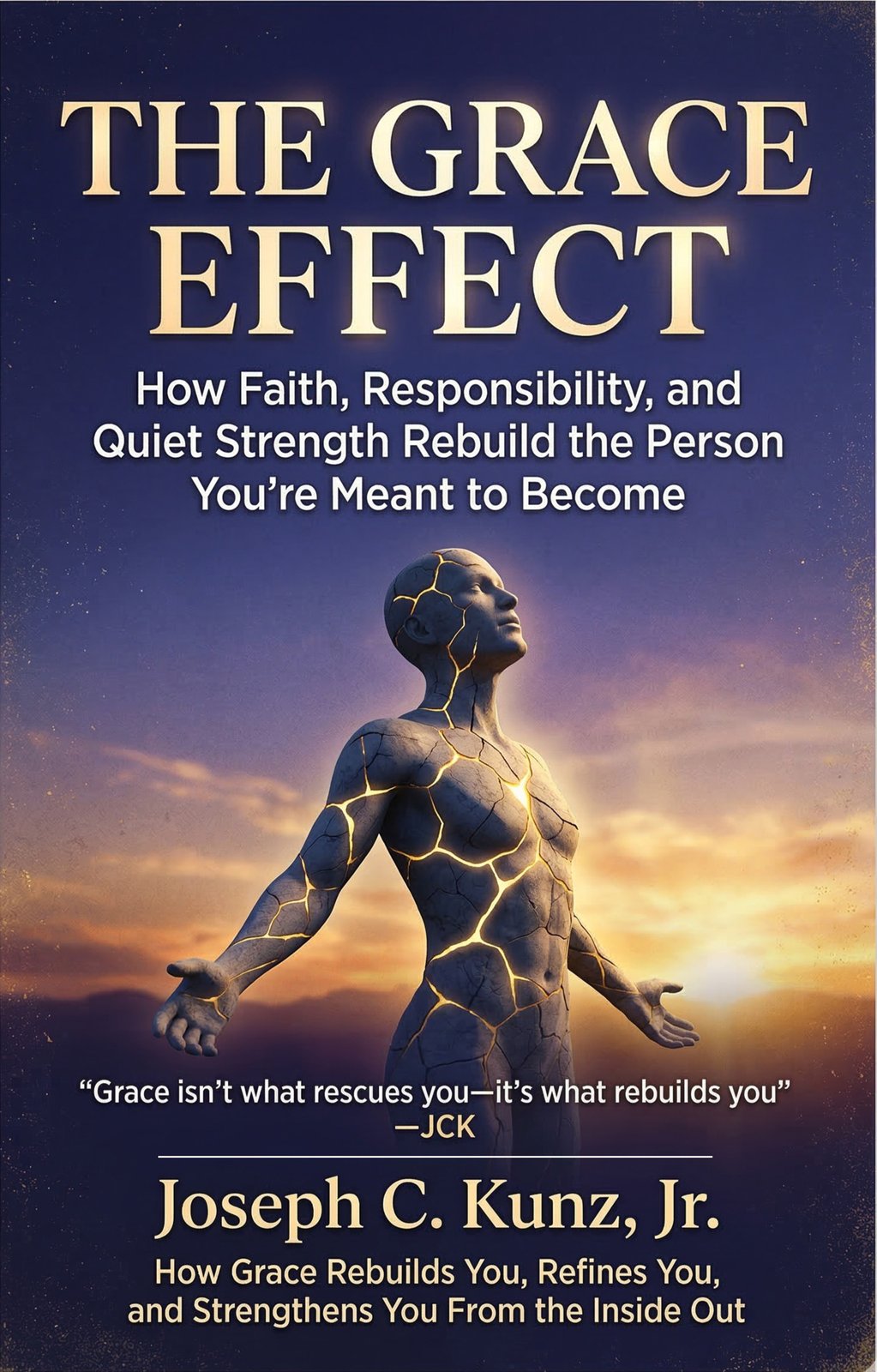
Forthcoming
What happens when the life we have worked to build no longer follows the plan?
The Grace Effect Series is a forthcoming collection for adults, men, and teenagers, exploring faith, responsibility, identity, and character after hardship.
The connection to this essay is personal. We can spend years becoming dependable, learning to solve problems, and preparing for difficulty. Then something happens that effort alone cannot put right. We still have responsibilities, but we must also learn to accept help, reconsider our expectations, and live without control over everything that matters.
Rebuilding is not the same as becoming self-sufficient again. It can also mean discovering more honestly what we need, what we can contribute, and what we must receive. The Christian understanding of grace begins with God’s gift, not with our success at restoring the life we expected.