The Public Square Is Downstream
The public square is downstream from the soul, the home, the church, and the habits that either form character or quietly dissolve it. —Joseph C. Kunz, Jr.
Why Cultural Collapse Begins Closer to Home Than Most People Want to Admit
By Joseph C. Kunz, Jr.
Synopsis
This is not another essay blaming everything on politicians, institutions, media, or some abstract “culture out there.” In this essay, Joseph C. Kunz, Jr. argues that public disorder is almost always the downstream result of private disorder—of souls left undisciplined, families left unformed, churches left timid, and ordinary people who slowly trade self-government for appetite, comfort, and drift. A culture does not become hollow all at once or mainly from the top down. It hollows out when enough people stop telling the truth, stop honoring limits, stop carrying responsibility, and start treating private compromise as if it has no public cost.
Kunz makes the case that the public square is not the starting point of moral collapse but its mirror. He explains why laws and institutions matter but cannot compensate for the inward breakdown of character, why homes and habits shape nations long before headlines do, and why the most dangerous cultural lies are often the ones people practice quietly before they ever defend them publicly. The real crisis, he argues, begins much closer to home than most people want to admit.
The conclusion is simple: a society cannot remain healthy when the people inside it are no longer governing themselves under truth. Public life will always reflect what private life has normalized. Which means the work of renewal begins not first in the spotlight, but in the quiet places where character is either formed or surrendered.
Public collapse is what private disorder looks like after it gets dressed up and made official. —JCK
I. Introduction: The Lie of Distance
One of the most comforting lies in modern life is the lie of distance.
It is the lie that says the problem is always somewhere else. In Washington. In the universities. In the media. In the schools. In the corporations. In the elites. In the “culture” as some giant machine floating above the rest of us.
There is truth in some of that. Institutions matter. Laws matter. Schools matter. Ideas matter. A nation can absolutely be damaged by corrupt leaders, dishonest systems, and diseased public philosophies.
But that is not the whole truth.
The whole truth is harder because it lands closer to home.
A culture does not collapse only because the wrong people gain power. It also collapses because ordinary people normalize the private habits, excuses, indulgences, cowardice, and moral evasions that eventually show up in public life wearing a suit and carrying a microphone.
That is what many people do not want to admit.
They want the problem to remain safely out there because then they can remain safely innocent in here. They can denounce the age without examining themselves. They can condemn public corruption while protecting private compromise. They can sound morally serious without asking whether they are helping produce the very world they claim to hate.
But the public square is downstream.
It is downstream from the soul.
Downstream from the home.
Downstream from the marriage.
Downstream from the church.
Downstream from the habits a people practice long before those habits become policies, institutions, or slogans.
That is where this conversation needs to begin.
II. Public Life Reflects Private Formation
A public square does not arise in a vacuum.
It is not created from nothing by a few intellectuals, politicians, or institutional managers. Those people matter, but they are not magicians. They do not invent a culture from scratch. They work with the moral material already present in the people.
That is the point many modern discussions miss.
Public life is always reflecting something. It is reflecting what a people love, what they excuse, what they fear, what they worship, what they refuse to restrain, what they no longer believe, and what they are no longer willing to suffer for.
That reflection may not be immediate. It may be delayed by strong institutions, inherited standards, or the leftover moral capital of earlier generations. But eventually the reflection becomes visible.
If enough people stop governing themselves, public life will become harder to govern.
If enough people start worshiping comfort, public life will become softer and less serious.
If enough people stop telling the truth in private, public life will fill with polished dishonesty.
If enough people stop honoring marriage, family, and duty, the public square will eventually be populated by more fractured, unstable, and morally unformed adults.
If enough people treat freedom as appetite rather than self-command, public institutions will slowly adapt to that degraded vision of freedom.
None of this happens in a day.
That is why people miss it.
They want dramatic causes. They want singular villains. They want a clear event where civilization took the wrong turn. But cultural collapse is usually slower and more ordinary than that. It is often the cumulative effect of small abdications repeated millions of times until the public square begins mirroring what private life has already become.
III. The Home Is More Political Than Politics
This is one of the hardest truths for modern people to accept: the home is more political than politics.
Not because the home should become partisan, ideological, or noisy. Quite the opposite. The home is political in the deepest sense because it is one of the first places a human being learns what authority is, what love is, what limits are, what truth sounds like, what consequences mean, and whether freedom is something ordered or merely something felt.
The home teaches scale before the state ever does.
A child learns:
whether words mean anything,
whether discipline is real,
whether love has standards,
whether sacrifice is normal,
whether promises hold,
whether apologies matter,
whether adults govern themselves or merely improvise.
That formation does not stay in the home.
It walks into schools, marriages, friendships, churches, businesses, neighborhoods, and voting booths. It enters public life through the habits, expectations, and emotional reflexes of the people shaped by it.
This is why strong homes are not a sentimental side issue. They are civilizational infrastructure.
A society cannot mass-produce public seriousness if it has spent years tolerating private chaos. It cannot generate stable citizens out of homes where truth was optional, authority was erratic, standards were unclear, and self-restraint was never learned. It cannot talk intelligently about freedom while raising people who were never taught that freedom begins with self-command.
And yet this is exactly what many people want. They want the fruits of social order without the daily disciplines that produce it. They want good citizens without demanding homes. They want civic trust without private honesty. They want public virtue without domestic formation.
That is fantasy.
Politics can restrain some damage.
Law can punish some evil.
Institutions can delay some decay.
But none of them can replace the formative work of the home.
IV. Private Sin Never Stays Private
Modern people love the language of privacy because it often functions as a shield against moral consequence.
What I do in private.
What I consume in private.
What I tolerate in private.
What I excuse in private.
What I become in private.
All of it is treated as sealed off from the larger moral world.
But private sin never stays private.
It changes the person carrying it.
It changes how he speaks.
How he judges.
How he desires.
How he loves.
How he leads.
How he endures.
How he reacts when challenged.
How he treats weakness in others.
How much truth he can stand.
How much discipline he can bear.
The idea that private compromise has no public consequences is one of the great lies of a decaying culture.
The man who lies privately does not become honest when he enters public life.
The woman who resents discipline privately does not become principled when she gains influence.
The person who feeds appetite in secret does not suddenly become free in public.
The citizen who refuses self-government in ordinary life does not somehow become a guardian of liberty when larger questions arrive.
Character travels.
That is why a society cannot survive indefinitely on the fiction that vice is harmless so long as it remains personal. Vice is never merely personal. It shapes persons. And persons carry that shape into every room they enter.
When enough people are inwardly disordered, public disorder is not a mystery. It is a reveal.
V. Institutions Do Not Invent Moral Weakness—They Amplify It
This is where many diagnoses of cultural collapse get the sequence wrong.
They act as if institutions are the primary source of moral disorder, as though schools, media, governments, and corporate bureaucracies simply imposed a hollow culture on otherwise healthy people.
That flatters the public. It also avoids a painful truth.
Institutions usually do not invent widespread moral weakness from nothing. They amplify, ratify, reward, and organize what a people have already become willing to tolerate.
That does not make institutions innocent. Far from it. Corrupt institutions can magnify decay at terrifying speed. They can normalize lies, punish dissent, flatter appetites, and turn private disorder into official doctrine.
But they still require moral raw material.
If a people still possess strong moral sight, institutions have limits.
If a people still honor truth, lies face resistance.
If a people still value marriage, restraint, sacrifice, and faithfulness, institutional pressure cannot easily erase those things.
If a people still govern themselves, public absurdities face stronger boundaries.
Institutions become most dangerous when enough people have already grown too soft, distracted, compromised, or frightened to resist them.
That is why the moral state of ordinary people matters so much.
A public square filled with weak souls will eventually produce weaker institutions. And then those institutions will accelerate the weakness that made them possible in the first place.
That is how a culture spirals.
VI. The Collapse Usually Starts with “Reasonable” Compromises
Most people do not wake up one day and decide to help hollow out a civilization.
They get there more quietly.
They make a compromise here.
A rationalization there.
A private exemption here.
A lowering of standards there.
A refusal to confront what is wrong.
A willingness to laugh at what should shame them.
A little more appetite.
A little less restraint.
A little more drift.
A little less self-command.
They tell themselves it is not a big deal.
That phrase has done enormous cultural damage.
Not a big deal.
Not worth the fight.
Not worth the awkwardness.
Not worth the consequence.
Not worth being different.
But civilizations are not usually lost through one giant decision. They are lost through accumulated permission. Through millions of little private decisions in which people choose ease over clarity, indulgence over restraint, avoidance over truth, comfort over courage.
Then one day they look up and wonder why the public square feels strange, hostile, dishonest, confused, or morally upside down.
It feels that way because public life is now wearing the face private life has been practicing for years.
VII. Why People Resist This Truth
There is a reason this argument is hard to hear.
It threatens the pleasure of blame.
It is much easier to point to elites, institutions, trends, and systems than to admit that ordinary people help create the cultural weather they later complain about. It is easier to diagnose the public square than to ask whether one’s own home, habits, speech, appetites, and loyalties have been contributing to the rot.
This does not mean everyone carries equal blame. Obviously, they do not. Some people wield more power, spread more lies, and do more damage than others.
But cultural seriousness requires more than ranking villains.
It requires asking what sort of people a society is producing and rewarding—and whether we ourselves are resisting that formation or quietly cooperating with it.
That is the painful question.
Are we teaching self-government or just talking about freedom?
Are we telling the truth when it costs us, or only admiring truth as an idea?
Are we forming children, or outsourcing formation to institutions we already claim to distrust?
Are we using religion as a decoration, or living as though God’s authority reaches into our habits, marriages, spending, speech, resentments, and private decisions?
Are we building homes that can produce steady people, or merely homes that look respectable from the outside?
A lot of people do not want those questions. They prefer larger enemies and safer speeches.
But renewal starts when the excuses stop.
VIII. What Renewal Actually Requires
If the public square is downstream, then renewal must begin upstream.
That means:
better souls before better slogans,
better homes before better headlines,
better habits before better institutions,
better self-government before better politics.
Renewal begins when people start telling the truth in ordinary life.
When fathers recover moral presence.
When mothers refuse the softening and thinning of the home.
When parents form children on purpose.
When churches recover the courage to teach clearly and correct lovingly.
When men and women stop treating appetite as identity.
When work becomes part of character formation again.
When repentance becomes normal.
When self-command stops looking oppressive and starts looking necessary.
When people remember that private obedience is part of public health.
None of that is glamorous.
Too bad.
That is how civilizations survive.
Not merely through constitutions, elections, or speeches, but through the existence of enough people whose inner life still answers to truth. People who do not require constant external management because they have learned the harder art of internal rule.
That is the kind of person freedom requires.
And if too few people become that kind of person, then the public square will keep deteriorating no matter how many clever essays are written about it.
IX. Builders Understand This Better Than Spectators
Builders tend to understand something spectators often miss: what is visible always depends on what is load-bearing.
The visible part of a house may be the paint, the windows, the landscaping, the furniture, the exterior charm. But none of that matters if the foundation shifts, the beams weaken, and the structure begins to fail.
A civilization works the same way.
Public life is visible.
Institutions are visible.
Politics is visible.
Scandal is visible.
Policy is visible.
But the load-bearing beams are often less visible:
truthfulness,
restraint,
faithfulness,
humility,
self-command,
repentance,
duty,
sacrificial love,
moral clarity,
the willingness to live under something higher than the self.
Those are not glamorous. They are structural.
And when they weaken, public life eventually shows the damage.
That is why builders are usually harder to impress with rhetoric alone. They understand that what matters most is not what sounds grand, but what actually holds. They know that private life is not a side issue. It is often the workshop where public reality is forged long before the public notices.
X. Conclusion: Closer to Home Than Most People Want to Admit
Cultural collapse does not begin at a safe distance.
It begins closer to home than most people want to admit.
It begins in private compromises.
In unformed children.
In soft homes.
In cowardly churches.
In undisciplined appetites.
In adults who want freedom without self-government.
In the quiet normalization of things that eventually become too public to ignore.
This is not an argument against institutions, politics, or public action. Those things matter. They matter enormously.
It is an argument about sequence.
The public square is downstream.
It reflects what a people have already become willing to practice, excuse, celebrate, and ignore in private life. That is why no serious renewal can begin with public rhetoric alone. It has to begin where the deeper formation happens: in the soul, in the home, in the habits, in the loyalties, in the disciplines, and in the truths people either live under or slowly abandon.
A society is only as healthy as the people who inhabit it.
And when enough people stop governing themselves under truth, public life eventually takes their private disorder, dresses it in public language, and calls it normal.
That is how cultures collapse.
And that is why renewal begins much closer to home than most people want to admit.
The public square is never ahead of the people who inhabit it for long. Sooner or later, it tells the truth about them. —JCK
Related Essays: For Readers Ready to Stop Blaming the Skyline and Inspect the Foundation
If this essay hit a nerve, these two go deeper into the hidden formation, self-government, and private moral seriousness that eventually shape public life.
1. When Freedom Forgets Truth A hollow public square is not created by politics alone, but by private moral drift—because when freedom is cut loose from truth, responsibility, and self-government, both character and culture begin to collapse.
Reader Comment: This essay made me realize that cultural collapse does not begin in headlines—it begins when ordinary people start excusing what should have been resisted at home.
2. Stop Pointing at Them. Start Looking in the Mirror. Christianity’s civilizational power begins in personal repentance and self-government, because a free society cannot survive when believers keep diagnosing the culture while refusing to examine themselves.
Quote: What a society excuses in private, it eventually institutionalizes in public. —JCK
The Idea Behind This Essay: You Don’t Get a Strong Country by Raising Soft People
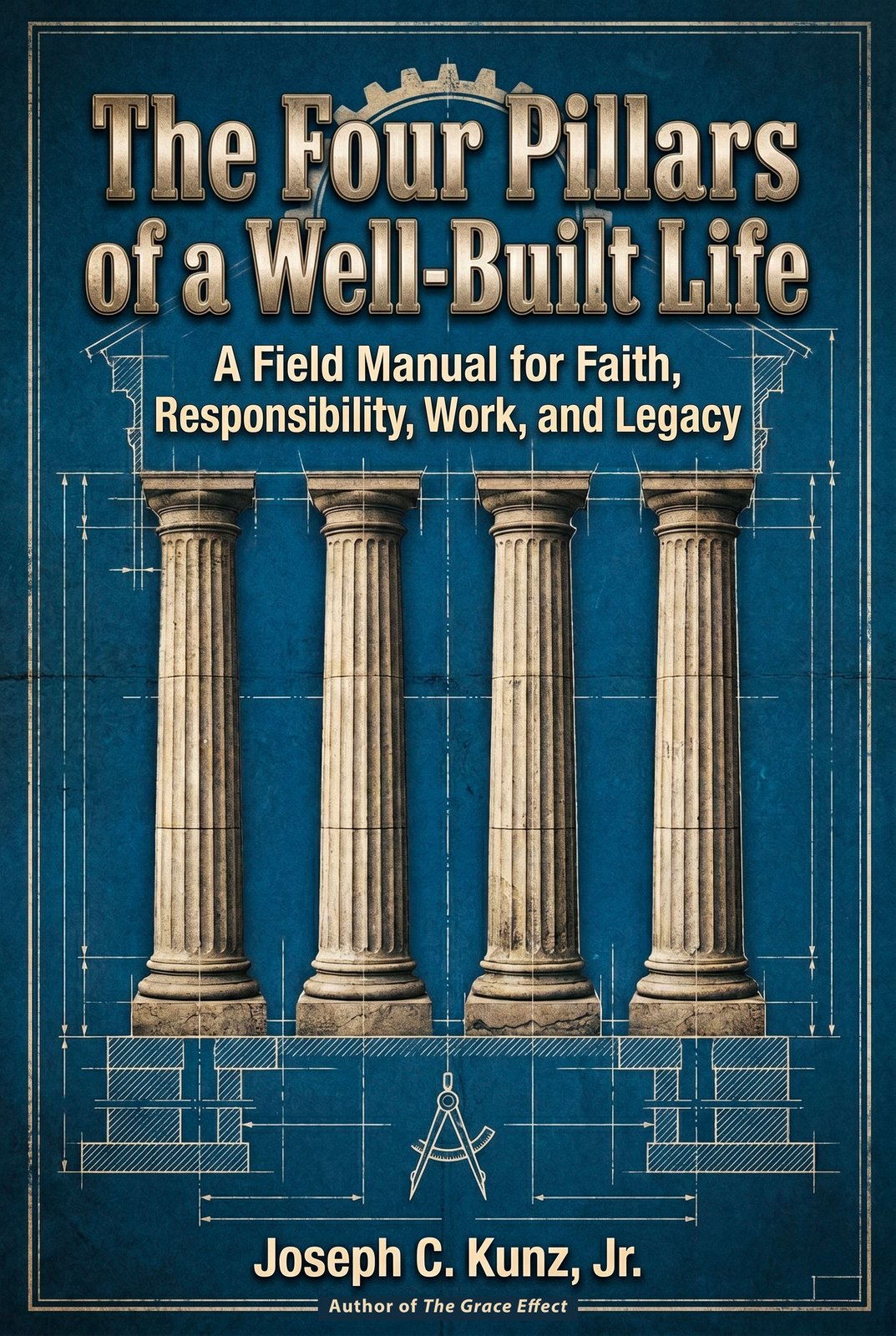
The Four Pillars of a Well-Built Life: A Field Manual for Faith, Responsibility, Work and Legacy
Everybody wants to fix the culture.
Almost nobody wants to admit where the culture actually comes from.
It comes from the people raising children in confused homes. From adults who want freedom without self-government. From private compromises that get repeated until they feel normal. From men who stop leading. From parents who outsource formation. From believers who complain about the darkness while letting the lights go out in their own house.
That is the brutal truth.
The public square is not falling apart because the wrong people wrote the wrong policy memo. It is falling apart because too many ordinary people stopped doing the quiet, load-bearing work that keeps a civilization standing in the first place.
That is why I wrote The Four Pillars of a Well-Built Life.
This book is not another elegant diagnosis for people who enjoy sounding alarmed and staying unchanged. It is a framework for rebuilding the kind of life that can still hold when the culture gets weak, loud, dishonest, and morally confused—through Faith, Responsibility, Work, and Legacy.
Because your children will inherit whatever you normalize. Your home is teaching even when you are not talking. And a society cannot stay sane when the people inside it stop governing themselves under truth.
You do not fix that with outrage. You fix it with structure. With standards. With repentance. With steadiness. With a life built strong enough to keep the rot from spreading through your own walls.
Read more about The Four Pillars of a Well-Built Life here and build the Kind of Life That Keeps the Public Square from Going Hollow.
Stayed tuned. Coming Soon.