The Adolescent Atheist: Why Rebellion Disguised as Reason Leaves the Soul Malnourished
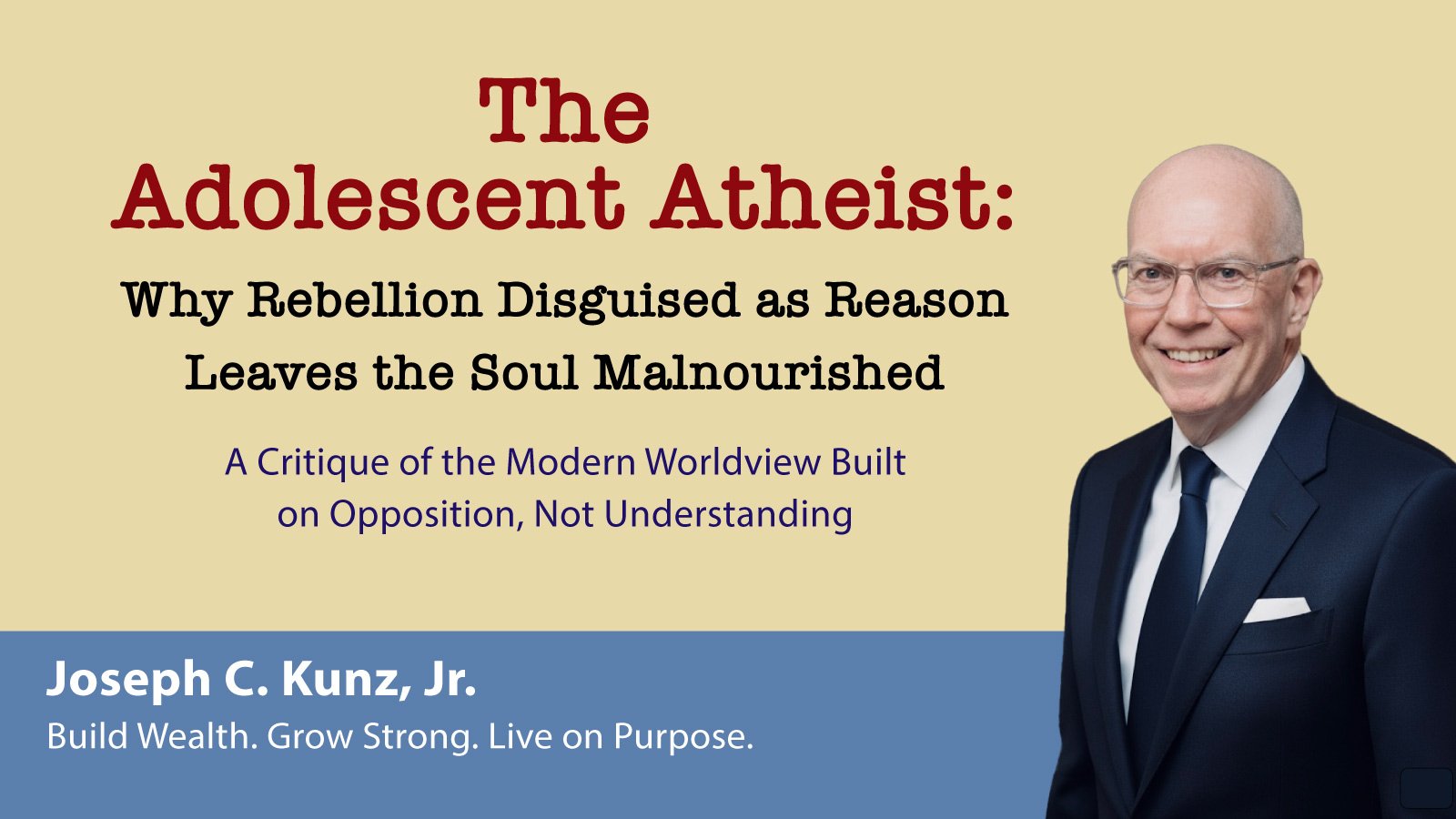
A sharp look at how modern atheism often hides emotional rebellion behind the mask of rational sophistication. —Joseph C. Kunz, Jr.
A Critique of the Modern Worldview Built on Opposition, Not Understanding
By Joseph C. Kunz, Jr.
Synopsis
Modern atheism often markets itself as intelligence, independence, and “following the science.” In this essay, Joseph C. Kunz, Jr. argues that much of it is not a conclusion reached through reason, but a posture adopted through rebellion—a worldview built on opposition rather than understanding. Beneath the polished vocabulary and confident sarcasm, he finds an emotional orientation that looks less like enlightenment and more like adolescence: the reflex to reject God, tradition, inherited wisdom, and anything that might demand humility.
Kunz examines why cynicism is mistaken for maturity, why contempt has become a substitute for thought, and why a life defined by negation cannot nourish the soul. He draws a hard distinction between honest doubt and identity-level defiance, and he makes the builder’s point: you can’t construct meaning out of permanent protest.
Rebellion may feel like freedom, but meaning only grows where the soul finally chooses to take root. —JCK
I. Introduction
There is a peculiar type of modern thinker—found on podcasts, in op-ed columns, on YouTube channels, inside university lecture halls, and increasingly in newsrooms—whose entire worldview is built on a single emotional posture:
Opposition.
Opposition to God. Opposition to tradition. Opposition to inherited wisdom. Opposition to anything that came before him.
He does not merely disagree with past generations—he must disagree with them, or else his carefully crafted identity evaporates. His posture, though dressed in intellectual sophistication, resembles something closer to adolescence than enlightenment.
Not adolescent in age. Not in intelligence. But in orientation.
This is the adolescent atheist—a grown adult whose worldview is the emotional equivalent of slamming the bedroom door, calling his parents idiots, and insisting he already knows everything he needs to know about life.
And society, for reasons worth exploring, keeps mistaking this for wisdom.
Key Terms — What I Mean (and Don’t Mean)
Consciousness:
What I mean: The lived interior life of a human being—self-awareness, reflection, intention, and the mysterious depth behind our thoughts and choices.
What I don’t mean: A mechanical byproduct of the brain firing like a computer chip.
Enlightenment:
What I mean: Genuine maturity—the slow, disciplined growth of wisdom, humility, and grounded understanding.
What I don’t mean: The adolescent rush of declaring oneself “free” from old beliefs without replacing them with anything deeper.
Materialism:
What I mean: The view that human beings are nothing more than biological machinery—matter in motion without soul, purpose, or intrinsic worth.
What I don’t mean: A simple appreciation for the physical world.
Meaning:
What I mean: The sense that life is ordered toward purpose—that our choices matter, our relationships matter, and our lives fit into a moral reality larger than ourselves.
What I don’t mean: Momentary emotion, personal preference, or feel-good sentiment.
Miracles:
What I mean: Meaningful, providential moments where life reveals a deeper order—nature elevated into purpose, not suspended by magic.
What I don’t mean: Hollywood spectacles, broken laws of physics, or divine fireworks.
Nihilism:
What I mean: The belief—sometimes loud, sometimes quiet—that nothing has inherent meaning, purpose, or moral weight.
What I don’t mean: Honest doubt or healthy skepticism.
Rationalist:
What I mean: Someone who insists the intellect alone can explain all of reality, rejecting anything that cannot be measured, graphed, or dissected.
What I don’t mean: A thoughtful person who uses reason as a tool while recognizing its limits.
Scientism:
What I mean: The belief that science is the only path to truth, even in areas where science has no jurisdiction—meaning, morality, consciousness, purpose.
What I don’t mean: Science itself, which is a good and necessary tool when it stays in its lane.
Transcendence:
What I mean: The dimension of reality that rises above mere physical existence—meaning, purpose, moral truth, and the sacred.
What I don’t mean: Floating spirits, mystical fog, or New-Age clichés.
Wisdom:
What I mean: The mature ability to see life clearly—its limits, its responsibilities, its deeper truths—and to live accordingly.
What I don’t mean: Information, cleverness, or intellectual arrogance.
Author’s Note
This critique is not about intelligence. Many modern atheists are sharp, articulate, and well-read. The issue is not their IQ—it’s their orientation. A person can be brilliant and still operate from an adolescent posture toward meaning: defining themselves by opposition, mistaking cynicism for insight, and refusing to engage the deeper questions that require humility rather than hostility.
Emotional maturity isn’t measured by how loudly you reject inherited wisdom, but by how courageously you build a worldview capable of sustaining a human life. My point is simple: rebellion is not the same as wisdom, and cleverness is not the same as growth.
II. Rebellion Masquerading as Maturity
Every teenager reaches a moment when rejecting the family’s beliefs feels like a rite of passage. It’s a declaration:
I think for myself now. I am no longer bound by the old rules.
This is normal—even necessary. Adolescence requires wrestling with authority.
But when a grown man builds his entire worldview on that same emotional template, something strange happens. What should have been a phase becomes a personality. What should have been growth becomes ideology.
The modern adolescent atheist—confident, polished, articulate—seems mature. He speaks in the tone of a man who has read deeply, thought carefully, and arrived at a worldview of his own making.
But the structure of his thinking reveals something far less impressive:
• If my ancestors believed it, it must be wrong.
• If religion shaped civilization, it must be oppressive.
• If millions find meaning in faith, they must be deluded.
• If a tradition is beloved, it must be naïve.
• If something transcends the self, it must be a fairy tale.
This is not reason. This is not independence.
This is reflex—an emotional stance mistaken for an intellectual one.
It is rebellion masquerading as maturity.
III. The Adolescent’s Illusion of Total Knowledge
Teenagers also experience the exhilarating (and hilarious) moment when they think they know more than their parents—not just about life, but about everything.
This same illusion animates the adolescent atheist.
He speaks with smooth certainty about matters that wiser men have approached with trembling humility for thousands of years:
• the soul
• moral truth
• the meaning of suffering
• the roots of consciousness
• the mystery of love
• the hunger for transcendence
• the afterlife
• the human heart
He dismisses all of it with the breezy confidence of a man who has solved existence using nothing more than a podcast mic, a Reddit thread, or a freshman philosophy seminar.
The irony is sharp: those who mock religion for being too “simple” often replace it with a worldview held together by unexamined assumptions, recycled slogans, and emotional rebellion.
He calls it reason. But it is just another form of absolutism—this time, dressed in scientific vocabulary.
Call it scientistic swagger—the belief that if something cannot be measured, quantified, or graphed, then it cannot matter.
This is not deep thought. This is the adolescent illusion of total knowledge.
IV. A Philosophy Defined by What It Opposes
A mature worldview offers something to build on—something that gives shape to responsibility, meaning, and the moral life.
But the adolescent atheist offers nothing to build on. He offers only something to tear down.
He is against God. Against tradition. Against transcendence. Against what earlier generations called miracles—not spectacle or suspended natural laws, but those meaningful, providential turns in life where a deeper order quietly reveals itself. Against spiritual experience in all its ordinary yet unmistakable forms. Against the idea that human beings are anything more than self-aware machinery.
He can tell you what he doesn’t believe. He cannot tell you what a human being is.
Rebellion is exciting. Responsibility is hard.
This is why so many philosophies built on negation—whether atheistic, activist, or academic—end up spiritually thin.
They remove the roof but forget to build the house.
V. The Modern Archetypes of Adolescent Atheism
If this mindset existed only in theory, it would be harmless. But modern culture is filled with archetypes of the adolescent atheist:
1. The Podcast Atheist
Smooth voice, strong opinions, plenty of confidence, and the unshakable belief that sarcasm is a substitute for metaphysics.
2. The Academic Skeptic
Wrapped in the prestige of a tenure-track position, insisting that because he can analyze belief, he has surpassed it.
3. The Social-Media Nihilist
Posting about the meaninglessness of life while demanding moral outrage over every political issue.
4. The Self-Proclaimed Rationalist
Certain he has freed himself from superstition, unaware that he has adopted new superstitions dressed in scientific language.
5. The Disillusioned Activist
Rejecting religion because it places any moral limit on his impulses, then claiming his activism is his “purpose.”
Each one mistakes rebellion for insight. Each one confuses negation for enlightenment. And each one is spiritually malnourished, whether he admits it or not.
VI. Why This Philosophy Never Grows Up
A worldview built on negation lacks the nutrients the soul requires:
• wonder
• humility
• gratitude
• reverence
• responsibility
• transcendence
• hope
Without these, the intellect withers into cynicism. The heart dries into irony. And the person becomes emotionally hollow, though still loud.
The adolescent atheist spends his life trying to convince himself that the emptiness he feels is freedom, and that the ache for meaning is weakness.
But that ache is not weakness. It is a reminder of what he has lost.
A philosophy cannot grow up if it defines itself only by what it rejects.
VII. The Cost of a Rebellion-Only Worldview
Society pays a price when adolescent atheism becomes fashionable:
1. Meaningless freedom
Freedom becomes license without purpose—movement without direction.
2. Morality without grounding
Everything becomes relative, except the things he insists must never be questioned.
3. Identity without depth
People define themselves by what they are against, not who they are.
4. Politics becomes religion
When transcendent belief collapses, power fills the vacuum.
5. Loneliness increases
The self becomes the only reference point—and the self is too small a universe to live in.
A society cannot thrive on rebellion alone. A culture that worships negation ends up with nothing worth preserving.
VIII. Real Maturity Looks Nothing Like This
Real maturity is not loud. It is grounded. It does not sneer at the past. It learns from it. It does not mock faith. It understands its necessity. It does not laugh at meaning. It seeks it.
Real maturity can say, I don’t know, because it understands that wisdom begins where arrogance ends.
Real maturity embraces responsibility—not rebellion—as the cornerstone of a meaningful life.
Faith, tradition, and humility do not limit the human spirit. They shape it. They anchor it. They nourish it.
A worldview that rejects every form of transcendence is not courageous. It is malnourished.
IX. Conclusion: The Soul Needs More Than Rebellion
If adolescence is defined by the exhilaration of breaking away, adulthood is defined by the humility of taking root.
A philosophy that never outgrows rebellion never grows deep.
The adolescent atheist may appear enlightened, but his worldview is too thin, too brittle, and too self-satisfied to sustain a human life.
The world is too mysterious, too painful, too beautiful, and too sacred to be lived entirely in opposition.
Rebellion can ignite the journey. But only truth—truth that transcends the self—can sustain it.
Breaking away is easy; building something worth standing for is where real maturity begins. —JCK
Related Essays: For Readers Who Refuse to Think on Autopilot
If this essay cut through the noise, these two will sharpen your judgment even further.
1. Don’t Outsource Your Thinking — Even to “Experts”
A call to reclaim your intellectual independence in a culture that rewards conformity and punishes clarity.
Reader Comment: This one hit me hard. I realized I’d been borrowing other people’s convictions instead of building my own.
Quote: Independent thinking isn’t rebellion—it’s responsibility. —JCK
2. The Mirage of Judgment: Why Other People’s Opinions Aren’t the Truth
A breakdown of why cultural approval is a trap, and how freeing yourself from others’ verdicts unlocks courage, clarity, and real self-respect.
Related Book: When You’re Done Breaking Things, Start Building Your Life
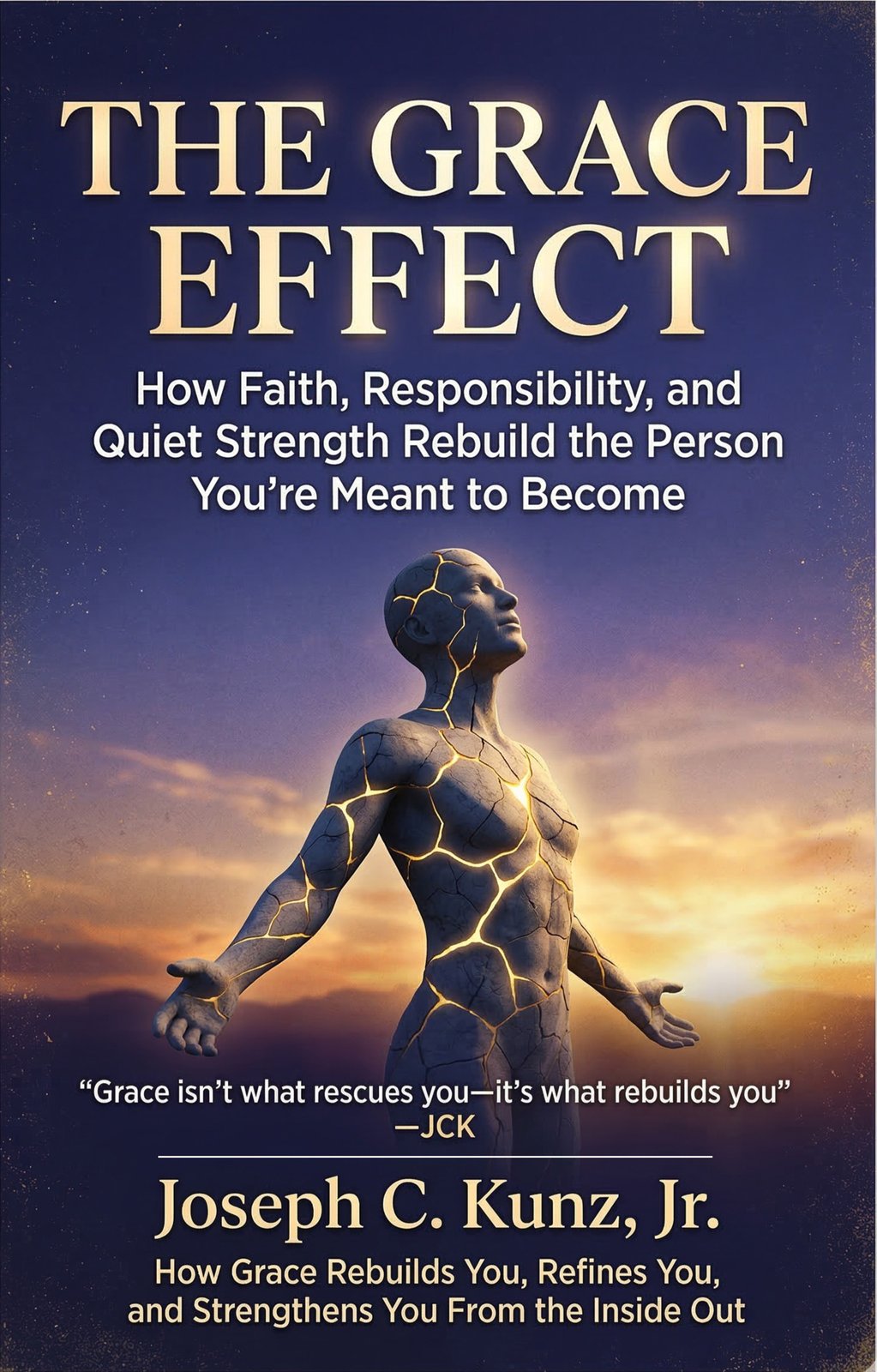
If this essay stirred something in you—the ache, the anger, the emptiness, the something’s missing you keep pretending not to feel—then hear this clearly:
You don’t need more arguments. You don’t need more rebellion. You need grace with muscle—the kind that rebuilds your life from the inside out.
That’s why I wrote The Grace Effect: How Courage and Kindness Can Transform Your Life (and the World). Because rebellion can expose the cracks, but only grace can rebuild the foundation.
This book is not soft. It’s not “be nice.” It’s not emotional wallpaper.
It’s courage in action. It’s kindness with a backbone. It’s the antidote to the hollowness this culture keeps trying to disguise as enlightenment.
If you want a life that actually means something—a life with moral weight, inner strength, and a purpose you can stand on when everything else breaks—then don’t shrug this off.
Get the book. Read it slowly. Let it challenge you. Let it change you.
Coming soon.
Because sooner or later, you must stop tearing everything down—and finally choose to grow up, stand tall, and live a life that actually matters.