Nudged by God — or Managed by the Machine?
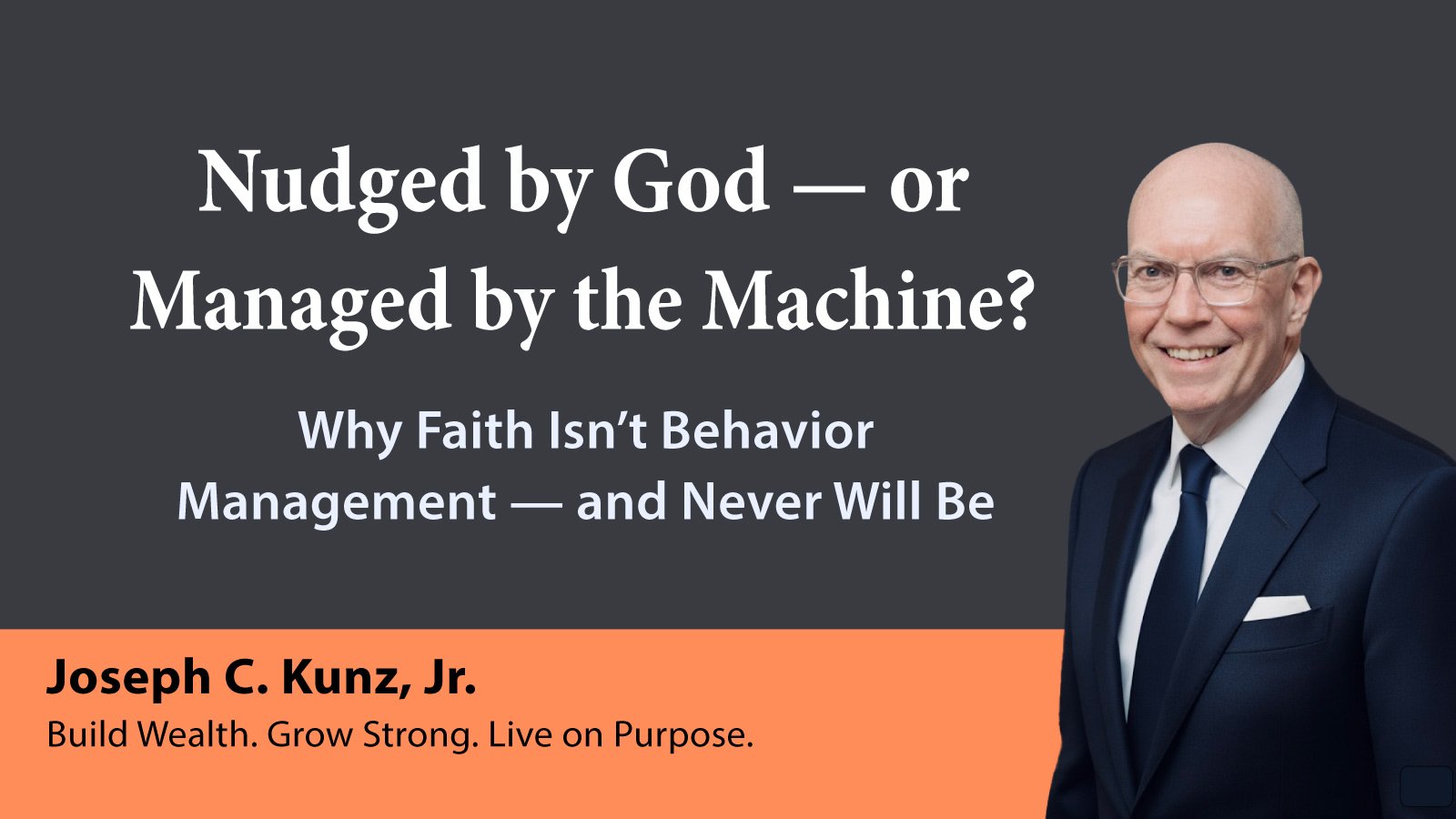
“Nudging” is the polite language of control—and it reveals a technocratic mindset that treats souls as projects, not moral agents made for truth, repentance, and self-rule. —Joseph C. Kunz, Jr.
Why Faith Isn’t Behavior Management — and Never Will Be
By Joseph C. Kunz, Jr.
Synopsis
Modern elites love “nudging” because it sounds humane, scientific, and modest. But the word hides a deeper posture: someone is steering, someone is being steered, and the goal is compliance—not conversion. In this essay, Joseph C. Kunz, Jr. argues that “nudging” is the vocabulary of a managerial age that treats human beings as inputs to shape rather than souls to form.
Kunz explains why the technocratic mindset flinches at real faith, why it prefers a God who “helps” without commanding, and why virtue can’t be engineered through clever incentives. Faith is not a behavioral tweak. It is surrender to truth. It forms courage, restraint, and integrity through obedience, suffering, and responsibility—especially in the places no policy expert can reach: the home, the conscience, and the secret life of the heart.
A nudge assumes you’re an object to manage. Faith assumes you’re a moral agent who must answer to God. —JCK
I. Introduction: The Sweetest Word for Control
“Nudge” is a sweet word.
It sounds gentle. It sounds caring. It sounds like someone helping you do what you already wanted to do—just with a little guidance.
And sometimes that’s true.
A reminder to drink water. A sign that points to the exit. A speed limit sign on a dangerous road. A small prompt that keeps you from making a stupid mistake. Fine.
But “nudge” has also become a fashionable word in elite conversation for something much bigger.
It’s a word that says, without saying:
We are the managers.
You are the managed.
Your behavior is the product.
And we get to shape it.
“Nudge” is the polite version of control. It’s control with soft lighting.
And that matters because a society’s vocabulary reveals its worldview. Words are never neutral. They carry assumptions. They smuggle in a posture.
So, when the educated class starts praising religion again, but does so in the language of “nudges,” “social cohesion,” and “stability,” believers are right to feel uneasy.
Because faith isn’t a program.
Faith isn’t an intervention.
Faith is not the machine helping you behave.
Faith is God confronting you with truth—and demanding your surrender.
II. The Language of Management: What “Nudge” Really Means in Plain English
Here’s the simplest translation.
A nudge is not an argument.
A nudge is not persuasion.
A nudge is not a moral appeal.
A nudge is a way of shaping behavior without openly dealing with the soul.
It works through framing, incentives, environment, and pressure. It changes the menu instead of changing the man. It relies on predictable human weakness—habit, fear, laziness, conformity.
Again, in some narrow situations, that can be harmless.
But when “nudging” becomes a moral philosophy—when it becomes the default way the elites talk about people—it reveals something ugly:
They don’t trust the human person.
They don’t trust conscience.
They don’t trust character.
They don’t trust self-rule.
They trust systems.
And the end result is predictable: a culture where people are managed like children and then scolded for not being grown.
But grown men are not produced by management.
Grown men are produced by moral formation.
And moral formation requires something the technocratic mind hates:
authority.
truth.
obedience.
cost.
In other words, it requires faith.
III. The Hidden Theology of the Technocrat: The Machine Has Beliefs, Even When It Denies Them
The technocratic mindset claims to be neutral. Scientific. Evidence-based. Above ideology.
That’s a fairy tale.
Because every system has a view of man.
And “nudge” contains a very specific view of man:
Man is a bundle of impulses.
Man is shaped by environment.
Man is predictable.
Man is manageable.
Man is not primarily a moral agent.
That worldview doesn’t require a God. It barely requires a soul.
It requires a control panel.
And here’s the irony: many technocrats insist people are “products of systems,” yet they also talk like they can redesign those systems to produce better humans—without dealing with sin, pride, lust, greed, cowardice, resentment, or selfishness.
They want virtue without repentance.
They want moral outcomes without moral authority.
They want cleaner behavior, but they don’t want a God who can say, “No.”
So, they start to appreciate religion in a way that keeps them comfortable.
Religion becomes a tool.
Religion becomes a stabilizer.
Religion becomes “useful.”
But “useful” is not worship.
“Useful” is not reverence.
“Useful” is not surrender.
“Useful” means: I remain the judge.
This is why the managerial class prefers a safe religion: one that produces social order while never confronting the manager.
A religion that helps other people behave.
A religion that never interrupts the expert.
A Creator who explains the universe but never commands the soul.
IV. Why Faith Cannot Be Reduced to “Nudges”: Conversion Is Not Compliance
Let me say this in the cleanest way I know.
A “nudge” aims at compliance.
Faith aims at conversion.
A “nudge” changes what you do.
Faith changes who you are.
A “nudge” works best when you don’t notice it.
Faith works best when you face truth directly.
A “nudge” treats sin like a design flaw.
Faith treats sin like rebellion.
And that’s why the modern world flinches at real faith. Because real faith does not negotiate.
Real faith does not merely offer suggestions. It commands. It convicts. It judges. It calls for repentance.
That is exactly what the managerial mind cannot tolerate, because the managerial mind needs one thing above all:
control.
Faith does not give you control.
Faith takes it away.
It says: You are not the center.
You are not the judge.
You are not the measure of all things.
You are accountable.
And accountability is the one word modern sophistication cannot handle without choking.
So, what does the “nudge” worldview offer instead?
A world where you can be improved without being humbled.
A world where you can be guided without being corrected.
A world where you can be managed without being judged.
That’s attractive.
It’s also false.
Because you can’t engineer a man into holiness.
You can’t incentive a man into courage.
You can’t frame a man into integrity.
You can’t manipulate a man into love.
You can modify behavior. Sure.
But faith is not behavior modification.
Faith is allegiance to truth.
And truth is not a technique.
V. The Place the Machine Cannot Reach: The Real Arena of Faith Is the Home and the Heart
This is where the elite language gets exposed.
The people who talk about “nudging” often talk as if the primary human problem is behavior.
Wrong.
The primary human problem is the heart.
Men do not fail mainly because they lacked information.
Men fail because they lacked restraint.
They lacked courage.
They lacked honesty.
They lacked humility.
They lacked love.
Those are not design problems.
Those are moral problems.
And moral problems can’t be solved with clever pressures.
They are solved through formation—slow, costly, and personal.
That’s why the real arena of faith isn’t the seminar room.
It’s the marriage where you want to quit.
It’s the temptation nobody sees.
It’s the resentment you keep feeding.
It’s the lie you can justify.
It’s the work you don’t feel like doing.
It’s the child who needs you steady.
It’s the suffering you didn’t ask for.
This is where faith either becomes real or gets exposed as decoration.
A man doesn’t need a nudge when he’s tempted to betray his vows.
He needs conviction.
A man doesn’t need a nudge when he’s one bad day away from compromise.
He needs courage.
A man doesn’t need a nudge when suffering arrives and bitterness starts knocking.
He needs a God who can give pain meaning and tell him, “Stand.”
The machine can’t do that.
The machine can pressure you.
But it cannot redeem you.
VI. The Alternative to Management: Formation, Not Manipulation
Now, let me be fair.
Not every attempt to influence behavior is evil. Parents influence children. Teachers influence students. Communities shape norms. Laws restrain obvious vice. Civilization has always done some of this.
The question is not whether humans influence each other.
The question is: what posture rules the influence?
The technocratic posture says: We will shape you.
The moral posture says: We will call you higher.
One treats you like a creature to be steered.
The other treats you like a soul to be formed.
And faith is the deepest version of that second posture.
Faith does not say, Let me tweak your behavior.
Faith says, “Let me tell you the truth.”
Faith is honest about sin.
Faith is honest about temptation.
Faith is honest about pride.
Faith is honest about the human hunger to be its own god.
And because it is honest, it can offer something management can’t:
repentance.
forgiveness.
grace.
new life.
real strength.
This is why faith produces what elite systems can’t manufacture:
self-rule.
A man who can rule himself does not need constant management.
A family built on duty does not need endless interventions.
A community rooted in shared moral truth doesn’t need a swarm of experts to keep it from falling apart.
That’s not because believers are perfect.
It’s because faith trains the soul to submit to something higher than appetite.
And a society that can’t submit to anything higher than appetite will eventually submit to the strongest manager.
VII. Conclusion: Your Soul Is Not a Policy Problem
“Nudge” is a clever word.
It is also a revealing word.
It reveals a class of people who believe the human person is something to be adjusted. Managed. Designed. Steered.
But a human being is not an input.
A human being is a moral agent.
And faith is not the machine helping you behave.
Faith is the truth confronting you.
Faith is the God who interrupts you.
Faith is the Lord who calls you to repentance and then gives you the grace to live differently.
If our society is truly rediscovering faith, it won’t happen through elite “nudges.”
It will happen when men and women stop negotiating with truth.
When they stop treating God as “useful.”
When they stop treating religion as a stabilizer for other people.
And when they finally say, without performance and without pride:
I am not the judge.
The machine can pressure behavior. Only faith can form a man. —JCK
The Series: Faith That Holds Up
We’re living in an age where contempt is mistaken for intelligence and “God talk” is treated like an academic hobby. This series calls that bluff. These essays aren’t about sounding smart—they’re about truth that forms a soul: humility instead of ego, obedience instead of self-rule, courage instead of comfort addiction. If you’re tired of the sneer and ready for faith that actually holds up, start here.
1. Disbelief Isn’t the Offense — Contempt Is
Doubt can be honest, but the sneer is a moral posture that corrodes truth, decency, and the virtues that hold society together.
2. When Intellectuals “Discover God” — What’s Missing?
Many elite “returns” stop at a safe, useful Creator, but real faith requires humility, reverence, repentance, and surrender.
3. Religion as a Tool: The New Elite Bargain
The new respectability of religion often comes with a bargain: “give us the benefits, but don’t demand obedience.”
4. Nudged by God — or Managed by the Machine?
“Nudging” is the polite language of control, but faith isn’t behavior management—it’s moral allegiance to truth that forms the soul.
5. God as a Theory Isn’t Faith
A costless “First Cause” may impress the mind, but faith begins when God stops being an idea and becomes an authority you obey.
6. Faith Isn’t a Theory — It’s Training
Faith isn’t mainly about cosmology—it’s training that builds endurance, integrity, restraint, and courage when life gets hard.
Faith isn’t proven by sounding smart; it’s forged in real tests—marriage, temptation, suffering, duty, and responsibility.
8. Why Autonomy-First Men Flinch at Faith
Autonomy worship makes the self the judge, so faith feels threatening—because faith begins where self-rule ends.
Start at #1, or pick any title that hits your nerve and jump in.
Related Book: Don’t Be “Nudged”—Be Formed
“Nudge” is a cute word.
It sounds gentle. Helpful. Scientific. Like someone just wants to “guide” you toward better choices.
But here’s what the word really means:
Someone thinks you’re steerable. And they think they should be the one holding the wheel.
That’s the modern bargain in plain English: We’ll manage your behavior—quietly—while calling it compassion.
And if you think that mindset stops at politics or marketing, you haven’t been paying attention. It’s coming for everything: how you speak, how you think, what you’re allowed to believe, and which virtues you’re permitted to admire.
Because the machine doesn’t want men.
It wants manageable people.
Faith is the opposite of that.
Faith isn’t behavior management. Faith is not “positive habits.” Faith is not a life hack.
Faith is allegiance to truth. Faith is obedience when it costs. Faith is restraint when temptation is easy. Faith is courage when fear would be justified.
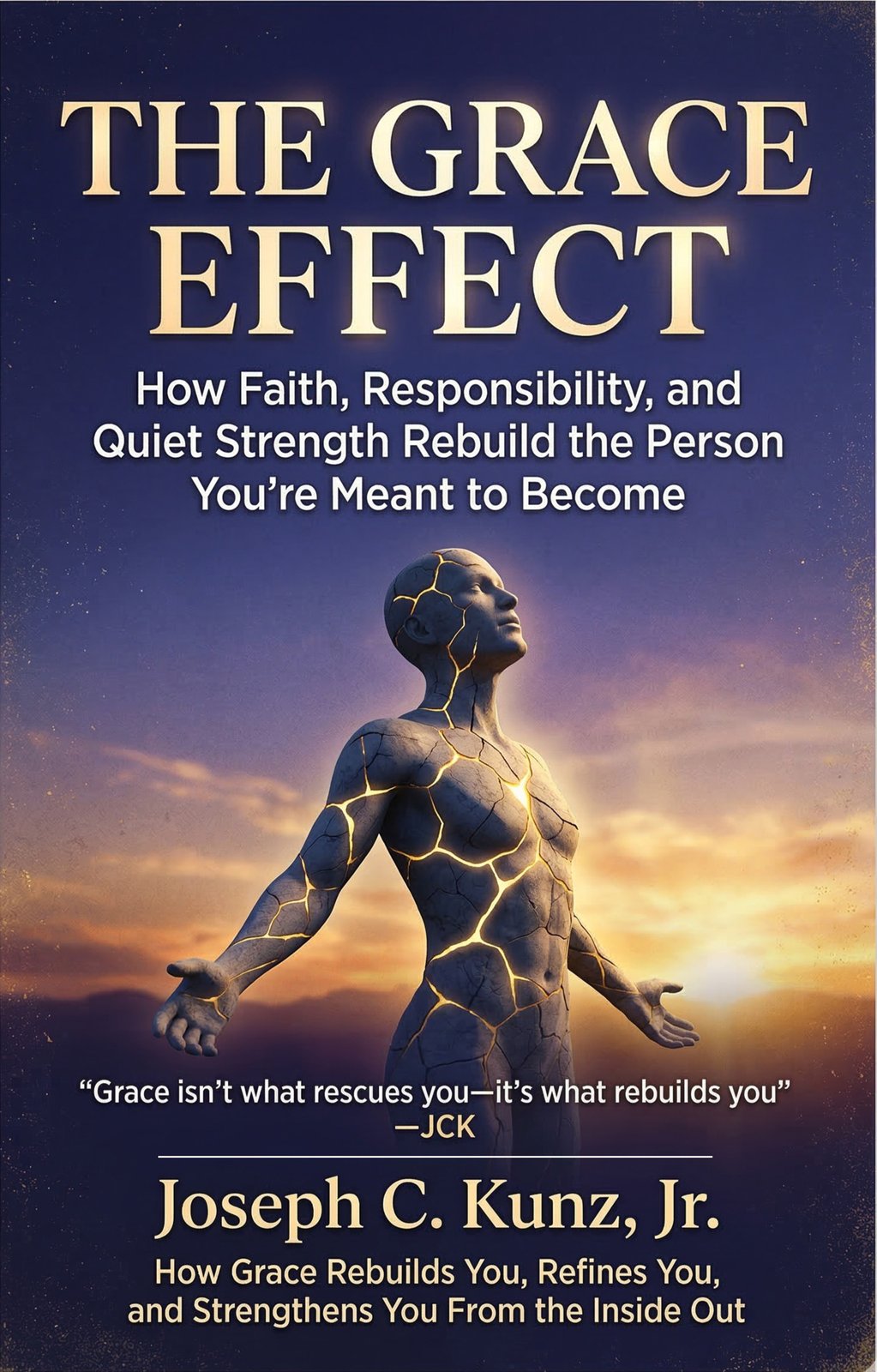
That’s why I wrote The Grace Effect.
Not to help you become “better behaved.” To help you become unmanageable—in the best sense. A man with self-rule. A man with moral backbone. A man who answers to God, not the crowd, not the algorithm, not the latest approved opinion.
Because grace isn’t softness.
Grace is strength under control.
And when the world is trying to steer you with invisible hands, you’re going to need a soul that’s been trained on purpose.
Read The Grace Effect here: Stop being nudged. Start being formed.
Coming soon.