Do the Good You Cannot Measure
The good that matters most is often the good no one can count, repay, review, rank, or reward. —Joseph C. Kunz, Jr.
Why Kindness Still Matters in a World Obsessed with Results
By Joseph C. Kunz, Jr.
Synopsis
This isn’t a soft essay about “being nice,” pretending every person has good intentions, or confusing kindness with weakness. In this essay, Joseph C. Kunz, Jr. argues that real kindness is not sentimental decoration. It is a mature moral discipline: the choice to do good even when the result is invisible, the reward is uncertain, and the kindness may never be returned.
Kunz makes the case that a society obsessed with measurement often forgets the quiet goods that hold families, friendships, workplaces, communities, and civilizations together. A word of encouragement, a restrained response, a small mercy, a moment of patience, or an act of ordinary decency may shape a life in ways no scoreboard will ever record. The central confusion is simple: we have learned to value what can be tracked, but not everything that matters can be measured.
The conclusion is simple: a mature person does not do good only when the result is visible, the reward is guaranteed, or the kindness is returned. Some of the most important work of a well-built life is done quietly, without applause, and without proof that it changed anything.
Kindness is not weakness. It is strength governed by mercy, patience, and responsibility. —JCK
I. Introduction: The World Wants a Scoreboard
We live in a world that wants everything measured.
Views. Likes. Shares. Reviews. Rankings. Sales. Followers. Engagement. Productivity. Return on investment. Performance. Influence. Reach.
Even good deeds can start to feel like they need a receipt.
Did anyone notice?
Did anyone thank me?
Did it make a difference?
Was it worth it?
Those are human questions. I understand them. A person can grow tired of giving, helping, listening, forgiving, encouraging, and showing up when the result seems invisible. Nobody wants to feel used. Nobody wants to pour himself into people who treat goodness like a convenience.
But if we only do good when the outcome is visible, we have reduced kindness to a transaction.
That is not moral maturity.
That is bargaining.
A mature person does not do good only when the result is visible, the reward is guaranteed, or the kindness is returned.
That sentence carries the whole essay.
It does not mean we should be foolish. It does not mean we should let people manipulate us. It does not mean we should confuse kindness with enabling, cowardice, or the refusal to tell the truth.
Real kindness is not weakness.
It is strength under discipline.
It is mercy with a backbone.
It is the decision to treat another human being with dignity even when the moment is small, ordinary, inconvenient, or unlikely to be remembered.
And often, that is exactly where the deepest good is done.
II. Kindness Is Not a Transaction
A transaction is simple.
I give this. You give that.
I help you. You help me.
I show respect. You show respect.
I am kind. You are grateful.
There is nothing wrong with healthy reciprocity. Families, friendships, businesses, marriages, churches, and communities all require some level of mutual duty. One-sided relationships eventually become unhealthy. A person who only gives and never receives can become exhausted, resentful, or quietly damaged.
But kindness itself cannot be reduced to a contract.
There are moments in life when the good we do is not returned.
A child may not understand the sacrifice.
A spouse may not immediately recognize the restraint.
A discouraged friend may not know how much your words mattered.
A stranger may walk away without ever remembering your name.
A co-worker may receive your patience and still remain difficult.
A student may carry your encouragement for years and never tell you.
That does not make the good meaningless.
It makes the good unmeasured.
That distinction matters.
A world obsessed with measurable outcomes has trouble honoring unmeasured goodness. It wants visible proof. It wants data. It wants numbers. It wants the chart to go up. It wants the conversion, the response, the testimonial, the thank-you note, the public acknowledgment.
But some of the most important things in life do not work that way.
You may never know when your restraint prevented a wound.
You may never know when your patience helped someone breathe again.
You may never know when your encouragement kept a young person from giving up.
You may never know when your ordinary decency became evidence to another person that the world was not as cold as it seemed that day.
That is not fantasy.
That is how human life works.
We are shaped by moments we cannot always trace.
III. Small Mercies Hold More Than We Think
There is a kind of kindness that announces itself.
It wants to be seen.
It wants the photograph, the caption, the applause, the public credit.
That kind of kindness may still do some good, but there is always a danger in it. When goodness becomes performance, the person being helped can quietly become a prop.
Real mercy does not need to make a spectacle of itself.
Much of the good that holds life together happens quietly.
A parent lowers his voice when he could have exploded.
A mother notices a child’s discouragement before it becomes despair.
A husband chooses patience when he is tired.
A wife offers encouragement when criticism would have been easier.
A teacher gives confidence to a student who has started to believe he is not capable.
A nurse treats a frightened patient with dignity when the shift has already taken too much from her.
A businessman gives someone a second chance because he remembers needing one himself.
A friend listens without turning the conversation back to himself.
A stranger makes room, holds the door, speaks kindly, or refuses to add one more humiliation to someone’s day.
None of that sounds dramatic.
That is the point.
A decent society is not held together only by laws, institutions, elections, courts, markets, police departments, schools, churches, and policies.
It is also held together by millions of small moral decisions no one records.
Courtesy matters.
Patience matters.
Restraint matters.
Mercy matters.
Encouragement matters.
The way people treat each other in small moments matters.
When those things disappear, life becomes harder long before anyone can prove exactly why.
The air changes.
The household changes.
The workplace changes.
The school changes.
The neighborhood changes.
The culture changes.
People become sharper, colder, more defensive, more suspicious, and more alone.
That is why ordinary kindness is not sentimental. It is civilizational.
It is one of the small hinges on which a humane world turns.
IV. The False Efficiency of a Hard Heart
Some people think kindness is inefficient.
They see patience as wasted time.
They see mercy as weakness.
They see tenderness as softness.
They see restraint as failure to dominate.
They see ordinary decency as something naïve people offer before life teaches them better.
That is a cheap view of strength.
Hardness is not the same as strength.
A hard person may be difficult to wound, but he may also become difficult to love, difficult to trust, difficult to approach, and difficult to live with. He may win arguments and lose influence. He may control a room and damage a home. He may avoid being taken advantage of and still become the kind of person no one wants to become.
Strength without mercy becomes cruelty.
Mercy without strength becomes enabling.
A well-built life needs both.
Kindness does not require us to abandon judgment. It does not require us to reward bad behavior. It does not require us to deny evil, excuse irresponsibility, or pretend every person deserves access to our time, trust, money, or inner life.
Boundaries matter.
Truth matters.
Standards matter.
But the existence of real limits does not cancel the duty of ordinary mercy.
A person can be firm without being cruel.
A person can say no without contempt.
A person can hold a standard without humiliating someone.
A person can correct without destroying.
A person can protect himself without becoming cold.
That is maturity.
And maturity is one of the most neglected forms of kindness.
V. We Owe Each Other More Than Indifference
Do we owe each other kindness?
Not in the shallow sense that everyone owes everyone else unlimited emotional availability.
Not in the childish sense that kindness means agreement.
Not in the dishonest sense that we must call everything good, affirm everything, excuse everything, or surrender every boundary.
But yes, we owe each other more than indifference.
We owe each other the basic dignity of being treated as human beings.
We owe each other the effort not to add needless cruelty to an already heavy world.
We owe each other enough restraint not to turn every irritation into a wound.
We owe children examples of adults who can carry strength without becoming harsh.
We owe our families more than the leftovers of our patience.
We owe our co-workers more than our private frustrations disguised as honesty.
We owe strangers the small mercies that make public life livable.
We owe the next generation evidence that adulthood is not merely exhaustion, sarcasm, appetite, and self-protection.
That does not mean we will always succeed.
No honest person succeeds all the time.
We get tired.
We get impatient.
We misread people.
We speak too quickly.
We carry old wounds into new moments.
We protect ourselves too fiercely.
We fail.
But the standard still matters.
A society begins to decay when people stop believing they owe one another anything beyond legal minimums and personal preference.
Law can punish some forms of wrongdoing.
It cannot create warmth at the family table.
It cannot make a father patient.
It cannot make a mother gentle under pressure.
It cannot make a boss fair.
It cannot make a citizen respectful.
It cannot make a neighbor decent.
It cannot make a human being merciful.
Those things come from formation.
They come from faith, responsibility, discipline, humility, gratitude, and the understanding that life is not only about what we can get, win, prove, or measure.
VI. The Good You Never See Again
One of the hardest parts of doing good is that you often do not get to see the ending.
You plant something and walk away.
You say the word.
You offer the encouragement.
You show restraint.
You give the help.
You extend mercy.
You treat someone with dignity.
Then life moves on.
You do not always know what happened next.
That bothers us because we like closure. We want to know that the good landed somewhere. We want evidence that the effort mattered. We want to see the fruit.
Sometimes we do.
A child grows up and remembers.
A friend later says, “You helped me more than you know.”
A student writes back.
A family member softens.
A stranger circles around years later and tells the story.
Those moments are gifts.
But they are not guaranteed.
Much of the good we do disappears from our sight.
That does not mean it disappears from the world.
Influence often works below the surface.
A child watches how adults speak.
A patient remembers the nurse who treated him like a person.
A young employee remembers the boss who corrected him without humiliating him.
A grieving person remembers the friend who simply sat there.
A student remembers the teacher who believed there was more in him.
A spouse remembers the moment when harshness could have entered the room but did not.
A family remembers the emotional climate one person created over decades.
Sometimes kindness becomes part of another person’s strength without either person knowing exactly when it happened.
That is legacy.
Legacy is not only what is written in a will, placed in a bank account, printed in a book, or carved into stone.
Legacy is also what other people carry because they lived under your influence.
The tone you set.
The patience you modeled.
The mercy you offered.
The courage you gave.
The dignity you protected.
The good you did when no one was keeping score.
VII. Kindness as Formation
The deepest reason to do the good you cannot measure is not only what it may do for someone else.
It is also what it does in you.
Every act forms the actor.
When you practice resentment, you become more resentful.
When you practice contempt, you become more contemptuous.
When you practice selfishness, you become smaller.
When you practice cruelty, cruelty becomes easier.
But when you practice kindness, something else happens.
You become the kind of person who can carry more without becoming bitter.
You become slower to wound.
You become harder to corrupt by anger.
You become less dependent on applause.
You become more useful in a world full of people who are tired, afraid, proud, confused, lonely, grieving, or quietly under pressure.
That does not happen automatically.
It must be practiced.
A kind person is not necessarily a naturally gentle person.
Sometimes he is a strong person who has learned restraint.
Sometimes he is a wounded person who has refused to spread the wound.
Sometimes he is a tired person who has decided not to make his fatigue someone else’s burden.
Sometimes he is a busy person who has learned that efficiency without humanity becomes ugly.
Sometimes he is a disciplined person who understands that the smallest choices reveal the deepest structure.
That is why kindness belongs under responsibility as much as it belongs under faith or legacy.
It is not merely a feeling.
It is self-government.
It is the rule of the soul over impulse.
It is the refusal to let irritation, pride, pain, exhaustion, or cynicism become the final authority over how we treat people.
VIII. The Faith Beneath the Unmeasured Good
For a believer, there is an even deeper reason to do the good we cannot measure.
We are not the final accountants of reality.
That does not excuse laziness. It does not mean outcomes do not matter. It does not mean we should avoid wisdom, prudence, or honest evaluation.
But it does mean that visible measurement is not the same as ultimate meaning.
God sees what people miss.
God sees the quiet restraint.
God sees the mercy no one thanked.
God sees the forgiveness that cost more than anyone understood.
God sees the patience offered in private.
God sees the good done without an audience.
God sees the ordinary faithfulness that never becomes impressive enough for public attention.
That should humble us.
It should also steady us.
But there is another kind of witness, too.
Our families may not see every act of kindness we offer. Our children may not be standing beside us when we speak gently to a stranger, encourage a discouraged person, show patience at work, give mercy where judgment would have been easier, or refuse to make someone’s hard day harder.
But over time, they come to know the pattern of our life.
A spouse knows.
Children know.
Close friends know.
The people nearest to us may not see every act, but they learn what kind of person we are. They know whether kindness is something we perform when it benefits us, or something rooted more deeply in our character.
That matters because kindness is not only something we give to others.
It is also something we teach by living.
A child who sees a parent treat people with dignity learns something about strength.
A spouse who sees patience offered under pressure learns something about love.
A family that watches mercy practiced over time learns that goodness does not have to announce itself to be real.
This is part of legacy.
The people closest to us become witnesses to the kind of life we are building. They see enough to trust what they do not see. They know whether our goodness is occasional, selective, theatrical, or real.
That does not mean we will always get it right.
No one does.
Faith does not remove the ache of being unappreciated. It does not make every act of kindness easy. It does not make difficult people less difficult. It does not prevent weariness, disappointment, or the need for boundaries and wisdom.
But faith reminds us that goodness is not wasted simply because it is unseen.
And legacy reminds us that even unseen goodness helps form the atmosphere of a home.
A person who believes only in visible reward will eventually stop doing invisible good.
A person rooted in something deeper can keep going.
Not perfectly.
Not without weariness.
Not without needing rest, boundaries, and wisdom.
But with a steadier heart.
A life governed only by visible return becomes narrow.
A life governed by faith can afford to do good beyond the range of applause.
IX. Conclusion: Do the Good Anyway
There will always be reasons not to be kind.
People are ungrateful.
People misunderstand.
People take advantage.
People forget.
People disappoint.
People do not always return what they have received.
That is all true.
But it is not the whole truth.
The whole truth is that a decent life cannot be built on cynicism. A strong family cannot be built on emotional bookkeeping. A healthy workplace cannot be built on contempt. A humane culture cannot be built by people who refuse to offer any good unless the return is guaranteed.
Some good must be done because it is good.
Some mercy must be offered because mercy is right.
Some patience must be practiced because impatience would wound.
Some encouragement must be given because discouragement is already heavy enough.
Some dignity must be protected because every human being is more than his worst moment, hardest day, weakest appearance, or most visible burden.
Do the good you cannot measure.
Not because you are naïve.
Not because everyone will deserve it.
Not because every kindness will be returned.
Not because the result will be visible.
Do it because a mature person does not need a scoreboard before choosing decency.
Do it because kindness forms the giver as well as the receiver.
Do it because civilization is repaired not only by grand speeches, public arguments, and institutional reforms, but by ordinary people who still know how to bring mercy, patience, restraint, encouragement, and dignity into the places where life is actually lived.
Do it because the smallest good may travel farther than you will ever know.
Do it because one day, when your life is measured by what truly mattered, the unmeasured good may turn out to be among the most important things you ever gave.
The good you do without applause may become part of someone else’s strength long after you have forgotten the moment. —JCK
Related Essays: Kindness, Grace, and the Mercy That Holds a Life Together
These companion essays deepen the argument that kindness is not weakness, and that mercy often becomes most powerful when it is quiet, disciplined, and lived under pressure.
1. Visible Hardship Reveals Invisible Kindness
This essay reflects on how a changed face after brain surgery can reveal hidden kindness, while reminding us to offer mercy before another person’s burden becomes obvious.
Reader Comment: This essay helped me realize how often we judge people by what we can see while remaining completely unaware of the battles they are carrying in private.
Quote: Sometimes visible hardship teaches us to become more merciful toward the invisible burdens of others. —JCK
This essay argues that grace is not softness, passivity, or surrender, but disciplined moral strength: the power to tell the truth, uphold standards, and carry pain without letting it turn into cruelty.
Reader Comment: This is the stronger companion essay if the reader needs to understand the difference between kindness, weakness, mercy, and moral strength.
Quote: Grace is not the absence of strength. It is strength that has learned what it is for. —JCK
Related Book: Grace Without the Greeting Card Fog
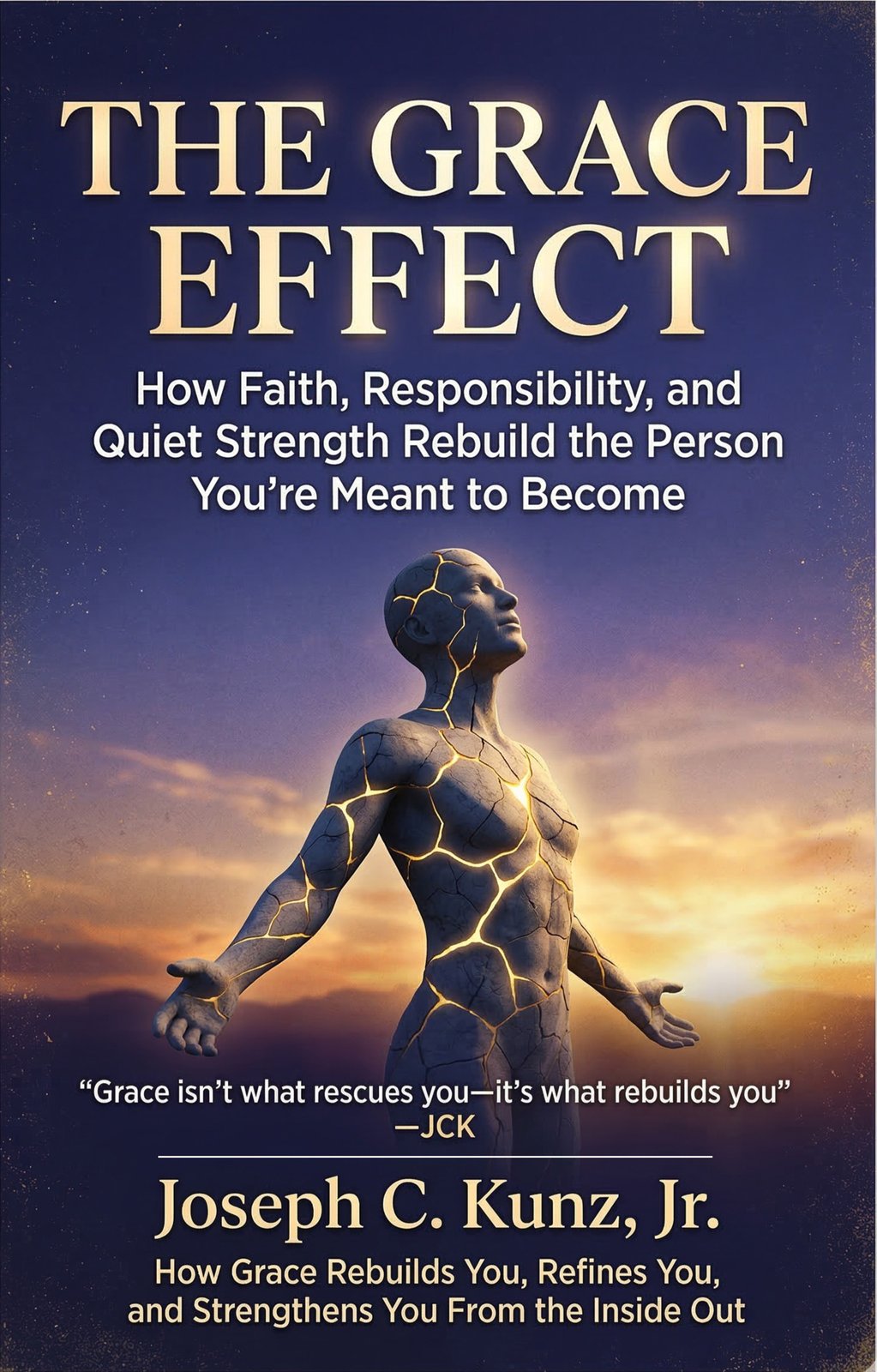
A culture that forgets grace does not become stronger. It becomes colder, louder, harsher, and more transactional. People start keeping score in every relationship. Mercy begins to look like weakness. Forgiveness begins to look like surrender. Kindness begins to look naïve. Before long, families, friendships, workplaces, and communities lose the quiet habits that make life livable.
The Grace Effect is being written for people who know grace must be more than a soft religious word. Grace has to enter the real places where life gets tested: marriage, family, work, suffering, forgiveness, failure, resentment, responsibility, and the private moments when no one is keeping score.
If you are tired of sentimental spirituality that cannot survive pressure, this book is for you.
If you know that strength without mercy becomes cruelty, this book is for you.
If you want to understand how grace can steady a life, repair what pride damages, and shape the legacy you leave behind, this book is for you.
In Formation: The Grace Effect