Visible Hardship Reveals Invisible Kindness
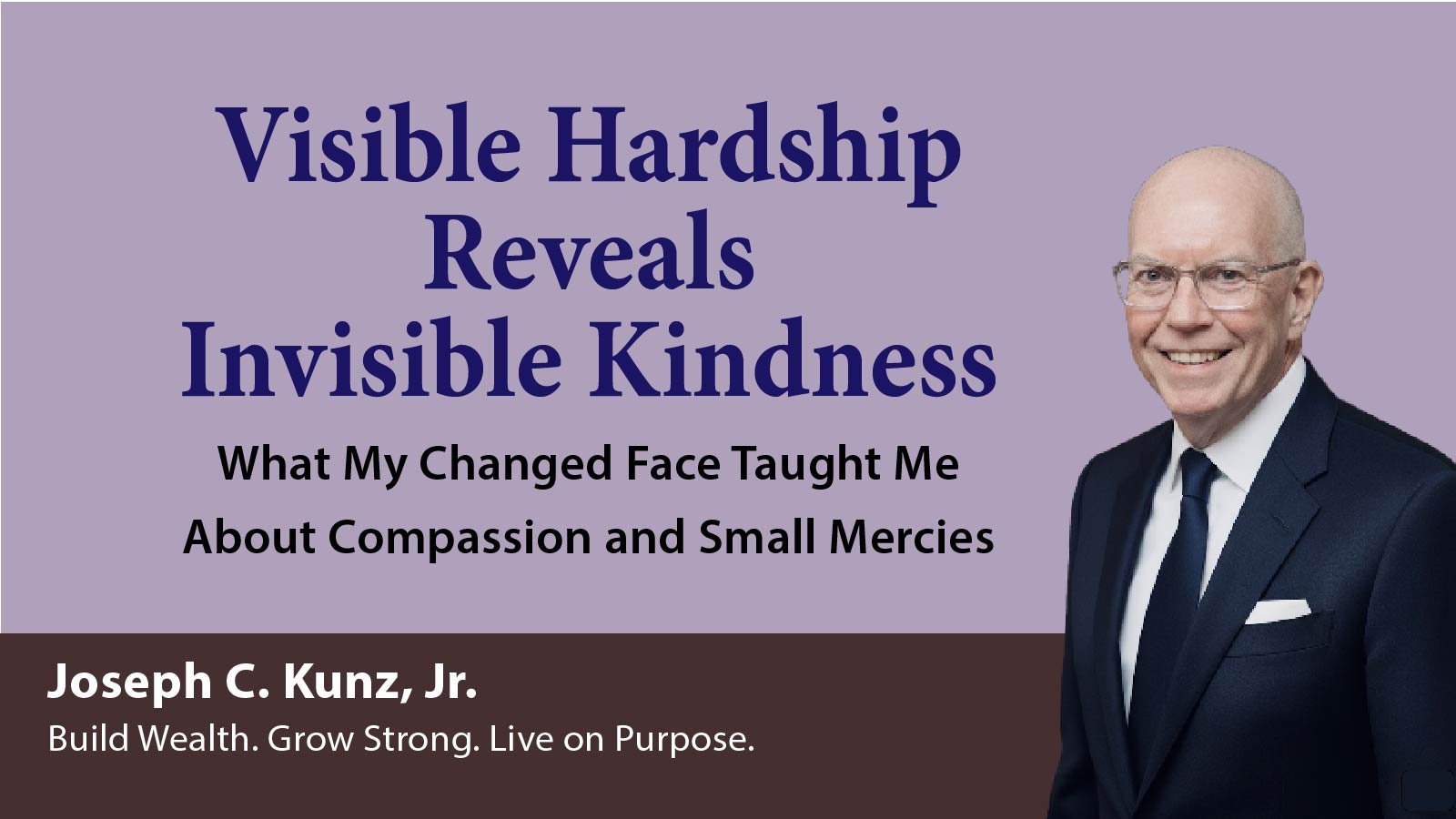
Visible hardship does not create human kindness. It reveals the kindness that was already waiting for a chance to act. —Joseph C. Kunz, Jr.
What My Changed Face Taught Me About Compassion and Small Mercies
By Joseph C. Kunz, Jr.
Synopsis
This isn’t an essay about self-pity, appearance, or needing strangers to approve of what they see. In this essay, Joseph C. Kunz, Jr. reflects on how his changed face after brain surgery made one part of his private trial visible to the world—and how that visibility unexpectedly revealed the quiet decency of ordinary people.
Kunz makes the case that visible hardship does more than invite kindness. It can also remind onlookers of their own vulnerability. A changed face, a limp, a scar, a wheelchair, or any visible sign that life has altered someone can quietly break through the illusion that hardship only happens to other people.
The conclusion is simple: we should not wait until someone’s burden becomes visible before we become patient, courteous, and merciful. The world is held together by more small mercies than we notice.
The world is held together by more small mercies than we notice. —JCK
I. Introduction: A Face I Did Not Choose
I am careful with the word suffering.
What I have gone through these last four years has been difficult, permanent, humbling, and life-changing. I will deal with some part of it for the rest of my life. But I know enough about the world to understand that many people carry crosses far heavier than mine.
I have seen real suffering. I know people endure illnesses, losses, betrayals, griefs, disabilities, wounds, fears, and private burdens that make my own situation look small by comparison.
So I do not want to overstate my experience.
At the same time, I do not want to pretend it has meant nothing.
After brain surgery, my face changed. Not a little. Enough that people notice. Enough that strangers sometimes look twice. Enough that my face can suggest something happened to me before I ever say a word.
I did not choose that.
No one wants a private medical ordeal turned into a public signal. No one asks for his face to become evidence that something happened. But life does not always ask our permission before it changes what others can see.
Still, at my age, I do not spend much time worrying about what strangers think when they look at me.
The opinions I cherish most belong to the people closest to me: my wife, my children, my family, and the people who actually know me. Those are the people whose love, respect, and understanding matter most.
But my changed face has taught me something I do not want to ignore.
Because the change is visible, people sometimes respond before I say a word.
They offer a seat. They hold a door. They make room. They show patience. They soften. They help.
And that has revealed something good.
Many ordinary people are decent when the moment gives them a chance to be.
II. The Small Mercies of Ordinary People
What has stayed with me is not that people are capable of kindness.
I already believed that.
Most ordinary people are decent. Most people wish others well. Most people, when given a clear chance to help without being asked for too much, will usually do the decent thing.
What has stayed with me is the way visible hardship changes the moment.
Someone offers a seat on the train. Someone holds a door a little longer. Someone gives me a little extra room. Someone slows down instead of rushing past. Someone responds with a little more patience than the moment strictly requires.
Most of the time, they do not make a production of it.
They do not ask what happened. They do not turn kindness into interrogation. They do not need the full medical history. They simply see a possible need and respond with a small mercy.
That has moved me more than I expected.
Not because I feel helpless.
Not because I need strangers to reassure me.
But because these small acts reveal something about people.
They reveal attention. They reveal instinctive decency. They reveal a willingness to make another person’s day slightly easier, even when there is no reward, no recognition, and no one watching.
That is not a small thing.
III. When the Tables Turn
I do not want to suggest that I expected people to be unkind.
I did not.
What has felt strange is not that people are kind.
What has felt strange is realizing that I am now sometimes the person they think may need help.
That is different.
For most of my life, I was the one noticing other people. An older person standing on the train. Someone walking slowly. Someone who looked unsteady. Someone carrying visible damage, illness, weakness, or age. I would see them and instinctively think, “Maybe I should hold the door. Maybe I should offer the seat. Maybe I should make room.”
That seemed normal.
Now the tables have turned.
Now I am the older man with the visibly changed face. Now I am the one a stranger may look at and quietly think, “Maybe he needs the seat. Maybe he needs the door held. Maybe he needs a little room.”
That is a strange place to find yourself.
Not humiliating exactly. Not tragic. Not even something I resent. But strange.
It is strange to realize that your face now communicates something before you speak. It is strange to see people respond to the visible evidence that life has marked you. It is strange to become, in another person’s eyes, the kind of person you once tried to help.
That does not make the kindness false.
It makes it more instructive.
Because when the tables turn, you begin to understand receiving mercy from the inside. You begin to understand that a small act of help can be both appreciated and awkward. You begin to understand that the person being helped may still feel strong, capable, independent, and fully himself—even while accepting the seat, the door, the room, or the patience being offered.
That is a useful lesson.
Mercy should never reduce the person receiving it.
Done rightly, it honors him.
IV. New York Kindness Is Often Quiet
I was born in New York City and have lived on Long Island my entire life.
But New York City has also been part of my life for as long as I can remember. I worked in the city for a time, attended classes at a university there, and have spent a great deal of my life visiting, walking, commuting, learning, working, and moving through the city like so many people who live in its orbit.
So I know the reputation people here have.
New Yorkers are often described as tough, blunt, rushed, impatient, and unfriendly. There is some truth in the toughness. People here move fast. They speak directly. They do not always wrap their words in softness. They can be impatient, especially when the train is late, the traffic is bad, or someone is blocking the way.
But I have not found the deeper reputation to be true.
What I have seen, especially since my face changed, is something different.
People may not always be sentimental. They may not stop for long conversations. They may not make a scene out of being helpful. But again and again, I have seen them act.
They offer the seat.
They hold the door.
They make room.
They notice.
They help quickly, quietly, and then go on with their day.
That kind of kindness may not be polished, but it is real.
In fact, I have come to appreciate it. There is something honest about a kindness that does not need to announce itself. It does not ask to be admired. It does not turn the person being helped into a project. It simply does what the moment requires.
That may be one of the better things about this place I have always called home.
New Yorkers may not always sound gentle.
But many of them know how to be decent when decency is needed.
V. The Reminder No One Asks For
Maybe my changed face does something else, too.
Maybe it reminds people, even for a second, that the distance between “that could never happen to me” and “that happened to me” is not as great as we like to believe.
A face that visibly suggests illness, injury, surgery, or stroke can quietly remind an onlooker that life is fragile. Bodies are vulnerable. Health can change. Strength can be interrupted. Control is never as complete as we pretend.
Any one of us can be altered by one diagnosis, one surgery, one accident, one fall, one scan, one phone call, one ordinary day that suddenly divides life into before and after.
That thought can soften a person quickly.
It can turn impatience into courtesy. It can turn indifference into attention. It can turn a stranger into someone willing to make room.
That does not mean every person consciously thinks all of this through. Most probably do not. But recognition can happen faster than words. The sight of visible hardship can break through the illusion that vulnerability belongs only to other people.
It does not merely make someone notice me.
It may remind that person, quietly and immediately, that he is human too.
That is not pity.
That is humility.
And humility is one of the hidden roots of compassion.
VI. Visible Hardship Changes the Room
Visible hardship changes the way people respond.
It does not always make people comfortable. Some people look away because they do not know how to respond to visible weakness, injury, illness, or physical change. Some become awkward. Some pretend not to notice. Some may stare without meaning harm.
That happens.
But many people respond with instinctive courtesy.
They may not know the right words, but they know enough to hold a door. They may not understand the story, but they understand the possibility of need. They may not be able to fix anything, but they can make one small moment easier.
That matters because most compassion does not begin with grand sacrifice.
It begins with attention.
Someone notices.
That is the first mercy.
Before the held door, before the offered seat, before the patient tone, before the extra moment of grace, someone had to look up from himself long enough to see another person.
That may sound simple, but it is becoming one of the harder disciplines of modern life.
We are rushed, distracted, irritated, entertained, worried, and absorbed. We carry small screens that constantly pull our eyes, our minds, and our sympathy away from the people standing right in front of us.
So when someone notices another human being and responds with kindness, even in a small way, that moment deserves respect.
VII. Hardship Does Not Automatically Make Us Better
There is another side to this.
Hardship does not automatically make a person compassionate.
Pain can soften us, but it can also harden us. It can make us more patient, or it can make us more bitter. It can make us more awake to the struggles of others, or it can turn us inward until our own wound becomes the only wound we can see.
A difficult experience gives us an opportunity.
It does not guarantee wisdom.
That distinction matters.
Some people go through hard things and become more generous. Others become more resentful. Some become more attentive. Others become more self-protective. Some come out with deeper mercy. Others come out keeping score.
The experience itself is not enough.
The question is what we allow the experience to form in us.
That is why my changed face has taught me two lessons at once.
First, it has taught me to receive kindness with gratitude.
That is not always easy. A man wants to be strong. He wants to be capable. He wants to be the one helping, providing, protecting, fixing, and carrying. Receiving help can feel awkward, especially when the need for help is assumed before it is spoken.
But sometimes the humble thing is to accept the kindness.
Not every offered seat is pity. Sometimes it is respect.
Not every held door is condescension. Sometimes it is courtesy.
Not every act of help is an insult to independence. Sometimes it is another person’s way of honoring your humanity.
The second lesson is more demanding.
If visible hardship can call kindness out of others, then the hidden burdens of others should call kindness out of me.
VIII. Most Burdens Are Still Invisible
My face may reveal that something happened to me.
But most people do not carry their burdens so visibly.
The woman in line at the store may be caring for a sick parent. The man who seems impatient may be afraid of losing his job. The young person with the blank expression may be quietly overwhelmed. The coworker who seems distant may be grieving. The stranger who looks perfectly fine may be carrying something that would bring many people to their knees.
This is where the lesson becomes larger than my own experience.
We should not need visible evidence of hardship before we become gentle.
We should not require a scar, a limp, a changed face, a wheelchair, a trembling hand, or a public crisis before we decide to be patient with another person.
Visible hardship makes compassion easier because it gives us a clue.
Invisible hardship asks more from us.
It asks us to become the kind of people who offer mercy before we have proof.
That is a higher form of responsibility.
It is easy to be kind when the reason for kindness is obvious. It is harder, and more mature, to be kind when we do not know the whole story.
But we rarely know the whole story.
That is why patience is so important. That is why courtesy matters. That is why small mercies are not sentimental extras. They are part of how decent people move through the world.
IX. Small Mercies Are Not Small
A seat on a train is not just a seat.
A held door is not just a door.
A patient tone is not just a tone.
These things tell another person, “You are not invisible to me.”
That is why small mercies matter. They interrupt the loneliness of carrying something difficult. They remind people that the world is not entirely cruel. They create a moment of human dignity in the middle of an ordinary day.
Most of us will not be called to heroic public acts every day.
But all of us are called to small private ones.
Let someone go first.
Hold the door.
Give the seat.
Lower your voice.
Be patient with the slow person in front of you.
Make room.
Assume there may be a story you cannot see.
These are not sentimental gestures. They are signs of moral formation. They reveal whether we are awake to anyone besides ourselves.
A person does not need to be rich to offer mercy.
A person does not need a title to practice kindness.
A person does not need to understand another person’s whole life to make one moment easier.
That is within reach for all of us.
X. What My Changed Face Has Revealed
I still wish my face had not changed.
I would be lying if I said otherwise.
But I am grateful for what it has revealed.
It has revealed that many people still know how to be decent. It has revealed that kindness often appears without announcement. It has revealed that strangers can become, for a few seconds, small instruments of grace.
It has also reminded me that I have no excuse to move through life half-asleep.
If my visible hardship can awaken compassion in others, then the invisible burdens of others should awaken compassion in me.
That may be the real lesson.
The world does not merely need stronger people. It needs more attentive people. It needs men and women who can see beyond themselves long enough to notice who might need help, patience, room, encouragement, or mercy.
My changed face did not teach me that I am weak.
It taught me that people are often better than I expected.
And it taught me that I have a responsibility to be better, too.
XI. Conclusion: The Mercy We Owe One Another
Not all hardship is visible.
Not all wounds announce themselves.
Not all people who need mercy will look like they need mercy.
That is why we must practice kindness before the evidence is obvious. We must become more patient than the situation appears to require. We must offer small mercies without demanding explanations. We must remember that every person we meet may be carrying something we cannot see.
Visible hardship revealed invisible kindness to me.
It also revealed something else.
Sometimes what softens people is not only compassion for the person in front of them. Sometimes it is the sudden recognition that life is fragile for everyone. None of us is as far from needing help as we imagine.
Now the responsibility is to carry that lesson forward.
The kindest people do not wait until hardship becomes obvious. They train themselves to notice, to soften, and to offer mercy before they are asked. —JCK
Related Essays: Visible Change, Quiet Strength, and Mercy in Daily Life
These essays stay close to the same ground: visible hardship, changed identity, quiet resilience, and the grace that appears when people keep showing up with dignity.
1. A Man’s Face, A Man’s Witness
This essay reflects on a changed face as a steady witness of grace, dignity, kept vows, and presence over appearance.
Reader Comment: Read this after Visible Hardship Reveals Invisible Kindness if you want to stay with the deeper question of what a changed face can reveal—not only to strangers, but to the man who must keep living, loving, working, and showing up through it.
Quote: A man is not reduced by what changed on his face if what holds inside him remains intact. —JCK
This essay explains how brain surgery, facial paralysis, and a new identity turned daily presence into quiet resilience.
Reader Comment: This is the companion essay for anyone who needs to remember that courage is often quiet, repetitive, unglamorous, and hidden inside the decision to keep going.
Quote: You don’t need to be loud to be strong. Sometimes the bravest thing you can do is keep showing up—especially when life tries to silence you. —JCK
Related Book: Grace Is Not Soft. It Shows Up.
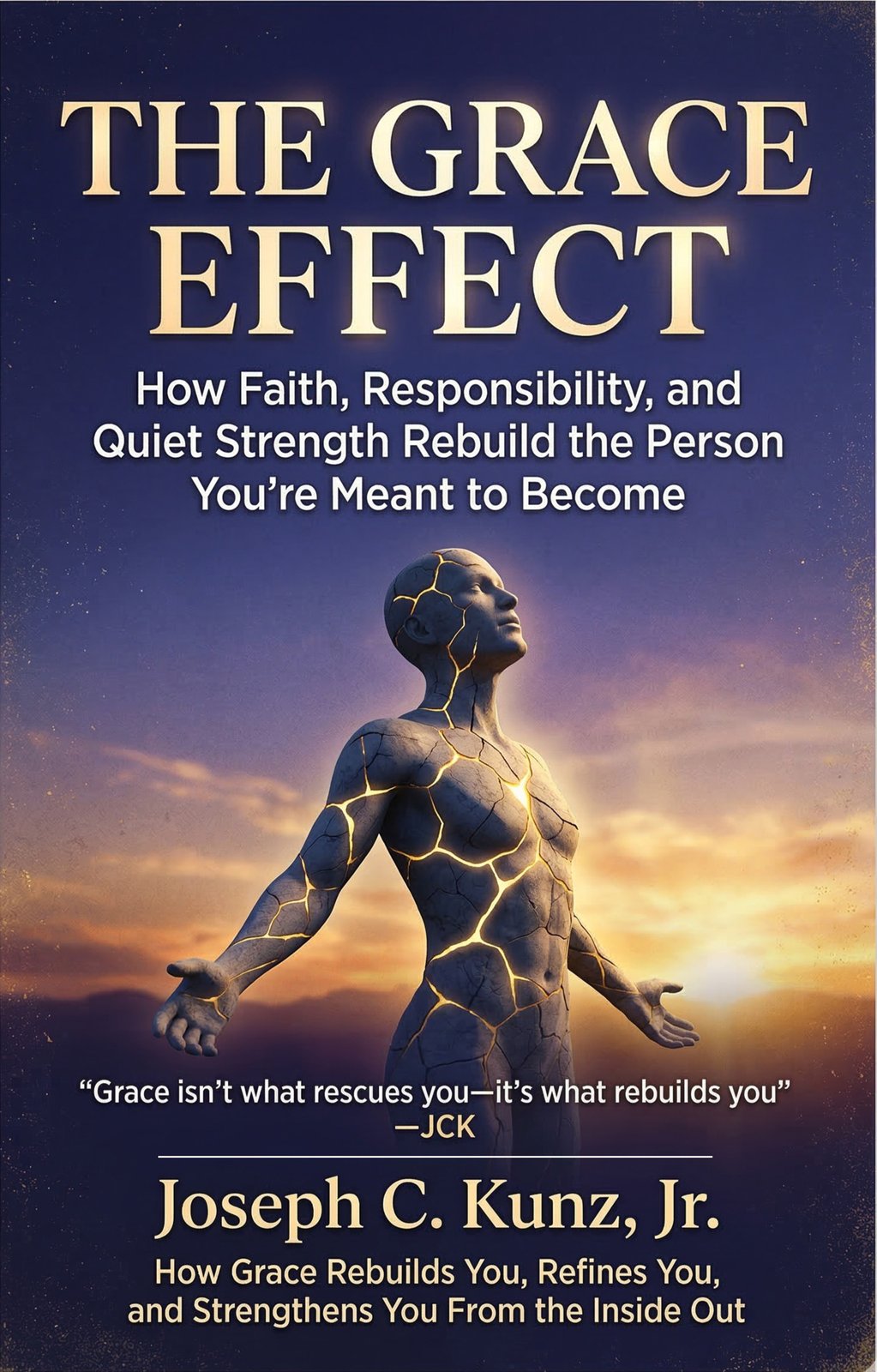
A hard world does not need more sentimental talk about kindness. It needs people formed deeply enough to notice, soften, help, forgive, endure, and offer mercy when no one is keeping score.
That is the heart behind The Grace Effect. This book is about the quiet force of grace in ordinary life—not as vague religious decoration, but as a real power that changes how people see, carry, forgive, serve, and strengthen one another.
Grace is not weakness. Grace is not pretending life is easy. Grace is what keeps a person human when life becomes heavy. It is what helps us receive help without shame and offer help without superiority. It is what turns a held door, a patient word, a faithful presence, or a small mercy into something larger than the moment itself.
If you have ever been changed by hardship and wondered what it is supposed to teach you, this book is for you.
If you have ever been carried by someone else’s kindness and wanted to understand why it mattered so much, this book is for you.
If you believe the world needs less performance and more mercy, less noise and more presence, less hardness and more grace, this book will speak to that need.
In Formation: The Grace Effect