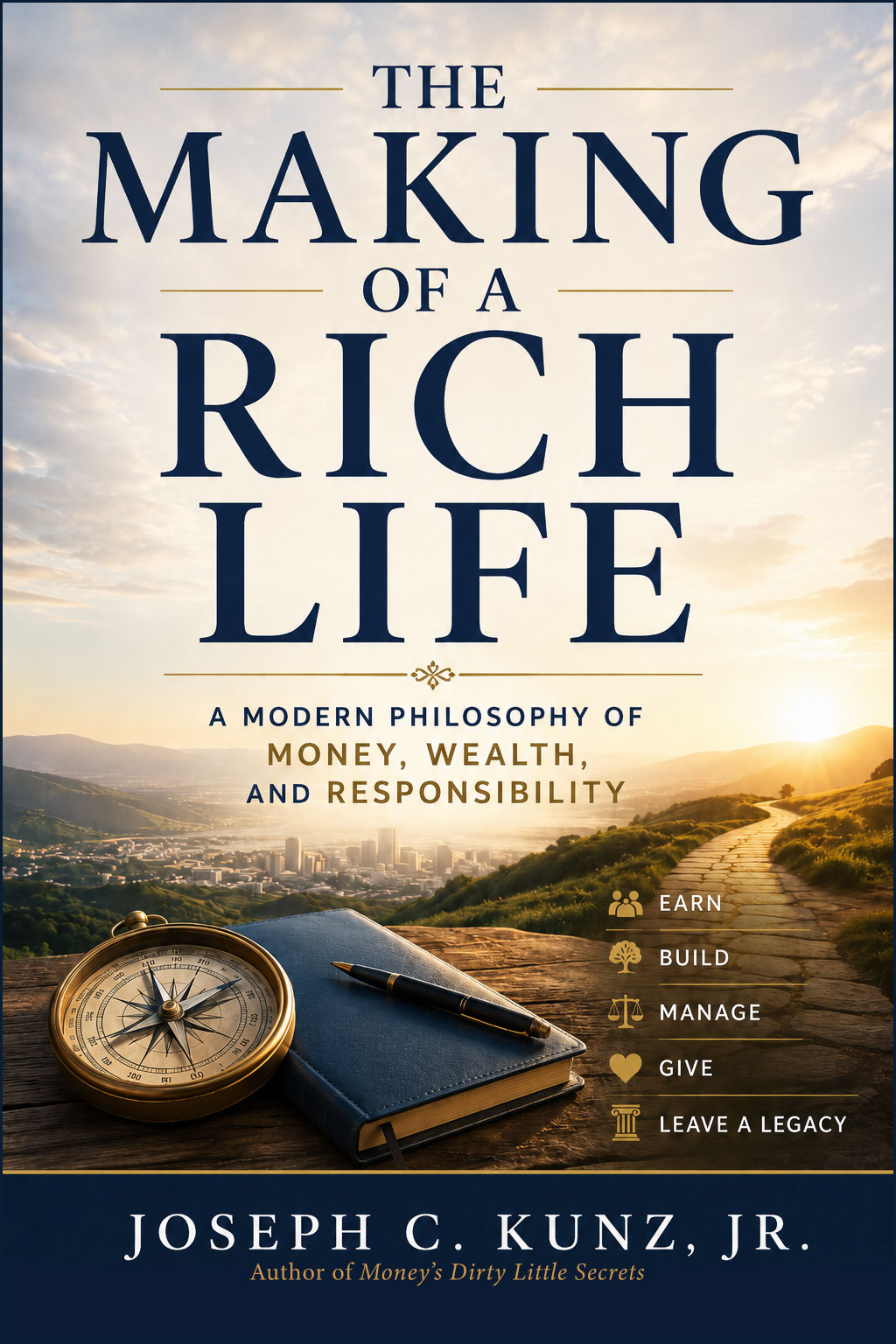
Money Is Part of Life. It Should Never Become the Meaning of Life. Most people are never taught how to think clearly about money.
They are taught how to earn it, spend it, save it, fear it, desire it, resent it, or display it. They receive fragments of financial advice, warnings about greed, promises of easy wealth, and conflicting messages about what success is supposed to look like.
But very few people are taught what money actually is, what wealth is for, what responsibilities accompany it, or where it belongs in a meaningful life.
The Making of a Rich Life brings those questions together.
This is not primarily a book about making more money. It is a book about understanding money—its power, its limits, its place in society, and its proper role in a life shaped by responsibility, purpose, family, freedom, generosity, and legacy.
Overview
Money is one of the most powerful tools human beings have created.
It allows people to exchange labor, preserve value, build businesses, support families, prepare for hardship, create opportunity, exercise greater freedom, and contribute to the lives of others.
But money can also become a source of fear, envy, vanity, dependence, conflict, and confusion.
It can support a meaningful life, but it cannot create meaning by itself. It can provide comfort, but not contentment. It can purchase attention, but not love. It can increase choice, but not wisdom. It can create the appearance of success while concealing disorder underneath.
The Making of a Rich Life offers a modern philosophy of money, wealth, and responsibility for readers who want to think about these matters with greater clarity and maturity.
Moving beyond formulas, financial hype, and shallow moralizing, Joseph C. Kunz, Jr. examines what money is, how legitimate wealth is created, why people desire it, what it reveals about character, and what obligations come with earning, owning, using, and passing it forward.
This is not a book about worshiping wealth or dismissing it. It is a book about putting money in its proper place.
What Does It Mean to Live a Rich Life?
A rich life is not simply a life with a high income, an impressive house, expensive possessions, or a large investment account.
Financial strength matters. It can protect a family, preserve independence, create options, support useful work, and allow a person to act when others can only react.
But financial wealth is only one part of a rich life.
A genuinely rich life also includes:
- Meaningful work
- Personal responsibility
- Strong relationships
- Moral clarity
- Useful knowledge
- Control over one’s time
- The ability to provide and protect
- Freedom from unnecessary dependence
- Generosity
- Purpose
- Faith
- And something worth passing forward
The goal is not to diminish the importance of money. The goal is to understand it well enough to give it neither less importance nor more authority than it deserves.
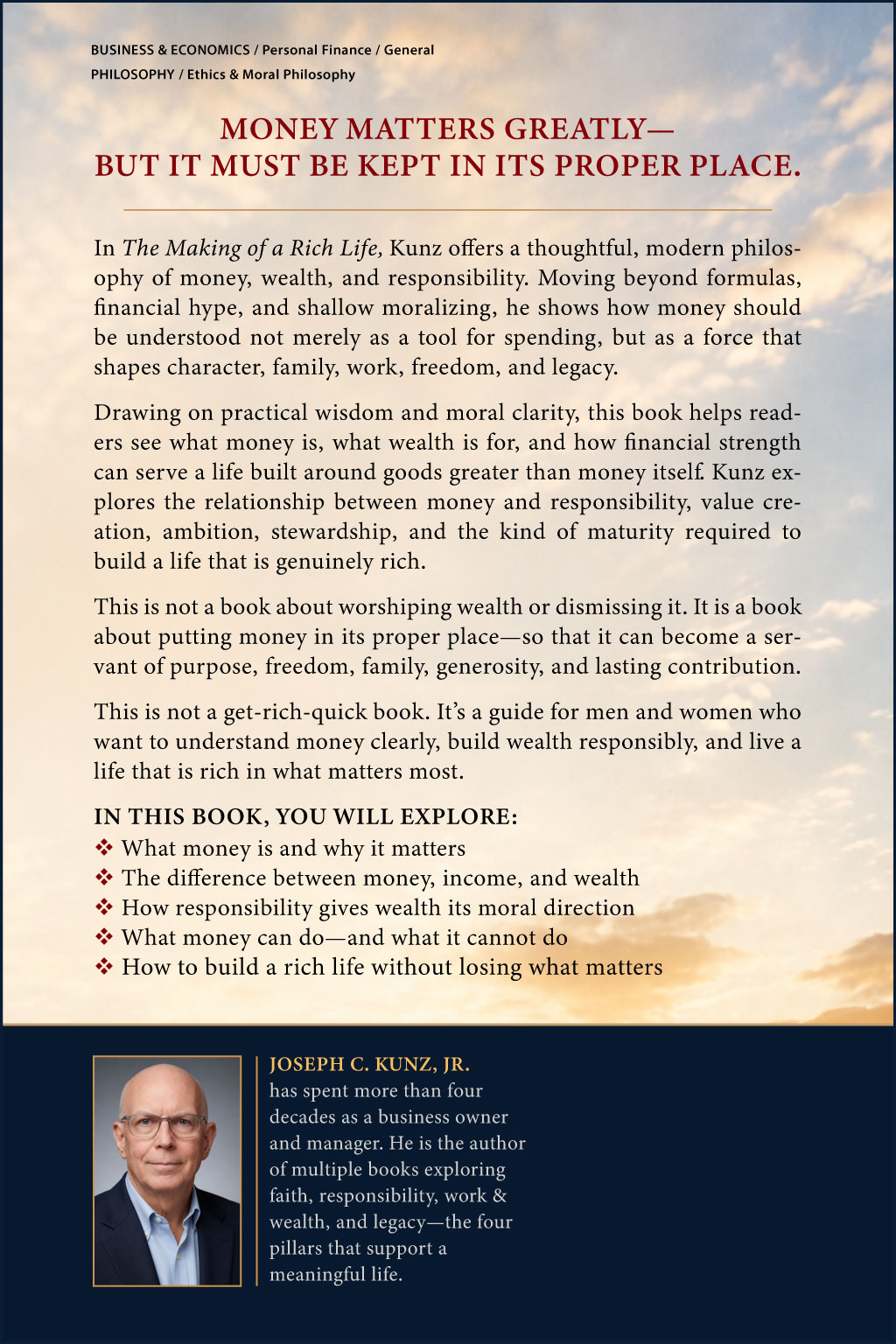
In This Book, You Will Explore
- What money is and why it matters
- The difference between money, income, assets, and wealth
- Why people desire financial success
- The difference between ambition, greed, envy, and responsibility
- How money affects character, identity, family, and relationships
- What money can provide—and what it can never provide
- Why legitimate wealth is created through usefulness, service, ownership, and value
- The moral meaning of profit, business, risk, and exchange
- How debt can change freedom and power
- Why financial strength creates obligations as well as opportunities
- What it means to have enough
- How wealth can serve purpose, family, generosity, and legacy
- How to build a rich life without losing what matters most
This Book Will Help You
Think More Clearly About Money
Separate money from income, wealth from consumption, price from value, ambition from greed, and financial success from personal worth.
Pursue Wealth Without Worshiping It
Recognize that financial strength is a legitimate human good while refusing to make money the measure of identity, virtue, or meaning.
Understand How Wealth Is Created
See how useful work, service, ownership, risk, trust, cooperation, and value creation contribute to genuine prosperity.
Examine Your Financial Motives
Consider whether your desire for money is being governed by responsibility, freedom, fear, comparison, status, generosity, or the need for control.
Use Money More Responsibly
Think more deliberately about earning, spending, saving, borrowing, investing, giving, protecting, and passing wealth forward.
Build More Than an Account Balance
Use financial strength to support a life of purpose, freedom, family responsibility, service, and lasting contribution.
A Modern Answer to an Old Question
More than a century ago, Wallace D. Wattles published The Science of Getting Rich.
Wattles rejected the idea that poverty was inherently virtuous and argued that human beings need material resources to develop their abilities and live fully. He distinguished between wealth created through usefulness and wealth pursued through competition, manipulation, or dispossession. He emphasized purpose, gratitude, service, and disciplined action.
He also went too far.
Wealth-building is not an exact science. Thought does not command material reality. Financial outcomes are not proof of moral superiority, and hardship is not always evidence of incorrect thinking.
The Making of a Rich Life begins with some of the questions Wattles raised but moves beyond his answers.
What does it mean to be rich?
What is money actually for?
What can it do for a life—and what can it never do?
How should wealth be created?
What responsibilities accompany it?
What should a person refuse to sacrifice for it?
And what should remain after the money and the person who controlled it are gone?
Wattles asked how a person gets rich. This book asks how money and wealth fit into the making of a rich life.
Money and the Four Pillars
Faith establishes the goods that money must never replace. It reminds us that human worth, meaning, love, moral order, and hope cannot be purchased.
Responsibility governs how money is earned, spent, protected, invested, shared, and passed forward. Financial freedom without self-government eventually becomes another form of disorder.
Work creates usefulness, develops competence, serves others, and gives material form to human ideas. Wealth preserves part of that created value and expands a person’s ability to choose, provide, build, and contribute.
Legacy asks what our financial lives form in other people. The real inheritance includes not only money and property, but also habits, judgment, discipline, opportunity, wisdom, and moral direction.
Together, the Four Pillars place money within the architecture of a complete life.
Who This Book Is For
The Making of a Rich Life is for:
- Men and women who want to understand money rather than merely chase it
- Readers tired of both get-rich-quick promises and reflexive condemnation of wealth
- Business owners, professionals, workers, and investors who want financial strength to serve a larger purpose
- Parents and grandparents who want to pass down financial judgment as well as financial assets
- Young adults trying to form a mature relationship with money before costly habits take hold
- People who have achieved financial success but are still asking what that success is for
- Readers who want to pursue wealth without surrendering character, family, faith, or freedom
- Anyone trying to build a life that is rich in more than appearances
This Is Not a Get-Rich-Quick Book
It does not promise that positive thoughts will produce money. It does not offer a secret formula for financial success. It does not claim that wealth makes a person virtuous or that poverty makes a person a failure. It does not dismiss practical financial strength as shallow or unimportant.
Instead, it offers something more foundational: a coherent way to understand money, wealth, responsibility, and the life those things are meant to serve.
About the Author
Joseph C. Kunz, Jr. has spent more than four decades as a business owner and manager. He is the author of multiple books exploring faith, responsibility, work & wealth, and legacy—the four pillars that support a meaningful life.
His work helps ordinary serious people think clearly, live deliberately, build wisely, and create lives strong enough to carry weight.
Money shapes choices, relationships, families, businesses, communities, and societies. Understanding it is part of becoming a mature and responsible person.
The Making of a Rich Life will help readers see money more clearly, pursue wealth more honestly, use it more responsibly, and place it within a life built around goods greater than money itself.