The Inheritance I Never Received Is the One I’m Trying to Leave
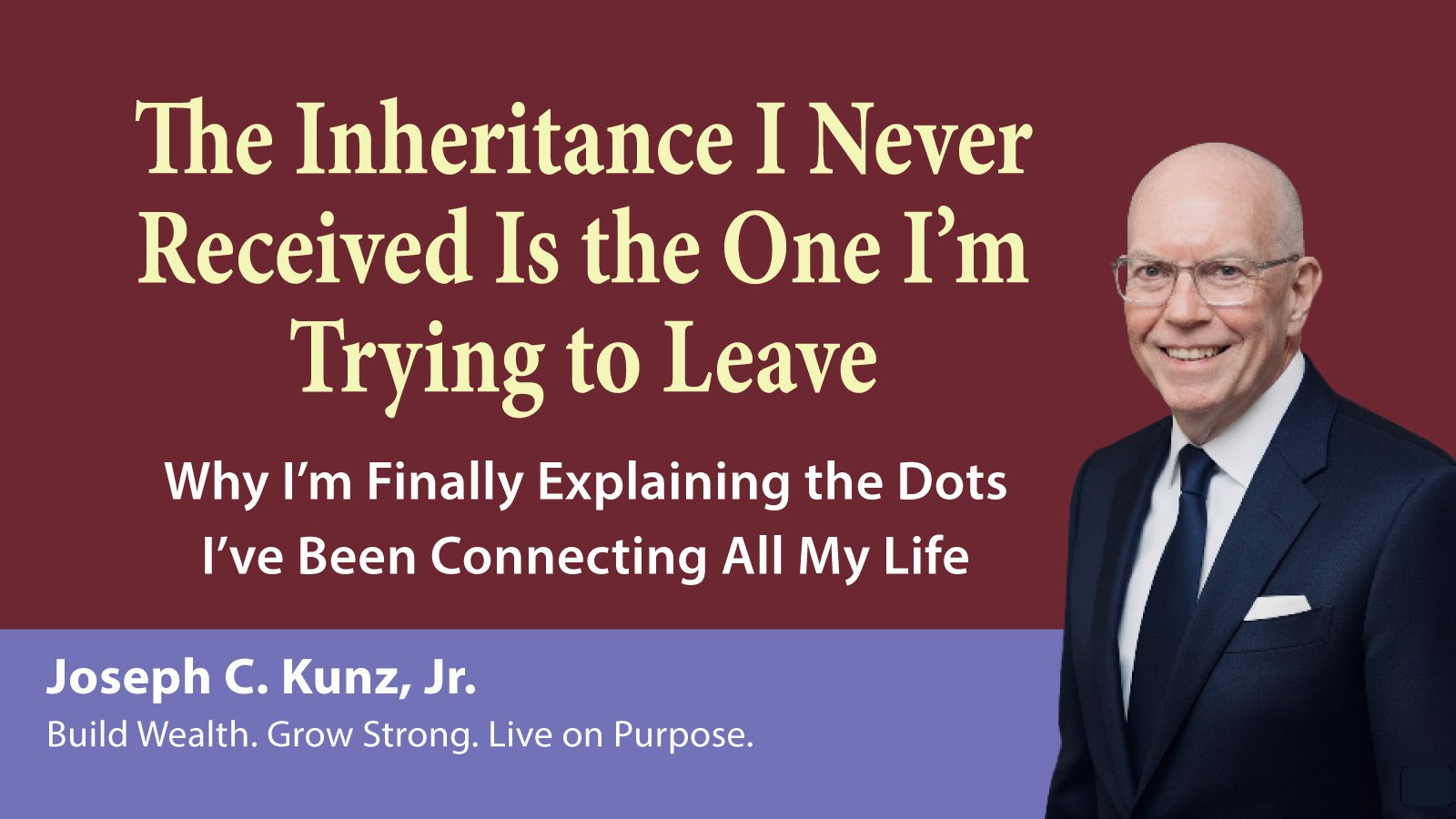
A father, husband, builder, and grandfather reflects on the hidden pattern that shaped his life—and why he now feels called to make that pattern clear for the people he loves. —Joseph C. Kunz, Jr.
Why I’m Finally Explaining the Dots I’ve Been Connecting All My Life
By Joseph C. Kunz, Jr.
Synopsis
This is not a nostalgic family reflection or a sentimental look back at a life of hard work and experience. In this essay, Joseph C. Kunz, Jr. reflects on how he spent much of his life sensing that the major parts of life were connected long before he had the language to explain that pattern clearly. What looked like separate struggles and responsibilities—faith, family, work, hardship, responsibility, resilience, and legacy—were, in fact, forming one deeper structure. Only later did he come to recognize that he had been “connecting the dots” across what he now calls the Four Pillars.
Kunz argues that this is one reason later-life reflection matters so much: not to romanticize the past, but to name the architecture underneath it. He explains how growing up without a father, without grandparents nearby, and without a fully inherited map forced him to build much of that structure gradually—through observation, work, suffering, discipline, faith, and time. He also shows why this realization now feels like a burden of stewardship: his wife, children, brothers, and grandchildren deserve more than fragments, memories, or isolated lessons. They deserve a clearer understanding of the pattern he spent a lifetime discovering.
The conclusion is simple: the strongest inheritance is not just money, stories, or even example—it is understanding. What is never explained can be forgotten, and what is never named can be lost. This essay is about finally putting language around a life spent connecting the dots, so the people he loves can receive not just what he built, but the deeper structure that made the building possible.
I spent most of my life building the structure before I had the language to explain the blueprint. —JCK
I. Introduction: I Knew There Was a Pattern Before I Had the Language for It
For most of my life, I would not have said I was building a philosophy.
I would not have said I was developing a worldview, or that I was “connecting the dots” across faith, responsibility, work, wealth, family, hardship, resilience, and legacy. I did not have that language yet.
But looking back, I do not think I ever believed the dots were random.
Deep down, I think I always sensed that there was some kind of connection between the different parts of life, even if I could not have explained it clearly or fully understood the process. I knew that what a man believed affected how he worked. I knew that how he worked affected how he provided. I knew that hardship changed the way he saw life. I knew that responsibility, faith, money, family, discipline, and endurance all touched one another somehow. I could feel that those things belonged together, even before I knew how to describe the structure they formed.
One reason for that may go back to something my mother would say: God was in all things.
That idea stayed with me.
I always liked looking at God that way—not confined to one corner of life, not limited to church on Sunday, but present through all of it: in work, hardship, responsibility, love, provision, endurance, and meaning. I did not know how to build a formal theology around that when I was young, but I believe that instinct shaped the way I saw the world. Long before I had a framework for it, I was already inclined to look for connection, coherence, and a deeper order holding things together.
Much later, I came to realize that this way of seeing life has deep kinship with what is often called Ignatian spirituality—the habit of seeing God at work in all things. I found that striking, and in some ways deeply fitting, because as a boy I was a catechism student at my local church, St. Ignatius Loyola Roman Catholic Church, long before I understood why that way of looking at life felt so natural to me.
I do not say that to make the story sound mystical or overly neat. I say it because it helps explain something true: the instinct was there before the language was there. The pattern was there before the framework was there. What I now call “connecting the dots” was already happening in me long before I had the words to name it.
Now, at this stage of life, I can see more clearly what I was reaching for all along. What looked like separate lessons and burdens were not separate at all. They were parts of one structure, slowly taking shape over time.
II. Some Men Inherit a Map. Others Build One Over Time
Because I sensed that life held together in some deeper way, I was always trying, in one form or another, to understand how the parts fit.
I did not grow up with a complete map already handed to me.
I had a mother for part of my life, but I did not have a father in my life, and I did not have grandparents nearby to provide that broader continuity across generations. I do not say that as complaint. I say it simply as part of the reality I had to build from.
When a person does not inherit a clear inner framework, he must form one more gradually. He learns by observing people, by paying attention to consequences, by watching what holds and what falls apart. He learns through work, hardship, discipline, faith, responsibility, and time. He learns by testing ideas against real life and by noticing which truths continue to prove themselves dependable under pressure.
That was much of my journey.
The instinct to look for connection may have been there early, but the structure itself was built slowly. I did not receive it in finished form. I had to piece much of it together over decades—through decisions, mistakes, work, marriage, fatherhood, endurance, recovery, and reflection. Not with resentment, but with effort. Not all at once, but one lesson at a time.
Looking back, I can now see that this slower process was shaping more than my opinions. It was shaping my judgment. It was teaching me how the major parts of life strengthen one another—or weaken one another—depending on how a man lives.
That is one reason I care so much now about putting these things into words.
When you need to build understanding gradually, you come to appreciate the value of clarity. You realize that what is never explained often remains only partly seen, even by the people closest to you. And in time, you begin to feel a responsibility to leave behind more than memories, reactions, or fragments. You want to leave behind a clearer structure—something the people you love can recognize, understand, and carry forward in their own way.
III. My Family Was Part of the Journey Long Before I Could Explain It
One of the clearest things I see now is that this process of “connecting the dots” was never happening in isolation.
My wife has been with me for forty-two years. My children have been part of my life for thirty-five years. My brothers knew me in the earlier years, before much of the later language and refinement had taken shape. And now my grandchildren stand downstream from all of it, whether they yet understand that or not.
That matters because a man does not need to explain his framework for the people closest to him to be shaped by it.
They are shaped by what he takes seriously, what he works for, what he worries about, what he honors, what he resists, and what he refuses to compromise. They live inside his habits, his standards, his tone, his priorities, and the atmosphere his convictions create. Long before a man ever writes a book or an essay, his family is already living inside the effects of what he believes.
That has certainly been true in my life.
My wife did not stand outside this journey watching it unfold from a distance. She shared in the work of it, the burdens of it, the responsibilities of it, and the building of it. My children did not simply hear my views on life. They grew up inside the world my choices, beliefs, discipline, and efforts helped create. My brothers knew the earlier terrain—the years when much of the structure was still being formed through real life rather than being clearly stated in words.
And now, as I think about my grandchildren, I feel that responsibility in a different way.
Because what a man leaves behind is never limited to possessions or memories. He also leaves behind a pattern. A way of seeing life. A way of responding to hardship. A standard for work. A view of faith. A sense of what matters and what does not. Even when those things are never fully explained, they are still being passed on.
That is one reason this writing matters so much to me now.
I do not want the people I love to receive only fragments. I do not want them left to piece together the deeper pattern from scattered moments, partial memories, or a few repeated phrases. If there is a structure underneath the life—and I believe there is—then I would rather name it plainly while I still can.
Because in the end, part of loving the people closest to you is not only building for them. It is also helping them understand what you were trying to build, and why.
IV. The Four Pillars Were There Before I Named Them
The longer I reflect on my life, the more I can see that the structure I now describe as the Four Pillars was present long before I had a formal name for it.
I did not invent these ideas late in life as a clever framework to organize my thoughts. I recognized them because they had already been shaping the way I lived, worked, judged, endured, and tried to build.
Faith was there—not as performance, sentiment, or religious image, but as a source of moral structure, accountability, and meaning. It was part of how I understood duty, suffering, limits, gratitude, and the need to answer to something higher than my own impulses.
Responsibility was there as well. It showed up in the belief that a man does not drift his way into a good life. He takes ownership. He carries weight. He does what needs to be done, even when it is inconvenient, unglamorous, or tiring. He learns that freedom without self-command collapses quickly.
Work and wealth were there too, not merely as practical concerns, but as matters of stewardship, provision, independence, and dignity. I have never believed work was only about earning a paycheck. Done rightly, it becomes part of how a man serves, builds, protects, and creates room for others to breathe. And wealth, when understood properly, is not vanity. It is one of the tools that gives stability, options, and the ability to help carry others.
And then there is legacy.
Even before I used that word more consciously, I believe I was already living with some awareness that life should amount to more than private comfort and personal consumption. A serious life should leave something behind—something useful, clarifying, strengthening, and worth carrying forward. Not just possessions, but understanding. Not just memories, but structure.
That is why the Four Pillars feel true to me now. They are not abstract categories laid on top of my life from the outside. They are the clearest language I have found for what was already there.
Looking back, I can see that these pillars were never separate departments. They were always reinforcing one another. Faith gave deeper meaning to responsibility. Responsibility gave shape to work. Work and wealth created the means for provision and stewardship. And legacy gave all of it a horizon beyond the present moment. The more clearly I see that, the more I understand that what I was really doing over all those years was not chasing separate goals. I was slowly building one integrated life.
That realization has brought a different kind of clarity to me.
It has shown me that many of the strongest truths in a man’s life do not always arrive as theories first. Often they arrive as lived convictions, tested in real life, and only later become language. The pattern is lived before it is named. The structure is built before it is described.
That, in many ways, is what this essay is trying to make plain.
V. Why Later-Life Reflection Matters
There is a kind of clarity that usually does not come early.
When a man is younger, he is often too busy living his life to fully interpret it. He is working, building, solving problems, carrying responsibilities, raising children, handling setbacks, making decisions, and trying to stay on his feet. He is occupied with what must be done now. Often, that leaves little room for stepping back and asking how the larger pattern fits together.
That is not a failure. It is simply how much of life works.
Understanding often comes in layers. A man learns one lesson through work, another through hardship, another through faith, another through marriage, another through fatherhood, another through recovery, another through time. At first, those lessons may seem separate because they arrive in different seasons and under different pressures. But later, if he is paying attention, he begins to see how they belong to one another.
That is one of the gifts of later-life reflection.
It allows a man to look back with more honesty, more perspective, and—if he is willing—more humility. He can see that some things that once felt isolated were actually connected. He can see that what seemed like scattered experiences were shaping habits of judgment, discipline, endurance, and belief. He can see that the life he was building had more internal coherence than he understood at the time.
In my case, that kind of reflection has not made me sentimental about the past. It has made me more serious about understanding it accurately.
I am less interested in polishing old stories than in identifying the truths that held up under pressure. I am less interested in romanticizing the struggle than in understanding what it taught. I am less interested in nostalgia than in clarity.
That is why later-life reflection matters to me now.
It is not an exercise in self-absorption. It is a form of stewardship. It is the work of turning lived experience into usable understanding. It is a way of asking what should be named more clearly, what should be passed on more deliberately, and what should not be lost simply because it was never fully explained.
At a certain point, reflection stops being merely personal. It becomes a responsibility.
Because if time has revealed the deeper pattern, and if that pattern contains something worth preserving, then a man should not keep it buried under memory alone. He should do his best to bring it into words—plainly, honestly, and while he still can.
VI. Why I Write Now
That is what brings me to the writing.
At this stage of my life, I am not writing because I suddenly want to become literary, and I am not writing because I think my life is more dramatic or important than anyone else’s. I am writing because I want to make the deeper pattern clearer while I still have the perspective to see it and the time to put it into words.
For many years, much of what I believed was expressed more through action than explanation. It showed up in how I worked, what I valued, what I took seriously, what I pushed against, what I tried to build, and what I hoped to pass on. But action, by itself, does not always explain its own meaning. People may see the effort without fully seeing the structure underneath it. They may remember the decisions without understanding the convictions that shaped them.
That is one reason I feel the need to write now.
I want them to inherit more than fragments. I do not want them to be left with only scattered impressions—he worked hard, he believed strongly, he cared about family, he took responsibility, he built something, he endured difficult things. All of that may be true, but it is still incomplete if the deeper pattern remains unspoken.
What I want to leave behind is not simply a record of events. I want to leave behind a clearer understanding of how the major parts of life connect. How faith steadies a man when circumstances do not. How responsibility keeps freedom from becoming drift. How work becomes more than labor when it is tied to provision, stewardship, and purpose. How wealth, rightly understood, creates options, stability, and the ability to help others. And how legacy is not merely what a man leaves, but what his life teaches when the pattern is finally made visible.
That is why this writing matters to me.
It is not about preserving my image. It is about reducing confusion. It is about making sure the people closest to me can better understand what I was trying to build and why certain things mattered so much to me. If there is any wisdom in the years behind me, then I would rather put it into words than assume it will somehow explain itself after I am gone.
In that sense, writing has become one more act of stewardship.
Just as a man tries to provide materially, protect what matters, and build something durable, he should also try to make his convictions more understandable to those he loves. He should try to leave behind not just effort, but explanation. Not just example, but clarity.
That is what I am trying to do now.
VII. The Real Inheritance Is Not Just Money
Money matters, and any serious adult should understand that.
Money creates options. It relieves pressure. It gives a family room to breathe. It can provide stability, preserve dignity, and make generosity more possible. To pretend otherwise is naïve. A man who cares about his family should care about provision, and provision always has a material side.
But money alone is a thin inheritance.
A person can receive resources without receiving judgment. He can inherit assets without inheriting discipline. He can be given financial advantage without understanding responsibility, stewardship, restraint, or the moral structure needed to handle freedom well. And when that happens, what was built over decades can be weakened or wasted in far less time than it took to create.
That is why I have come to believe that the stronger inheritance is not merely what a man leaves behind, but what he helps make understandable.
It is the framework underneath the work. It is the judgment behind the decisions. It is the moral logic that connects freedom to responsibility, work to dignity, wealth to stewardship, faith to steadiness, and legacy to character. Without that deeper structure, even good gifts can be mishandled. With it, people are better equipped to carry weight, make sound decisions, and build well in their own lives.
That is part of what I want to leave behind.
Not simply possessions, but perspective. Not simply memories, but meaning. Not simply the evidence that I built something, but a clearer explanation of what I believe makes a life worth building in the first place.
I do not expect the people I love to become copies of me, and I do not want to hand them a frozen script. Each life must still be lived personally, faithfully, and with its own responsibilities. But I do hope they can receive something sturdier than fragments. I hope they can receive a way of seeing—a stronger understanding of how the major parts of life belong together, and why that matters.
Because in the end, the deepest inheritance is not material alone.
It is the transfer of understanding.
And once a man sees that clearly, he begins to realize that making the pattern plain may be one of the most valuable things he can still do for the people he loves.
VIII. What Was Missing Helped Clarify What Matters
One of the quieter ways life teaches a man is through what was absent.
I did not grow up with the full continuity of guidance that some people receive more naturally. I did not have a father in my life, and I did not have grandparents nearby to help provide that broader sense of inherited structure across generations. I do not say that to invite sympathy or to turn absence into drama. I say it because, over time, it helped clarify something important for me.
What is not clearly given often needs to be slowly built.
When guidance is thin, a person learns by watching, by testing, by getting some things right and some things wrong, by noticing what holds and what collapses, and by piecing together meaning over a long stretch of time. That process can deepen a man if he is willing to learn from it. It can also make him appreciate, more keenly, the value of what is clear, steady, and faithfully passed on.
I believe that has been true in my life.
Because some things were not fully explained to me early on, I have come to care more deeply about explanation. Because some parts of the map had to be assembled slowly, I have come to value structure more consciously. And because some truths had to be learned through experience rather than inherited in finished form, I feel a stronger responsibility now to make those truths more visible for the people I love.
In that sense, what was missing did not simply leave a gap behind. It sharpened my understanding of what matters.
It taught me the importance of moral clarity. It taught me the value of steadiness. It taught me that what one generation leaves vague, the next generation may have to learn the hard way. And it taught me that part of responsible love is not only providing or protecting, but also explaining—giving the people closest to you a clearer sense of the structure underneath the life.
That is part of why this writing feels necessary to me now.
I am not trying to revisit the past in order to dwell on it. I am trying to draw from it honestly. I am trying to take what life taught me—sometimes clearly, sometimes slowly—and turn it into something more useful than private memory.
Because if absence helped clarify the value of structure, then one of the best ways to honor that lesson is to leave behind more clarity than I received.
IX. I Am Still Learning the Meaning of My Own Life
One of the humbling truths about getting older is realizing that a man can live a meaningful life before he fully understands the meaning of it.
That has been true for me.
I am still learning. I am still naming. I am still seeing connections more clearly now than I could when I was younger and still in the middle of building, working, carrying responsibility, and solving the next problem in front of me. That does not mean the earlier years lacked meaning. It means that some meanings only become visible with time.
There is humility in that.
It means I do not look back on my life as a man who had everything figured out early and then simply executed a flawless plan. Real life is not that tidy. My life, like any serious life, has included mistakes, blind spots, hard lessons, incomplete understanding, and seasons when faith, endurance, and responsibility mattered more than explanation.
But there is also encouragement in it.
A man does not need perfect language in youth for his life to be forming something true. He does not need a finished framework on day one in order to build something durable over time. Often the structure is being formed long before the full explanation arrives. The convictions are being tested before they are fully named. The life is being built before the blueprint can be clearly drawn.
That is how it has felt for me.
What I now call “connecting the dots” was not a late invention. It was a way of seeing, learning, and building that was already taking shape in me long before I understood it well enough to describe it. Now, with more years behind me, I can see that pattern more clearly and speak about it more honestly.
And at this age, that clarity carries a certain urgency.
A man becomes more aware that time is finite. He sees others in his generation begin to pass away, and it sharpens his sense that what matters should not be left vague when it can still be said plainly. Some things are too important to leave buried inside memory, half-formed impressions, or private understanding.
That is part of what has brought me here.
I am not writing because I think my life is extraordinary. I am writing because I believe that if a man has spent decades learning what holds, what matters, and how the parts of life fit together, then he should do his best to make that understanding available to the people he loves.
Because at a certain point, reflection is no longer only about looking back.
It becomes part of what you leave behind.
X. This Is What I Hope My Family Receives
When my family reads my essays and books, I do not want them to come away with the shallow summary that I simply had strong opinions or worked hard.
I want them to see the deeper pattern.
I want them to understand that the life I was trying to build was not held together by impulse, mood, or scattered priorities. It was held together—however imperfectly—by connected convictions. By the belief that faith should shape character. That responsibility should govern freedom. That work should serve more than comfort. That wealth should be handled as stewardship. And that legacy should mean more than leaving things behind; it should mean leaving something worth carrying forward.
I want them to understand that these were never separate concerns in my life.
Faith, responsibility, work, wealth, family, hardship, resilience, and legacy were always affecting one another. The way a man believes shapes the way he works. The way he works shapes the way he provides. The way he handles hardship shapes the way he leads. The way he thinks about money affects the way he uses freedom. And the way he lives all of that, over time, becomes part of what his family inherits—whether he explains it clearly or not.
That is what I hope they will see more clearly.
I hope they will see that my life was not only about building a business, enduring hardship, providing for a family, or trying to stay steady through the pressures of life. It was also about learning, often slowly, what makes a life hold together. What gives it strength. What keeps it from drifting. What makes it useful, trustworthy, and worth building in the first place.
And because I did not receive every part of that understanding in finished form, I want to leave behind more than I was given.
Not more noise. More clarity.
Not more sentiment. More structure.
Not more autobiography. More understanding.
That, to me, is part of the real inheritance.
Not that my family would remember me as a man with a story, but that they would better understand the pattern underneath the story. Not that they would merely know what I did, but that they would better understand what I believed was worth building, and why.
That is what I hope they receive.
XI. Naming the Pattern Before It Gets Lost
There comes a point when a man realizes that if he does not put certain things into words, part of what mattered most may remain only partially understood.
Not because the people he loves are incapable of seeing it. And not because everything important in life can be reduced to language. But because memory is selective, life is busy, and what is never clearly explained is often reduced over time to shorthand.
A few stories. A few sayings. A few impressions. He worked hard. He cared about family. He believed in God. He had strong values.
Those things may all be true. But by themselves, they do not fully reveal the structure underneath the life.
That is what I do not want to leave to chance.
I do not want the deeper pattern to survive only as fragments or generalities when I still have the ability to name it more clearly. I do not want the people closest to me to struggle to reconstruct it later from partial memories when I can explain it now with greater honesty and intention.
Because the longer I have lived, the more I have come to believe that clarity is part of love.
To build for the people you love is one form of care. To provide for them is another. To protect them is another. But to help them understand the deeper structure of what you were trying to build—that too is a form of care. It gives them something more solid than sentiment. It gives them a clearer pattern to reflect on, test, carry forward, and make their own.
That is why I do not see this writing as self-expression alone.
I see it as an act of stewardship.
I am trying to name what was often lived before it was explained. I am trying to make visible what was shaping so much of my life even when I could not yet fully describe it. I am trying to leave behind not just the evidence that I believed certain things, but a clearer account of how those beliefs fit together and why they mattered.
Because if the pattern is worth living, it is worth naming.
And if it is worth naming, then it should be named before it gets lost.
This, in many ways, is what I am trying to do now.
XII. Conclusion: The Real Inheritance
For most of my life, I was building the structure before I had the language to describe it.
Now I can see more clearly that faith, responsibility, work, wealth, family, hardship, resilience, and legacy were never separate themes in my life. They were connected truths, slowly forming one framework. My wife, my children, my brothers, and now my grandchildren were—and still are—part of that journey, whether I had fully explained it or not.
That is why this matters to me now.
I am not trying to turn my life into a legend, and I am not trying to complain about what was missing. I am trying to make the deeper pattern clear—to name the structure underneath the life, so the people I love can better understand what I was building and what is worth carrying forward.
At this age, a man becomes more aware that time is finite. He sees others in his generation begin to pass away, and it clarifies something important: what matters should not be left vague when it can still be said plainly.
Because the strongest inheritance is not just what you leave, but what you finally make clear.
And after all these years, that is what I am trying to do: put words around a life spent connecting the dots, so the deeper pattern does not get lost.
I spent a lifetime connecting the dots. Now I write so the people I love can see the picture. —JCK
Related Essays: For the Reflective Reader Ready to Go Deeper
If this essay made you think about what you’re really passing down, these two will take you deeper into the structure underneath it.
A reflective essay about seeing the setbacks, lessons, responsibilities, and turning points of life not as random episodes, but as connected waypoints forming one meaningful path.
Reader Comment: This essay helped me realize that what looked like chaos in my life was often a pattern I simply had not learned to name yet.
Quote: What feels random at first often becomes meaningful when you finally see how the dots connect. —JCK
2. The Best Inheritance Isn’t Money—It’s This
A clear-eyed essay on why the greatest thing a man leaves behind is not money or possessions, but the faith, values, and inner structure that help the next generation build a life that holds.
Reader Comment: This one made me stop thinking only about what I’m leaving behind and start thinking about what I’m actually handing down.
Related Book: Before Your Life Gets Reduced to a Few Vague Sentences
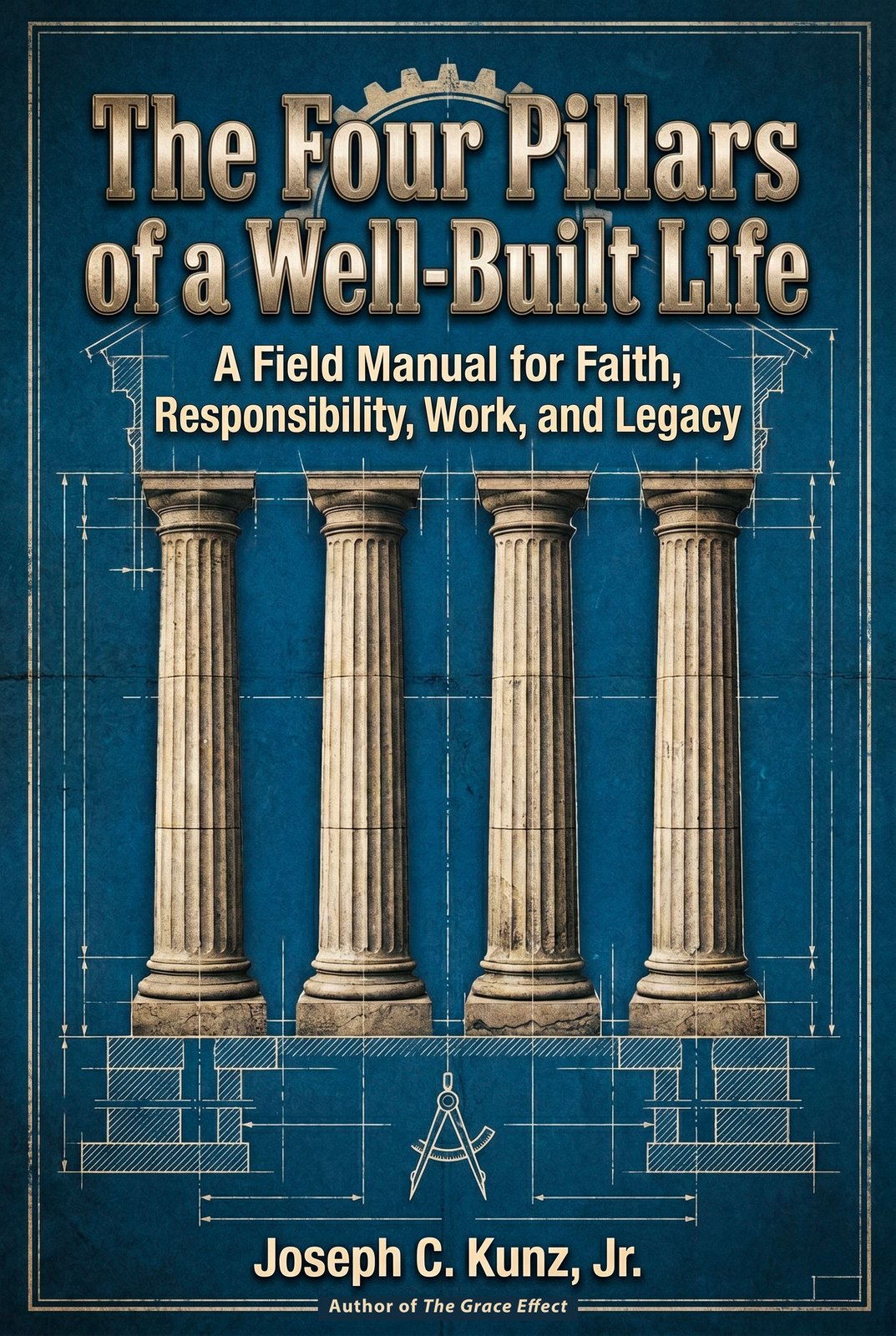
The Four Pillars of a Well-Built Life.
If you don’t name the pattern, the people you love may only inherit the fragments.
Most men wait too long.
Too long to explain what they believed. Too long to say what mattered. Too long to connect the dots for the people who were living inside the consequences of their choices the whole time.
Then one day, all that remains is the shorthand.
He worked hard. He loved his family. He had strong values. He believed in God.
Fine. But that’s not enough.
A life is more than a handful of safe sentences people say after the fact. A serious life has structure. It has a foundation, a frame, an engine, and a destination. And if you don’t make that structure clear while you still can, the people you love may remember your effort without ever fully understanding your architecture.
That is exactly why I wrote The Four Pillars of a Well-Built Life.
This book is not about motivational fluff, sentimental wisdom, or polished clichés for people who want to feel inspired for twelve minutes and then go right back to drifting. It is a hard-eyed framework for building a life that actually holds—through faith, responsibility, work, and legacy. It is the deeper map underneath the life I’ve been trying to understand, live, and now finally explain.
If this essay hit you in the chest, don’t stop here.
Go deeper into the framework behind it: Step into The Four Pillars of a Well-Built Life and see the full architecture.
Coming soon.