The Hunger for What Is Real
A starving soul does not need more noise; it needs truth strong enough to build a life on. —Joseph C. Kunz, Jr.
Why Faith, Responsibility, and Legacy Still Matter
Joseph C. Kunz, Jr.
Synopsis
This isn’t another complaint about young people, social media, influencers, weak culture, or modern distraction. And it isn’t a nostalgic sermon about how everything was better before the internet. In this essay, Joseph C. Kunz, Jr. argues that people are tired of fake stuff because fake success, fake freedom, fake spirituality, fake identity, and fake wisdom cannot do the serious work of forming a human life.
Kunz makes the case that the hunger beneath modern life is not merely boredom, rebellion, or distraction. It is under-formation. A culture can entertain people, affirm them, sell to them, distract them, and hand them endless versions of themselves, but it cannot replace faith, parental formation, personal responsibility, meaningful work, and legacy. Parents remain the first formers of their children. The Church and community should nourish what is true. But once a child becomes an adult, the final responsibility transfers to the person who must decide what he will build, repair, reject, strengthen, and pass on.
The conclusion is simple: a starving generation does not need another performance. It needs formation—faith as the foundation, responsibility as the frame, work and wealth as the engine, and legacy as the destination of a life built to hold.
Fake things can attract attention, but only truth can carry weight. —JCK
I. Introduction: The Hunger Under the Noise
People are tired of fake stuff.
They may not say it that way. They may not have the language for it. They may not connect it to faith, responsibility, family, work, money, fatherhood, motherhood, Church, country, or legacy.
But they feel it.
They feel the thinness.
They feel it in fake confidence.
Fake success.
Fake freedom.
Fake identity.
Fake spirituality.
Fake toughness.
Fake compassion.
Fake expertise.
Fake community.
Fake wisdom.
They feel it in a culture that never stops talking but rarely says anything worth building a life on.
A person can be entertained all day and still feel starved at night. He can have a phone full of voices and still have no one telling him the truth. He can have endless access to information and still have no wisdom. He can be encouraged to “be himself” before anyone has helped him become someone worth being.
That is not progress.
That is hunger with better technology.
We live in a time that has confused stimulation with nourishment. It has confused choice with freedom. It has confused visibility with importance. It has confused emotional intensity with truth. It has confused attention with love.
And eventually people start to notice.
The applause does not satisfy.
The screen does not bless.
The crowd does not form.
The algorithm does not father.
The culture does not forgive.
The market does not give meaning.
The self cannot save itself.
That is why people are tired of fake stuff.
Because fake stuff cannot carry real life.
II. Fake Works Until Reality Shows Up
Fake works for a while.
That is why it is dangerous.
Fake confidence can get attention.
Fake success can impress strangers.
Fake spirituality can sound comforting.
Fake freedom can feel exciting.
Fake toughness can look masculine.
Fake compassion can win approval.
Fake identity can create a temporary sense of belonging.
But fake things fail when weight arrives.
And weight always arrives.
Sickness arrives.
Failure arrives.
Marriage gets tested.
Children need formation.
Parents age.
Money gets tight.
Temptation comes close.
Death enters the room.
A business shakes.
A family fractures.
A man looks in the mirror and realizes he has become less than he was called to be.
That is when slogans collapse.
That is when performance runs out of tricks.
That is when a person discovers whether his life has structure or only decoration.
Because life is not finally measured by what a man says when everything is easy. It is measured by what holds when the pressure comes.
A fake life may photograph well.
It does not bear weight.
And human beings were made for weight. Not crushing weight. Not meaningless suffering. Not misery dressed up as virtue.
But real weight.
The weight of duty.
The weight of love.
The weight of truth.
The weight of family.
The weight of work.
The weight of faith.
The weight of becoming someone others can depend on.
A life without weight becomes thin.
A life with no truth above it, no duty within it, no work beneath it, and no legacy beyond it eventually becomes a polished emptiness.
That is where many people are now.
Polished, connected, distracted, opinionated, stimulated—and starving.
III. The Modern World Feeds Appetite and Starves Formation
A person does not become strong by accident.
A child does not become wise because he has access to the internet.
A young man does not become disciplined because he watches motivational clips.
A young woman does not become secure because strangers approve of her photograph.
A family does not become healthy because everyone has a full calendar.
A culture does not become moral because it uses the language of kindness while refusing the demands of truth.
Formation must be done on purpose.
That is what the modern world often forgets.
We hand young people devices before wisdom.
Expression before discipline.
Options before standards.
Attention before character.
Comfort before courage.
Therapy language before moral language.
Autonomy before self-government.
Then we act shocked when many of them become anxious, fragile, confused, angry, lonely, and unformed.
But why should we be shocked?
If you feed a person noise, do not be surprised when he lacks peace.
If you feed him outrage, do not be surprised when he lacks gratitude.
If you feed him appetite, do not be surprised when he lacks self-control.
If you feed him slogans, do not be surprised when he lacks wisdom.
If you feed him victimhood, do not be surprised when he lacks agency.
If you feed him fake freedom, do not be surprised when he becomes enslaved to impulse.
This is not an attack on young people. It is a defense of them.
Many are not merely rebellious. Many are underfed.
Not materially, necessarily. Spiritually. Morally. Relationally. Philosophically.
They have been given stimulation without formation.
And a person can only live on that for so long.
IV. Responsibility Begins at Home
The first responsibility for formation belongs to parents.
That should not be controversial.
Before a child understands politics, economics, theology, philosophy, culture, or history, he understands the atmosphere of his own house.
He watches.
He watches how his parents speak.
He watches how they handle anger.
He watches how they treat money.
He watches whether faith is real or decorative.
He watches whether work is honored or resented.
He watches whether marriage is protected or neglected.
He watches whether forgiveness is practiced or only discussed.
He watches whether responsibility is carried or avoided.
That is formation.
Parents are not merely providers. They are formers.
They are the first teachers, first witnesses, first examples, first authority figures, and first living definition of what adulthood looks like.
The Church can help.
Schools can help.
Coaches can help.
Employers can help.
Grandparents can help.
Books can help.
Mentors can help.
Good friends can help.
But none of them replaces the parents.
The home is the first culture.
And when parents surrender formation to the culture, the culture does not leave the child neutral. It forms him in its own image.
But this truth has a second half.
Once the child becomes an adult, the responsibility transfers.
An adult may not be responsible for what he was not given. But he becomes responsible for what he refuses to build.
A man may not have been taught discipline. He is still responsible for becoming disciplined.
A woman may not have been taught faith. She is still responsible for seeking truth.
A young adult may have been raised by screens, confusion, softness, absence, indulgence, or fear. He is still responsible for deciding what will govern his life.
A weak childhood may explain the cracks in a man’s foundation, but it does not give him permission to spend the rest of his life living in rubble.
At some point, every adult has to stop saying, “Nobody taught me,” and start saying, “Then I need to learn.”
That is where a serious life begins.
V. One Parent Left. One Parent Stayed and Tried.
I learned some of this early.
My father left when I was young. He went on to have another wife and another family.
That kind of absence marks a child. It does not have to destroy him, but it marks him. A father’s absence is not just the absence of another adult in the house. It is the absence of a daily model, a daily witness, a daily presence, a daily answer to the question: what does a man do when life gets heavy?
My mother, meanwhile, began developing Alzheimer’s when she was only thirty-nine.
But even with that terrible burden beginning to enter our lives, she understood something clearly: her children needed formation. She knew it was part of her role to help us grow into adults.
She was not perfect. No parent is. But she stayed. She tried. She carried what she could.
One parent left.
One parent stayed and tried.
That contrast taught me more about responsibility than any school, coach, employer, or institution ever could.
My father’s absence wounded me, but my mother’s effort formed me.
My two younger brothers and I were fortunate in one sense. We were smart, tough, and willing to work. We helped at home. We held multiple jobs. We learned early that life was not going to arrange itself around our wounds.
If something needed to be done, we did it.
We did not have the luxury of becoming fragile. There was work to do.
I never expected the Church, my schools, my employers, my coaches, or the culture to assemble my life for me. I could learn from others. I could observe. I could be influenced. I could be helped.
But I understood early that no one else could build my life for me.
That is not bitterness. It is clarity.
I could not choose the father I had. I could choose the man I would become.
That choice did not happen in one dramatic moment. It happened in work, discipline, observation, mistakes, responsibility, and the slow refusal to let absence have the final word.
That is why I do not write about responsibility as a theory.
I write about it as a man who had to learn early that life does not build itself.
VI. The Church Should Feed Souls, Not Chase Applause
The Church belongs in this conversation too.
If people are spiritually and morally underfed, we cannot place all the blame on young people, parents, schools, politics, media, or social platforms.
The Church exists to feed souls.
That is not its only role, but it is not a small one.
Priests, pastors, bishops, Catholic educators, Christian writers, and serious lay witnesses should be teaching, writing, explaining, preaching, recording, and speaking into the places where people are actually being formed.
And many people are being formed online.
That does not mean the Church should become an entertainment machine. It does not mean every priest should become an influencer. It does not mean the faith should be reduced to clips, slogans, branding, or digital personality.
That would only create a religious version of the same fake stuff.
The Church should not chase attention.
It should form souls.
But formation requires presence. And if the Church is absent where people are being shaped, other voices will gladly take its place.
The internet will catechize.
The question is not whether people will be taught. They will be taught.
The question is who will teach them, and toward what end.
If the Church does not help form people online, the internet will gladly deform them there.
But the Church cannot replace the home either.
The Church supports parental formation. It deepens it, corrects it, nourishes it, sacramentalizes it, strengthens it, and gives it eternal direction.
But it cannot do the daily work for parents who refuse to form their children.
A one-hour Mass cannot undo a week of spiritual negligence at home.
A homily cannot replace a father.
A parish program cannot replace a mother.
A youth group cannot replace a family culture.
The Church has a role. A serious role. A sacred role.
But parents remain first.
And adults remain responsible.
VII. Faith Is Not a Mood. It Is the Foundation.
Faith is not a decoration added to life after the practical things are handled.
It is not a mood.
It is not a vibe.
It is not a tribal badge.
It is not religious wallpaper.
It is not a sentimental escape from reality.
Faith is foundation.
It answers the deepest question: what do you stand on when everything else shakes?
Because everything else will shake.
Your health may shake.
Your family may shake.
Your business may shake.
Your plans may shake.
Your confidence may shake.
Your country may shake.
Your assumptions may shake.
And when that happens, a person discovers very quickly whether his life was built on rock or fog.
This is why fake spirituality fails.
Fake spirituality wants comfort without surrender.
Inspiration without obedience.
Grace without repentance.
Peace without truth.
Belonging without conversion.
God as decoration, not foundation.
That kind of faith cannot hold.
It may soothe. It may affirm. It may sound beautiful for a while. But it does not form a person deeply enough to carry suffering, resist temptation, forgive enemies, build a family, face death, or live with moral courage.
Real faith does not make life easy.
It makes life intelligible.
It tells a person he is not God.
That sounds offensive to the modern ego, but it is actually mercy.
You are not the source of truth.
You are not responsible for inventing meaning from scratch.
You are not saved by achievement, money, politics, beauty, applause, control, or self-expression.
Faith puts the self back in its proper place.
Not erased.
Ordered.
And an ordered life is stronger than an inflated one.
VIII. Responsibility Is the Frame That Makes Freedom Possible
Modern culture talks constantly about freedom.
Freedom to choose.
Freedom to express.
Freedom to define yourself.
Freedom to pursue happiness.
Freedom to reject limits.
Freedom to live your truth.
But freedom without responsibility is not strength.
It is drift.
A person who cannot govern himself is not free.
A young man ruled by appetite is not free.
A young woman ruled by approval is not free.
A parent ruled by convenience is not free.
A worker ruled by resentment is not free.
A consumer ruled by impulse is not free.
A citizen ruled by propaganda is not free.
A soul ruled by pride is not free.
Responsibility is not the enemy of freedom.
Responsibility is what makes freedom usable.
It gives shape to desire.
Discipline to energy.
Direction to ambition.
Strength to love.
Structure to the soul.
This is why responsibility still speaks. Because people know, even when they resist it, that a life without discipline eventually becomes exhausting.
Doing whatever you want sounds like freedom until your wants become your master.
Following your feelings sounds authentic until your feelings lead you off a cliff.
Blaming everyone else sounds comforting until you realize blame cannot build a life.
Responsibility is hard.
But irresponsibility is harder in the long run.
That is one of the great truths young people need to hear, and many adults need to remember.
The bill always comes due.
Responsibility lets you pay it with dignity.
IX. Work Is Where Responsibility Becomes Visible
Work matters because work reveals the truth.
It is easy to have opinions.
It is harder to become competent.
It is easy to announce values.
It is harder to live them under pressure.
It is easy to talk about purpose.
It is harder to show up every day, do what needs to be done, serve people well, manage money wisely, improve your skills, and build something useful.
Work is where responsibility becomes visible.
That does not mean work is the whole meaning of life. It is not.
A man can work too much. He can hide in work. He can use work to avoid family, faith, tenderness, or self-examination. He can confuse productivity with holiness and income with worth.
That is not strength. That is imbalance wearing a tool belt.
But the opposite lie is just as dangerous: that work is merely a burden, money is dirty, ambition is selfish, and provision is shallow.
No.
Work is moral.
Money is moral.
Stewardship is moral.
Competence is moral.
Provision is moral.
A person’s relationship with work and money reveals whether he understands responsibility beyond words.
How you work shows what you respect.
How you earn shows what you are willing to become good at.
How you spend shows what you desire.
How you save shows whether you can govern yourself.
How you invest shows whether you think beyond today.
How you give shows whether money serves you or owns you.
Fake success skips this.
Fake success wants image without competence, income without service, wealth without discipline, luxury without sacrifice, and freedom without stewardship.
That is why it collapses.
Real work forms people.
It teaches patience, excellence, humility, endurance, problem-solving, service, and consequence.
It teaches a person that wishing is not building.
And building is the language of serious adulthood.
X. Legacy Is the Destination Fame Cannot Touch
Fame is loud.
Legacy is quiet.
Fame wants strangers to know your name.
Legacy wants the right people to be stronger because you lived.
Fame asks, “How many people saw me?”
Legacy asks, “What did my life make possible for others?”
That distinction matters in a culture obsessed with visibility.
A man can be known by thousands and still be absent from his own family.
A woman can be admired by strangers and still be unknown by the people who need her most.
A person can build a brand and neglect a soul.
A family can live under one roof and be scattered across separate screens, separate hungers, separate wounds, and separate worlds.
Legacy brings the question home.
What are you passing down?
Not just money.
Not just property.
Not just photographs.
Not just stories.
Not just a last name.
What convictions?
What habits?
What view of God?
What understanding of work?
What example of marriage?
What relationship with money?
What model of forgiveness?
What attitude toward suffering?
What definition of success?
What did it feel like to live under your influence?
That last question should stop a serious person cold.
Because legacy is not merely what people say after you die.
Legacy is what people absorb while you live.
Your family is studying you even when nobody is taking notes.
They notice what makes you angry.
They notice what you laugh at.
They notice whether your faith changes your behavior.
They notice whether you apologize.
They notice whether money makes you generous or small.
They notice whether work makes you useful or merely busy.
They notice whether responsibility makes you strong or hard.
They notice whether love in your house is spoken, shown, or assumed into silence.
Legacy is daily formation.
And that is why fake living is so dangerous.
Eventually, somebody inherits it.
XI. Why People Still Hunger for the Old Truths
The modern world often acts as if faith, responsibility, work, and legacy are outdated.
They are not outdated.
They are load-bearing.
A society can mock them, ignore them, distort them, or replace them with trendier language. But it cannot escape the need for them.
People still need faith because they need a foundation deeper than the self.
People still need responsibility because freedom without self-government becomes chaos.
People still need work because effort, competence, and service form character.
People still need wealth rightly understood because stewardship gives responsibility practical strength.
People still need legacy because a life curved inward eventually becomes small.
These truths remain because human nature remains.
The technology changes.
The hunger does not.
People are tired of fake stuff because fake stuff cannot answer the permanent questions.
Who am I?
Why am I here?
What is true?
What must I carry?
What must I repair?
What must I build?
Who needs me to become stronger?
What will remain after I am gone?
A screen cannot answer that.
A slogan cannot answer that.
A political tribe cannot answer that.
A brand cannot answer that.
A bank account cannot answer that by itself.
Only a rightly ordered life can begin to answer it.
And a rightly ordered life is not assembled from trends.
It is built from truth.
XII. The Older Generation Must Recover Its Nerve
Young people do not need older people to become cool.
They need older people to become clear.
They do not need us to imitate their slang, chase their platforms, flatter their confusion, or baptize every cultural trend in the name of compassion.
They need us to tell the truth without contempt.
That last part matters.
Truth without love becomes a weapon.
Love without truth becomes surrender.
A serious witness needs both.
We need fathers, mothers, grandfathers, grandmothers, priests, pastors, teachers, coaches, employers, writers, and serious adults who can say:
Your life matters too much to waste.
Your soul matters.
Your body matters.
Your family matters.
Your choices matter.
Your work matters.
Your money matters.
Your faith matters.
Your future matters.
The people coming after you matter.
That message does not expire.
But the older generation has to recover its nerve.
Too many adults are afraid to speak clearly. Afraid to offend. Afraid to be judged. Afraid to sound old-fashioned. Afraid to say some things are true and others are false. Afraid to say some paths lead to life and others lead to ruin.
That fear has consequences.
Silence forms too.
When serious adults go quiet, unserious voices do not.
The culture will not leave young people unformed. It will form them badly.
So the answer is not outrage.
The answer is witness.
Clear witness.
Faithful witness.
Lived witness.
Parental witness.
Christian witness.
Hard-earned witness.
Not perfection.
Witness.
The next generation does not need perfect elders. Thank God, because that would disqualify all of us.
But they do need honest ones.
They need people who can say:
I failed there.
I learned this.
I rebuilt here.
I would not build on that again.
This held.
That collapsed.
This is worth carrying forward.
That kind of honesty has weight.
And weight is exactly what a thin culture lacks.
XIII. Conclusion: Give Them Something That Holds
People are tired of fake stuff because fake stuff cannot form a human life.
It cannot forgive sin.
It cannot build discipline.
It cannot raise a child.
It cannot strengthen a marriage.
It cannot teach sacrifice.
It cannot make suffering meaningful.
It cannot turn work into service.
It cannot turn money into stewardship.
It cannot turn success into peace.
It cannot turn attention into love.
It cannot turn existence into purpose.
Sooner or later, fake things run out of tricks.
The applause fades.
The screen goes dark.
The crowd moves on.
The trend changes.
The self gets tired of worshiping itself.
And the old questions return.
What do you stand on?
How do you govern yourself?
What are you building?
Who are you responsible to?
What will remain?
Those questions are not modern or ancient.
They are human.
That is why faith, responsibility, work, wealth, and legacy still matter.
Not because they are fashionable.
Because they are true.
Parents are responsible for what they hand down.
The Church and community are responsible for helping nourish what is true.
But every adult is finally responsible for what he builds, repairs, rejects, strengthens, and passes on.
A starving generation does not need another performance.
It needs formation.
It needs faith as the foundation.
Responsibility as the frame.
Work and wealth as the engine.
Legacy as the destination.
Everything else is decoration.
And decoration cannot hold the weight of a human life.
A life built on fake things may look successful for a season, but only a life built on truth can become a legacy. —JCK
Related Essays: More on Formation, Responsibility, and the Life That Holds
These essays continue the same argument from two different angles: how children are formed, and how a whole life is built.
1. Who Is Raising Your Child — You or the Algorithm?
This essay argues that Big Tech has a real moral duty not to exploit children, but parents still carry the first and oldest responsibility to form their children before the algorithm does.
Reader Comment: Read this alongside “People Are Tired of Fake Stuff” because both essays make the same hard distinction: powerful outside forces matter, but they do not erase parental responsibility.
Quote: Big Tech cannot exploit childhood weakness, and parents cannot outsource childhood formation. —JCK
This essay shows how the major pieces of a serious life belong together, and why faith, family, work, freedom, money, and responsibility cannot be separated without weakening the whole structure.
Reader Comment: Read this next if you want to see the larger architecture behind the argument. “People Are Tired of Fake Stuff” explains the hunger; this essay explains the framework.
Quote: A strong life is not assembled from disconnected parts. It is built from truths that belong together. —JCK
Related Book: Stop Decorating the Ruins
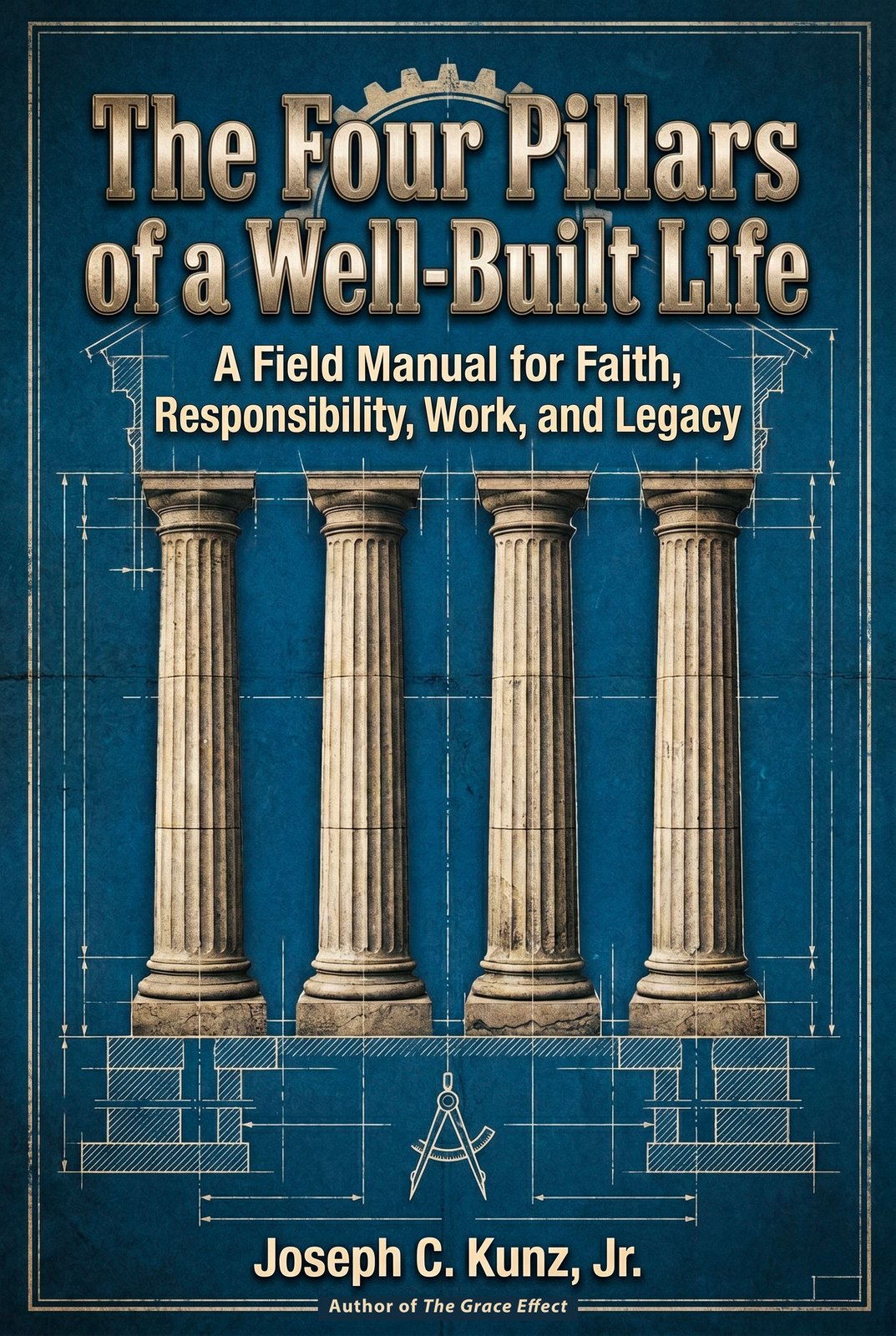
The Four Pillars of a Well-Built Life
A culture built on fake stuff can still look busy, polished, successful, and impressive. But when the pressure comes, decoration is exposed for what it is. It cannot form character. It cannot hold a family together. It cannot teach a man to govern himself. It cannot turn money into stewardship. It cannot give suffering meaning. It cannot build a legacy.
That is why I am writing The Four Pillars of a Well-Built Life. This book is the full framework behind this essay. It is about the truths that still hold when the noise fades: faith as the foundation, responsibility as the frame, work and wealth as the engine, and legacy as the destination.
If you are tired of shallow success, this book is for you.
If you know life needs more than comfort, applause, and self-expression, this book is for you.
If you want a framework strong enough to carry faith, family, work, money, suffering, and legacy, this book is for you.
If you want to stop drifting and start building, this book is for you.
Being Built to Hold: The Four Pillars of a Well-Built Life