Private Exemptions, Public Collapse
Many men don’t lose their witness in a scandal — they lose it in a hundred private exceptions that felt “reasonable” at the time. —Joseph C. Kunz, Jr.
How Moral Drift Destroys Your Witness Long Before Anyone Sees It
By Joseph C. Kunz, Jr.
Synopsis
This isn’t an essay about “being perfect,” and it’s not a paranoid warning that you’re one bad day away from ruin. In this essay, Joseph C. Kunz, Jr. argues that moral collapse rarely begins with open rebellion — it begins with exemptions: small permissions you grant yourself when pressure is high, fatigue is real, and conscience starts negotiating terms. These exemptions feel harmless because they’re private, practical, and easy to rationalize. But they don’t stay small. They compound.
Kunz makes the case that moral drift is rarely dramatic — it’s structural. It happens when a man keeps building a life while quietly weakening the load-bearing beams: truth-telling, clean dealing, restraint, humility, and repentance (course correction). He explains how “just this once” turns into a pattern, how private inconsistency eventually leaks into public character, and why credibility often dies long before reputation does. He also shows why this matters for a Christian witness — because people don’t only evaluate what you say; they evaluate whether your life is safe, solid, and trustworthy under pressure.
The conclusion is simple: you don’t protect your witness by winning arguments or curating an image. You protect it by refusing private exemptions — and by returning quickly to the standard when you fail. Because collapse is usually loud, but drift is quiet. And drift is where the outcome is decided.
The drift is the danger — because it feels like normal. —JCK
I. Introduction: The Quiet Way a Man Falls
Public collapse is usually loud. It makes headlines, breaks families, burns businesses, and leaves behind a trail of “How could he?” and “I never saw it coming.”
But the fall didn’t start in public.
It started in private — in the quiet decisions a man made when nobody was watching and nobody was clapping. Not the obvious sins that announce themselves with sirens, but the small exemptions that feel “reasonable” in the moment: the half-truth, the hidden resentment, the lazy corner cut, the private indulgence, the delayed apology, the money game, the little lie you call “strategy.”
That’s moral drift: a slow structural weakening of a life that still looks fine from the street. And that’s why it’s so dangerous. You can be admired while you’re drifting. You can be “successful” while your character is quietly losing its load-bearing strength.
This essay is about stopping the drift — not through theatrics, but through standards: faith, responsibility, work, and legacy. Because your witness doesn’t collapse when you lose an argument. It collapses when your private life becomes unsafe.
II. Moral Collapse Isn’t Usually a Decision — It’s a Series
A. The myth: “He chose to ruin his life.”
That’s the story people tell because it’s clean and dramatic. It makes collapse feel like a single moment: one terrible decision, one big betrayal, one explosive failure.
But most collapse doesn’t work that way.
Most collapse is a series.
A man doesn’t “suddenly” become dishonest.
He starts trimming the truth.
He starts managing perception.
He starts justifying “necessary” deception.
Then he gets accustomed to it.
A man doesn’t “suddenly” become unfaithful.
He starts flirting with the line.
He starts feeding private fantasies.
He starts treating boundaries like suggestions.
Then he acts surprised when the line disappears.
A man doesn’t “suddenly” become cruel.
He starts storing resentment like savings.
He starts treating irritability like a personality.
He starts excusing disrespect because he’s “under stress.”
Then the people closest to him start living on eggshells.
Collapse is rarely a cliff.
It’s more often a slope you didn’t notice because you were moving gradually.
B. The mechanism: exemptions
An exemption is a permission slip you write yourself:
• “Just this once.”
• “I deserve it.”
• “It’s not that big a deal.”
• “Everyone does it.”
• “You don’t understand what I’m dealing with.”
• “I’ll fix it later.”
• “I’m only doing what I need to do.”
Exemptions are attractive because they don’t feel like rebellion. They feel like survival.
But they are not neutral.
Every exemption trains you.
It trains you to distrust your own standard.
It trains you to bargain with conscience.
It trains you to treat faith as talk and discipline as optional.
And the man you become is the man you’ve been training — not the man you claim you are.
III. The Exemption Ladder: How “Just This Once” Becomes “This Is Who I Am”
Here’s the pattern. It’s boring — which is why it’s deadly.
A. Step 1: Permission
You give yourself permission to violate your standard in a small way.
Not because you hate the standard.
Because you’re tired.
Because you’re stressed.
Because you’re offended.
Because you’re angry.
Because you’re busy.
B. Step 2: Rationalization
You create a story that makes the exemption feel responsible:
• “I’m protecting my family.”
• “I’m just being strategic.”
• “They would do it to me.”
• “I can’t be the only honest one.”
• “This is how the world works.”
Now you’re not just breaking the standard — you’re defending the break.
C. Step 3: Pattern
You repeat it.
And repetition doesn’t just create habit — it creates identity.
What you once did reluctantly becomes normal.
What you once hid becomes routine.
What you once feared becomes familiar.
D. Step 4: Drift
You stop noticing the slope.
Your words still sound strong.
Your “positions” still sound right.
Your public image can still look polished.
But your interior life is compromised. And compromised interiors don’t hold weight forever.
E. Step 5: Leak
Private drift becomes public reality.
It leaks through tone.
It leaks through impatience.
It leaks through shortcuts.
It leaks through disrespect.
It leaks through the weird “off” feeling people get around you.
You can hide many things — but you can’t hide what your life feels like to the people who live closest to it.
F. Step 6: Collapse
Then the headline happens.
And everyone says it was sudden.
It wasn’t sudden.
It was trained.
IV. The Five Places Drift Loves to Hide
Moral drift has favorite hiding places — areas where “reasonable” people feel justified.
A. Truth: the half-lie lifestyle
You stop lying outright. You start editing.
You leave out the inconvenient detail.
You frame the story to protect your image.
You “clarify” in a way that conveniently benefits you.
You call it wisdom. You call it leadership.
But truth-telling is either a standard or it isn’t.
And once you train yourself to manage truth, your witness starts sounding like a marketing campaign.
B. Money: clean dealing vs. clever dealing
You start using fine print like a trap.
You start exaggerating value.
You start “selling” people instead of serving them.
You start cutting corners because you “need the margin.”
Then you keep your faith language — and lose your credibility.
And in the real world, it’s hard to trust “God talk” attached to dirty dealing.
C. Desire: private indulgence
You treat lust as a private hobby.
You treat fantasy as harmless.
You treat boundaries as negotiable.
Then you act shocked when your marriage feels cold, your discipline is weak, and your mind is divided.
You can’t build a strong life with a divided interior.
D. Resentment: the secret addiction
Resentment feels justified — which makes it one of the most corrosive sins a man can carry.
You replay conversations.
You build a case against people.
You keep score.
You feed bitterness like it’s wisdom.
Then your tone changes.
Your patience thins.
Your charity dies.
And your family feels it long before anyone else does.
E. Competence: sloppiness under pressure
You get lazy.
You stop sharpening your skills.
You stop doing the work with excellence.
You call it “burnout.” Sometimes it is.
But sometimes it’s drift disguised as self-care.
Competence is a moral category because other people pay for your sloppiness.
Your customers pay.
Your coworkers pay.
Your family pays.
A man who wants credibility cannot live in chronic “good enough.”
V. The Drift Test: The Questions That Expose You
If you want to know whether you’re drifting, don’t start with theology. Start with the stress test.
Ask:
1. Where am I currently granting myself exemptions?
2. What am I hiding that I’m calling “private”?
3. What am I excusing that I would condemn in someone else?
4. Where has my apology slowed down?
5. Where has my discipline weakened while my opinions stayed strong?
6. If my family described my tone under pressure, what would they say?
7. Am I cleaner in public than I am in private?
That last one is the killer.
Because witness isn’t a persona. It’s an integrity pattern.
VI. How the Four Pillars Stop the Drift
This is where it becomes practical. Drift doesn’t stop because you “feel convicted.” Drift stops when you rebuild structure.
A. Faith — A standard above your emotions
Faith isn’t a mood. It’s a moral authority.
When you drift, the issue is rarely “I don’t believe.”
It’s “I don’t want the standard right now.”
Faith stops drift by restoring the proper order:
• God is not a concept you admire.
• God is an authority you obey.
• Conscience is not an obstacle.
• Conscience is an alarm.
Faith says: “No exemptions. Return to the standard.”
B. Responsibility — Ownership without drama
Responsibility is the refusal to outsource your failures.
Not: “They made me.”
Not: “I had no choice.”
Not: “That’s just how I am.”
Responsibility says:
• “I did it.”
• “I was wrong.”
• “I’m fixing it.”
• “I’m changing the pattern.”
Drift dies when ownership becomes immediate.
C. Work — Clean competence under pressure
Work is where drift often shows up first because pressure reveals what you really worship:
Comfort? Image? Money? Control?
A builder’s work ethic is part of his witness:
• Tell the truth.
• Do the job well.
• Keep your word.
• Don’t manipulate outcomes.
• Don’t use people.
Your work is where your integrity becomes visible.
D. Legacy — The long game that exposes the short game
Legacy is what your name means when you’re not in the room.
Exemptions are short-game thinking:
“Get through this moment.”
“Protect my comfort.”
“Protect my image.”
Legacy says: “No. Build something clean.”
Because your children and grandchildren will inherit what you normalize.
And drift is inherited faster than wisdom.
VII. Conclusion: Don’t Fear Collapse — Fear Drift
You don’t need to live scared.
But you do need to live awake.
Public collapse is dramatic — which is why it gets your attention.
Moral drift is quiet — which is why it gets your life.
Drift is what happens when a man keeps his words but weakens his standard.
Drift is what happens when he stays loud in public but gets sloppy in private.
Drift is what happens when he keeps explaining himself instead of correcting himself.
If you want to protect your witness, stop hunting for big heroic moments.
Refuse the small exemptions.
Make the apology fast.
Make the dealing clean.
Make the discipline non-negotiable.
Return to the standard quickly when you fail.
Because collapse is usually loud.
But drift is where the outcome is decided.
The most dangerous sins are the ones that feel reasonable. —JCK
Related Essays: For the Serious Reader Who Wants the Drift Exposed
If this essay made you uncomfortable (in the right way), these two will help you find the leak before it becomes a flood.
1. Stop Pointing at Them. Start Looking in the Mirror. A hard, clarifying call to repentance and self-government—because cultural renewal never starts “out there,” it starts in the man staring back at you. Reader Comment: This one didn’t entertain me — it corrected me. I caught myself mid-excuse.
2. Manhood Is Built in the Moments No One Sees A builder’s reminder that public strength is always downstream of private discipline—and that character is forged long before anyone applauds it. Quote: Private habits are public outcomes in slow motion. —JCK
Related Book: Stop Practicing Your Collapse
You don’t blow up your life in one heroic act of stupidity. You train for it — one “reasonable” exemption at a time. One half-truth. One private indulgence. One corner cut. One apology you delay because you’re “not in the mood.”
And here’s the part nobody wants to admit: you can still look like a good man while you’re drifting. You can still talk like a principled man while your private life is quietly turning into a hazard zone. That’s how collapse gets you — not with a cliff, but with a slope.
If this essay hit you in the chest, good. That’s not condemnation — that’s conscience doing its job. Because the goal isn’t to be impressive. The goal is to be clean. Safe. Steady. The kind of man your wife can trust, your kids can lean on, your coworkers can count on, and your future self won’t have to apologize for.
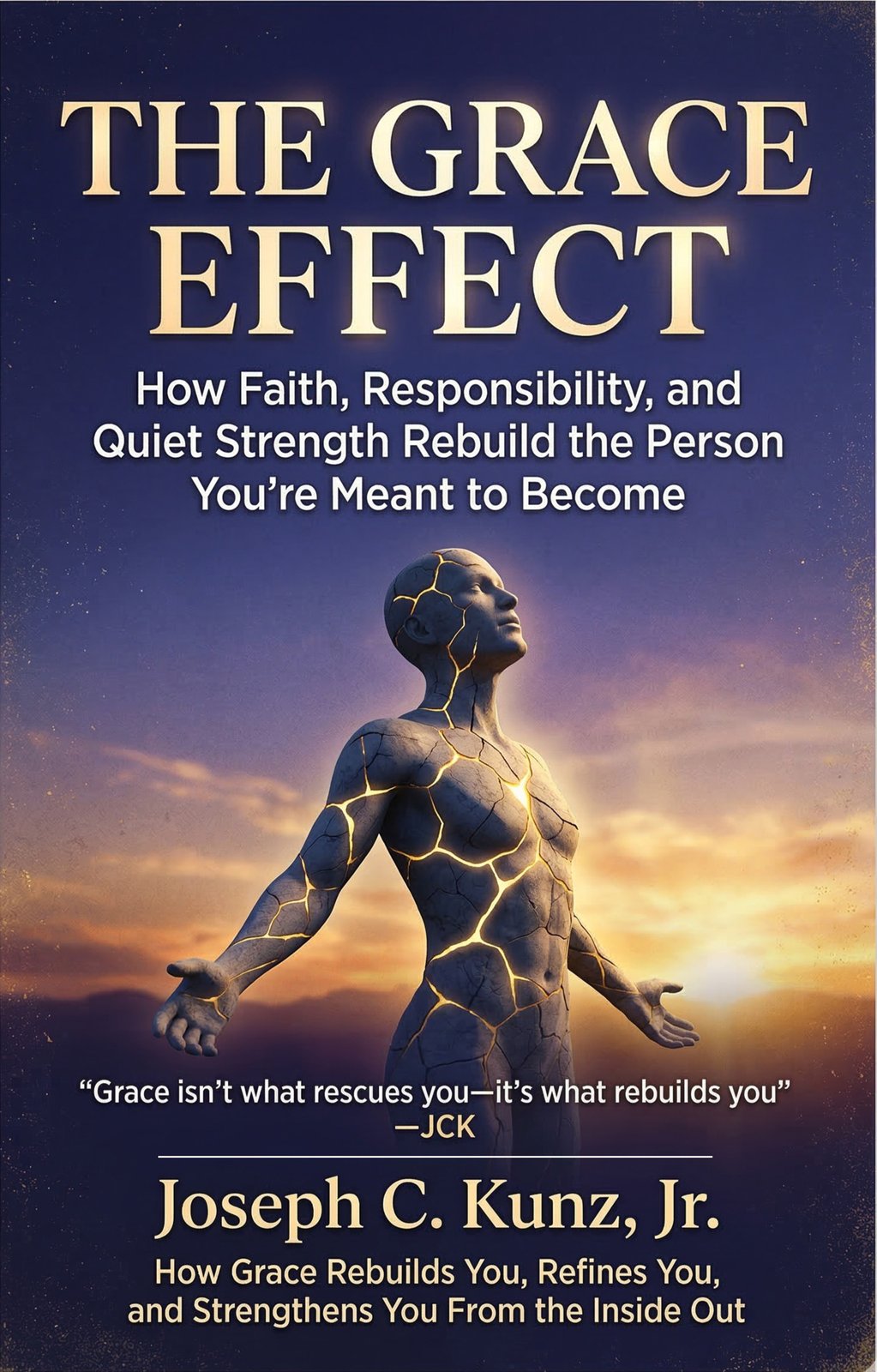
That’s what The Grace Effect is for. Not “religious vibes.” Not performance faith. Not a personality upgrade you post online. It’s a rebuild book — how grace produces backbone, how repentance becomes course correction, and how discipline stops being a slogan and starts being a standard you live under when pressure is high and nobody’s clapping.
If you’re tired of negotiating with your own conscience… If you’re tired of being “strong in public” and sloppy in private… If you want your witness to be real — not just loud…
Read The Grace Effect. Start rebuilding where it actually counts.
Stay tuned for the release of this book.