Humility in the Right Place, Words in the Right Order
Trust, influence, and lasting success are built not only by talent but by humility rightly placed and language rightly used. —Joseph C. Kunz, Jr.
How Character and Language Shape Trust, Influence, and Success
By Joseph C. Kunz, Jr.
Synopsis
This isn’t another soft sermon about “being humble” or a polished networking lesson about saying the right things to get ahead. In this essay, Joseph C. Kunz, Jr. argues that well-placed humility and disciplined language are not cosmetic traits but structural advantages. They shape how a person learns, leads, earns trust, carries responsibility, deepens faith, and builds a life that actually holds under pressure.
Kunz makes the case that humility, rightly understood, is not weakness, self-erasure, or false modesty. It is the disciplined refusal to make yourself the center of reality. He also argues that language is not merely a communication tool but a moral instrument—one that reveals character, clarifies thought, strengthens trust, and determines whether a person creates order or confusion wherever he goes. Across the four pillars of faith, responsibility, work and wealth, and legacy, he shows that men and women rise or fall not only by effort and intelligence, but by whether they can place themselves properly before truth and speak in a way that honors it.
The conclusion is simple: talent matters, but it is not enough. The people who build strong lives, stable families, lasting influence, and real success are usually the ones who have learned two rare disciplines—humility in the right place, and words in the right order.
Talent may open a door, but character decides whether people trust you inside the room—and language decides what happens after you enter it. —JCK
I. Introduction: The Things That Matter After Talent
We live in a culture that worships talent and then acts surprised when talented people become arrogant, unstable, hard to trust, or impossible to follow.
That is one of the strangest blind spots of modern life.
People spend years trying to become more impressive, more skilled, more connected, more marketable, more visible, more successful. But far fewer spend time learning how to carry strength without vanity, how to speak with precision without manipulation, or how to win without becoming insufferable. That is where a great deal of human failure begins. Not in the absence of ability, but in the absence of order.
Some people are gifted but not grounded. Others are driven but not teachable. Others are articulate but dishonest. Others are confident but sloppy with words, vague with commitments, allergic to correction, and blind to the damage they cause. They may still make money. They may still attract attention. They may still look impressive from across the room. But they often leave confusion behind them. They create friction in relationships, instability in business, noise in conversation, and distrust in the people closest to them.
That is because talent can carry a person only so far.
After that, deeper things take over.
Character takes over. Humility takes over. Language takes over. The ability to tell the truth takes over. The ability to admit error takes over. The ability to speak clearly, listen carefully, apologize honestly, negotiate calmly, set boundaries firmly, and carry oneself without theatrical ego—that is where life stops being a performance and starts becoming a structure.
A great many people want influence. Far fewer want the interior discipline required to carry influence without corrupting it.
A great many people want success. Far fewer want the moral seriousness required to keep success from hollowing them out.
A great many people want to be heard. Far fewer have done the work to make their words trustworthy.
That is why humility and language belong together.
Humility puts a man in right relation to reality. Language allows him to name reality accurately, respond to it wisely, and help others do the same.
When either one is missing, life gets distorted.
When both are present, a person becomes dangerous in the best sense of the word.
II. Humility in the Right Place: Not Smallness, But Order
Humility has been badly marketed.
Many people hear the word and think of weakness, passivity, uncertainty, timidity, or self-doubt. They imagine a person who shrinks himself, downplays his ability, avoids strong convictions, and constantly performs a kind of public modesty so other people will find him likable. That is not humility. That is often insecurity wearing a polite mask.
Real humility is much more serious than that.
Humility is not pretending to be less than you are. It is refusing to pretend you are more.
It is knowing what you know—and what you do not know. It is understanding your strengths without worshiping them. It is seeing your limits without collapsing under them. It is carrying your gifts as stewardship, not as a personal coronation.
A humble man can be strong. He can be ambitious. He can be disciplined. He can build, lead, correct, compete, and win. In fact, he often does those things better than the vain man, because he is not constantly burning energy protecting an image.
Vanity is expensive.
Vanity makes people defensive. Vanity makes them hard to teach. Vanity makes them exaggerate, posture, interrupt, overpromise, talk too much, refuse correction, and turn every disagreement into a threat to their identity.
Humility does the opposite.
Humility frees a person to learn because he does not need to look omniscient.
It frees him to apologize because he does not need to look flawless.
It frees him to ask questions because he does not need to look superior.
It frees him to listen because he does not need every room to orbit around him.
That is what I mean by humility in the right place. Not humiliation. Not self-negation. Not fake modesty. Order.
The self belongs in its proper place—not at the center of truth, not above correction, not beyond accountability, and certainly not in the seat reserved for God.
Once that order is established, strength becomes cleaner. Leadership becomes more trustworthy. Learning becomes faster. Relationships become more durable.
A man who has placed himself properly before truth becomes much harder to fool—including by himself.
III. Words in the Right Order: Language as a Moral Instrument
Language is one of the most underrated forces in human life.
People tend to think of words as wrappers for ideas, or tools for persuasion, or ways to pass information from one mind to another. They are that. But they are more than that. Language is also a revealer, a builder, a boundary-setter, a trust-former, and sometimes a destroyer.
The words a person uses do not merely express his thinking. Over time, they shape it.
A man who cannot name things accurately usually cannot deal with them honestly.
A man who lives in euphemism will often live in confusion.
A man who speaks vaguely will usually act vaguely.
A man who hides behind inflated language, manipulative tone, or carefully curated ambiguity is often trying to create escape routes for himself.
That matters.
Because clear speech is not just a communication skill. It is a character signal.
It tells people whether you are serious, whether you are reliable, whether you are hiding, whether you are bluffing, whether you can be trusted when things become difficult.
Consider the difference between these kinds of language:
“I made a mistake” versus “Mistakes were made.”
“I don’t know” versus pretending.
“That was my fault” versus endless explanation.
“No” versus a dishonest maybe.
“This is what I can do” versus inflated promises designed to impress.
Language reveals moral posture.
The disciplined use of language is not about sounding polished. It is about placing truth above impression management.
That is why words in the right order matter.
Not because eloquence is magic. Not because rhetoric is everything. But because a disordered mind eventually produces disordered speech, and disordered speech creates disordered lives.
Precise language creates clarity. Clarity reduces friction. Reduced friction increases trust. Trust increases influence. Influence, carried with integrity, becomes one of the most useful forms of power a person can possess.
IV. Faith: Humility Before Truth, Speech Before God
The first pillar is faith because faith answers the first and most serious question: what stands over me?
A person with no humility before God may still have opinions, rituals, moral instincts, political convictions, and strong preferences. But faith requires something far more demanding than that. It requires the surrender of the self’s imaginary throne.
You do not come to faith by crowning yourself wiser than truth.
You come to faith by recognizing that you are not self-created, self-explanatory, self-sufficient, or morally self-authorizing.
That is humility at the deepest level.
It is the recognition that reality is not built around your appetites, your preferences, your ego, or your private moral improvisation. It is the recognition that you answer to something higher, and that freedom only becomes meaningful when it is placed inside truth.
Without humility, spirituality often turns sentimental, performative, or self-designed. A man builds a god that never contradicts him, a morality that never costs him, and a faith that never requires obedience. That is not faith. That is self-approval in religious clothing.
Language matters here too.
How a man speaks about God, grace, sin, discipline, suffering, duty, and redemption reveals whether his inner life has any real structure. If his language about faith is always vague, therapeutic, borrowed, or fashionable, there is a good chance his faith is thin. Serious faith does not require constant public performance, but it does require clarity.
A man should be able to say what he believes, what he serves, what he refuses, and what he stands on when life gets hard.
Faith that cannot be named clearly is often faith that cannot be lived consistently.
Humility places the soul properly before God. Language helps a man confess, teach, encourage, correct, pray, and bear witness. Both matter. Neither is optional.
V. Responsibility: Accountability Has a Vocabulary
Responsibility is not an abstract virtue. It shows up in sentences.
That is one of the clearest facts in life.
Irresponsible people do not merely make irresponsible decisions. They usually speak irresponsibly too. Their language is evasive, inflated, slippery, defensive, foggy, and full of escape hatches. They leave everything just unclear enough that they can later deny what was said, what was promised, or what was owed.
Responsible people sound different.
They know how to say, “I was wrong.”
They know how to say, “I should have handled that better.”
They know how to say, “Here is the standard.”
They know how to say, “This is my responsibility.”
They know how to say, “No.”
They know how to say, “Enough.”
They know how to say, “I gave you my word.”
Responsibility requires humility because responsibility begins with reality. A proud person resists reality whenever it threatens his self-image. He explains instead of repents. He rationalizes instead of corrects. He talks around the issue instead of through it.
Humility cuts through that nonsense.
It allows a person to face the facts without theatrics. It allows him to receive correction without collapsing. It allows him to improve without turning every flaw into a crisis of identity.
And language gives responsibility its operating system.
Marriage depends on it. Parenting depends on it. Leadership depends on it. Friendship depends on it. Business depends on it. Self-government depends on it.
A house full of vague expectations becomes a house full of resentment. A business full of fuzzy commitments becomes a business full of rework, mistrust, and avoidable conflict. A life full of imprecise language becomes a life full of self-created chaos.
Responsibility has a vocabulary. The people who master it tend to become anchors instead of liabilities.
VI. Work, Wealth, and Influence: The Marketplace Rewards More Than Skill
The world of work is full of people who think competence alone should be enough.
In a perfect world, maybe. In the real one, no.
Competence matters. Skill matters. Intelligence matters. But the marketplace also rewards people who can be trusted, understood, negotiated with, followed, and believed. That is where humility and language become serious economic assets.
A humble professional learns faster because he can admit what he does not know.
He makes fewer expensive mistakes because he asks better questions.
He becomes easier to work with because he is not trying to dominate every interaction.
He gains credibility because he does not oversell himself.
He avoids the amateur habit of mistaking loudness for authority.
That matters in every field.
In sales, people buy trust before they buy product.
In leadership, people follow clarity before they follow charisma.
In negotiation, disciplined language prevents stupid concessions and emotional leakage.
In client service, accurate language prevents disappointment and conflict.
In business ownership, the ability to write, explain, present, frame, and persuade can turn ordinary competence into serious leverage.
Words carry value.
A man who can articulate value clearly has an advantage over a man with equal talent who cannot explain what he does, what problem he solves, or why anyone should trust him with money, responsibility, or opportunity.
This is where many gifted people quietly lose ground. They assume their work should speak for itself. Sometimes it does. Often it does not. In the real world, people need to understand you before they can fully trust you, and they need to trust you before they can fully reward you.
None of this means language should be used as a trick. I am not talking about manipulation, image management, or verbal cosmetics. I am talking about disciplined truthfulness made useful.
That is different.
Real influence is not built on cleverness. It is built on credibility.
And credibility is what happens when character and language agree.
VII. Legacy: Families Are Built Out of Repeated Words
Legacy is not only what you leave behind in assets, achievements, or reputation. It is also what you leave behind in language.
Every family has a vocabulary.
Every household has repeated phrases, named priorities, tolerated excuses, moral assumptions, emotional patterns, and spoken standards that become its culture. Children absorb them long before they know how to analyze them. Spouses live inside them. Generations are shaped by them.
Children do not merely inherit money, habits, or opportunities. They inherit a vocabulary for reality.
They inherit the words that teach them what matters, what is expected, what is forgiven, what is shameful, what is admirable, what is normal, and what is non-negotiable. A family is shaped not only by what it owns, but by what it repeatedly says is true, good, expected, and worth protecting.
Some homes are built out of drift, sarcasm, blame, avoidance, and vague values. Others are built out of gratitude, clarity, truth, standards, humor, forgiveness, loyalty, and repeated moral language that gives structure to the people inside the walls.
That does not happen by accident.
A legacy-minded man understands that words are part of inheritance. If he is humble, he becomes teachable enough to pass on wisdom instead of ego. He stops trying to look like a legend in his own house and starts trying to be useful. He becomes less concerned with appearing impressive and more concerned with transmitting principles that will hold when he is no longer there to speak them himself.
If he uses language well, he can name the family’s standards. He can repeat what matters. He can correct without crushing. He can encourage without flattering. He can pass on convictions in sentences his children and grandchildren will still remember years later.
Legacy depends on repetition.
What is honored gets strengthened.
What is tolerated gets normalized.
What is named gets clarified.
What is left unsaid often gets lost.
A family’s moral architecture is built, in part, through words in the right order.
Not grand speeches. Not endless lectures. Clear, repeated truths spoken consistently over time.
That is how inheritance becomes more than money.
That is how a man leaves structure behind.
VIII. Conclusion: Ordered Men Build Durable Lives
The older I get, the less impressed I am by talent that arrives with no discipline, no humility, and no command of language.
I have seen too many gifted people waste themselves through arrogance, vagueness, indiscipline, and verbal carelessness. I have seen too many smart people talk themselves into confusion, talk others into distrust, or sabotage relationships and opportunities because they never learned the disciplines that matter after talent.
Humility and language are two of those disciplines.
Humility, rightly placed, keeps a man teachable, grounded, accountable, and properly sized before reality. Language, rightly ordered, gives him the power to clarify, build trust, carry truth, create standards, lead people, make money, and leave something solid behind.
Together, they do something rare.
They make strength more trustworthy.
They make intelligence more useful.
They make influence cleaner.
They make success more stable.
And they make a life more capable of carrying weight.
That is not a small thing.
Because most of life is not won by being the flashiest person in the room. It is won by being the one people can trust when the room gets tense, when the facts get uncomfortable, when the stakes get real, and when the work must be done without vanity, confusion, or excuse.
That person usually does not need to announce his strength.
You can hear it in how he speaks.
You can see it in how he listens.
You can feel it in how little he needs to perform.
You can trust it because it is ordered.
The truth is simple.
A disordered ego and careless speech can waste an enormous amount of talent. But humility in the right place, and words in the right order, can turn ordinary ability into extraordinary credibility.
And credibility—earned slowly, carried cleanly, and backed by character—is one of the most valuable forms of success a human being can possess.
Real influence begins when ego is put in its place and language is put to work in service of truth. —JCK
Related Essays: For the Reader Who Knows Talent Alone Is Not Enough
If this essay sharpened your thinking, these will take you deeper into the disciplines that make strength trustworthy.
1. Clarity Is Strength: The Words That Build (or Break) a Life A serious look at how language shapes thought, relationships, authority, and self-command—and why sloppy words usually reflect a sloppy inner life.
Reader Comment: This one made me realize that confusion in my life was not always bad luck—sometimes it was the result of weak thinking and weaker words.
Quote: Clear words do more than communicate thought—they reveal whether a man has done the work to think straight in the first place. —JCK
2. The Apology Gap An honest examination of why so many people resist admitting fault—and how the ability to apologize cleanly is one of the clearest signs of maturity, humility, and strength.
Reader Comment: This essay hit hard because it exposed how often pride disguises itself as explanation, defensiveness, or silence.
Related Book: Stop Chasing Impressive. Start Becoming Unshakable.
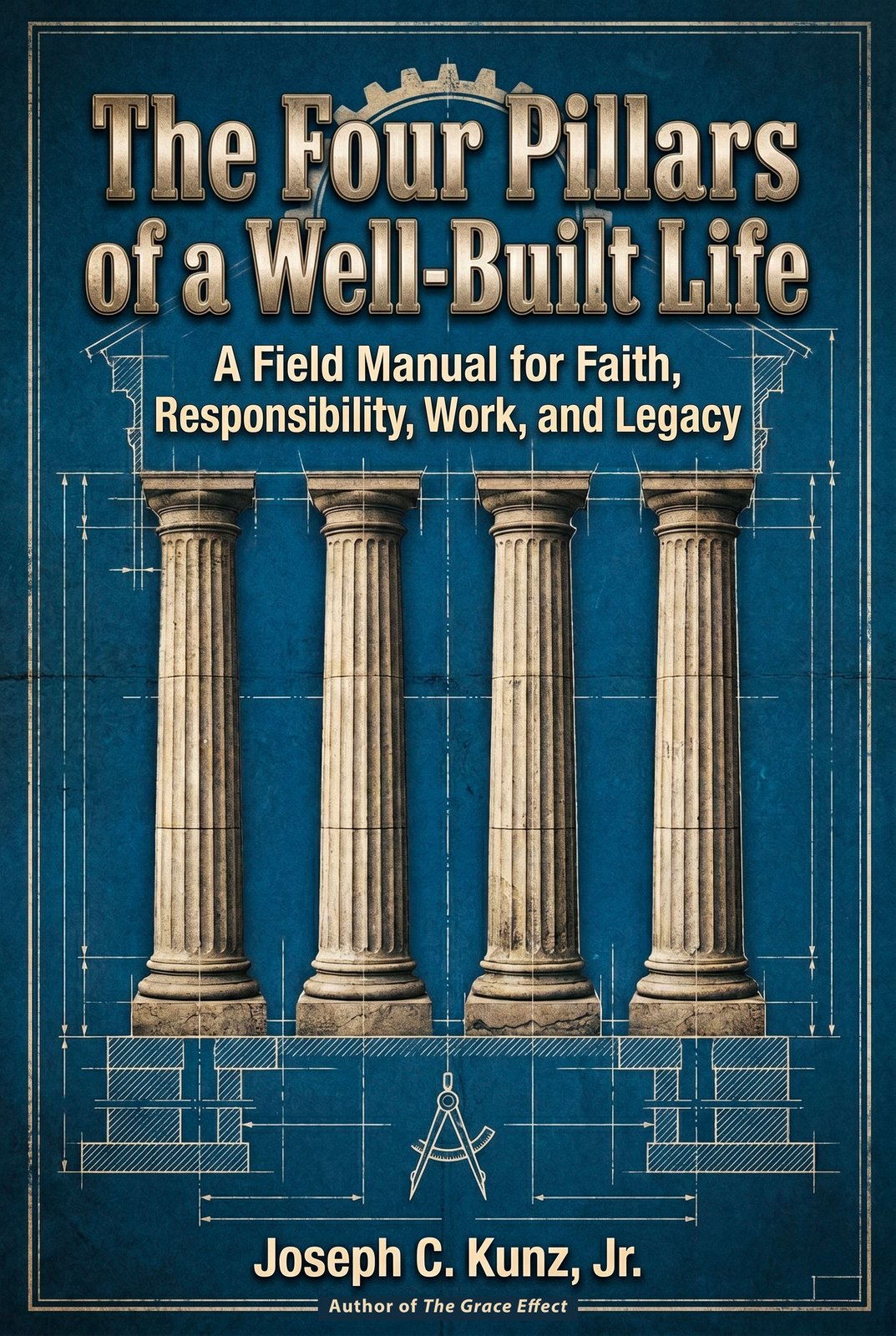
The Four Pillars of a Well-Built Life
Talent can make people notice you. It can get you in the room, win you applause, and even make you money. But talent alone will not make you trustworthy. It will not make you grounded. It will not make you the kind of man your family can lean on, your work can be built on, or your conscience can live with when the noise dies down and the truth finally shows up.
That kind of life is built differently.
The Four Pillars of a Well-Built Life is not about polishing your image or collecting motivational fluff like a grown man with a drawer full of inspirational refrigerator magnets. It is about building the inner structure most people never build—faith that steadies you, responsibility that matures you, work and wealth that serve something higher, and legacy that leaves more than memories behind. Because the world does not need more talented wrecks with clever mouths and fragile egos. It needs men and women whose lives can actually carry weight.
If something in this essay hit you in the chest, don’t shrug it off and go back to drifting.
Step into The Four Pillars of a Well-Built Life and start building the kind of life people can trust when it matters most.
In Progress. Worth the Wait.