Faith Isn’t a Feeling — It’s a Discipline
Faith isn’t a vibe or a badge—it’s a load-bearing discipline your family, work, and legacy quietly rely on. —Joseph C. Kunz, Jr.
How Self-Government Turns Belief Into Backbone
By Joseph C. Kunz, Jr.
Synopsis
This isn’t a sentimental essay about “having faith” or finding a spiritual mood that makes life feel easier. In this essay, Joseph C. Kunz, Jr. argues that modern life trains people to treat faith like an emotion—something you feel when conditions are right—rather than a disciplined standard you live under when conditions are hard. When faith is reduced to vibes, inspiration, or public identity, it becomes fragile: it disappears the moment stress rises, fatigue hits, or comfort starts negotiating with conscience.
Kunz makes the case that faith is a form of self-government—a repeatable practice that shows up as truth-telling, restraint, repentance (course correction), and consistency when nobody is clapping. This isn’t about earning God’s approval—it’s about building a life that doesn’t collapse when feelings change. He explains why “performance faith” collapses under real pressure, how moral drift happens through small exemptions and rationalizations, and why discipline is the difference between a belief you admire and a life that actually holds.
The conclusion is simple: faith isn’t proven in big moments—it’s proven on Tuesday morning, when you don’t feel inspired but you still keep the standard. Because discipline is how belief becomes backbone—and backbone is what your family, your work, and your legacy quietly depend on.
Discipline is how belief becomes backbone. —JCK
I. Introduction: Tuesday Morning Faith
Feelings make terrible leaders
Most people don’t lose faith because they become atheists.
They lose faith because they treat faith like a feeling—then they wake up one morning and the feeling is gone.
Feelings are useful… but they’re terrible leaders. They spike, they dip, they exaggerate, they lie when you’re tired, and they negotiate when you’re tempted. And modern life is basically a full-time factory built to manufacture feelings—outrage, envy, fear, lust, distraction, approval-seeking—then sell you “relief.”
Here’s the part we don’t like admitting: I know how easy it is to confuse a spiritual dip with spiritual failure—especially when you’re tired and life is loud. When the calendar is stacked, your patience is thin, and the world is doing everything it can to keep you reactive, you start believing the lie that “I’ll get serious again when I feel better.”
But that’s backwards.
If your faith depends on a certain emotional temperature—calm, inspired, uplifted, confident—you’re building on quicksand. Because life doesn’t stay calm long enough for that strategy to work.
Tuesday morning is the test
Real faith shows up on Tuesday morning:
When the day is boring, heavy, inconvenient, or messy. When you’re not “in the mood.” When you don’t feel brave. When your patience is thin and your ego is loud. When the easiest move is to lower the standard just a little.
That’s the real test. Not the big moment. The daily moment.
Because faith isn’t primarily something you feel. It’s something you practice.
Discipline makes freedom repeatable
And here’s the paradox most people miss: discipline sounds restrictive… until you realize it’s the only thing that makes freedom repeatable. You don’t need more religious emotion—you need a standard that holds when life gets loud.
II. The Lie We’ve Been Sold About Faith
A. We’ve turned faith into vibes
A lot of us have been trained to treat faith like an internal sensation: a warm spiritual glow, a strong “sense,” a rush of confidence, a peaceful mood. When it’s there, you feel “connected.” When it’s gone, you feel broken.
1. Feel it = “I’m close to God”
When life is smooth, the bills are paid, the relationships are calm, your body feels good, your mind is clear—faith feels easy. It’s like breathing at sea level.
a. The problem: easy faith doesn’t prove anything
Easy faith can be real, sure. But it’s not tested. It hasn’t had to carry weight.
A bridge doesn’t prove itself when nobody drives on it. It proves itself under load.
And this is where people get fooled: they confuse consolation with conviction.
A lot of people don’t want faith—they want relief. And relief feels like faith until it doesn’t.
2. Don’t feel it = “Something’s wrong with me”
Then pressure hits. You’re tired. You’re stressed. You’re overstimulated. And suddenly you don’t “feel spiritual.” So, you assume you’re drifting—or worse—you assume faith is fake.
a. This creates a fragile faith that collapses under normal life
Not tragedy. Not catastrophe. Normal life.
You stop practicing because you don’t feel it. Then you feel worse because you stopped practicing. Then you call that spiral “losing faith.”
That’s not losing faith. That’s confusing faith with mood.
Here’s a cleaner rule: feelings are data, not directives.
They tell you what’s happening inside you. They do not get to vote on what is right.
B. We turned faith into performance
The second lie is just as common: faith as a public identity badge. Something you announce, signal, defend, post, argue, or display.
1. Public faith, private chaos
A man can talk like a man of faith while living like a man ruled by impulse. He can have the language and lack the discipline.
a. Performance is cheap; integrity is expensive
Performance costs you nothing when nobody can see behind the curtain.
Integrity costs you something—especially when it forces you to admit, “I was wrong,” or “I’m drifting,” or “I need to fix this.”
And if we’re being honest: every man who talks about standards must watch his own blind spots. It’s easy to preach clarity and still excuse yourself. It’s easy to admire discipline and still avoid it in the moments that count.
2. The danger: your private life always collects the bill
A man can “believe” all the right things and still be unstable, reactive, addicted, dishonest, or irresponsible.
a. Faith-without-discipline becomes a costume
And costumes don’t carry weight.
They look good—until real stress hits.
Then you find out what’s actually in the structure.
Performance faith lets you borrow a reputation you haven’t earned in private. But private life always calls the loan.
III. What Faith-as-Discipline Actually Means
A. Discipline is decisions you make before emotions vote
A Builder doesn’t wait for the right mood to do the right thing. Because moods are unreliable—especially in a world designed to hijack them.
Discipline is how you stop being governed by appetite, ego, and comfort.
It’s self-government.
And here’s the important clarification, so nobody misunderstands me: discipline isn’t how you earn grace. Discipline is what grace makes possible. Grace doesn’t erase standards—it powers them. It doesn’t remove consequences—it gives you the strength to face them without becoming bitter inside them.
1. Faith is not what you claim—it’s what you practice
Faith is what you do when:
• it’s inconvenient,
• it costs you pride,
• it exposes you,
• and nobody applauds.
Discipline isn’t intensity. It’s pre-commitment.
It’s the decision you made yesterday that protects you from the man you can become today.
a. Faith shows up as truth-telling (reality alignment)
Truth-telling is not just “not lying.” It’s refusing to manipulate reality to protect your ego. It’s not hiding behind technicalities. It’s not rewriting the story so you always look like the victim or the hero.
Truth ends the double life.
Truth is the start of freedom because lies always require maintenance.
Truth protects Family because a home can survive many things, but it can’t survive a man who won’t be honest.
b. Faith shows up as restraint (self-control)
Restraint is the lost virtue of our time. People call it repression. Builders call it strength.
A disciplined man can say no:
• to anger that wants to speak first,
• to cravings that want to rule,
• to spending that wants to impress,
• to lust that wants to cheapen love,
• to shortcuts that want to buy speed with integrity.
Restraint isn’t small. It’s foundational. Restraint protects love from appetite.
And restraint is one of the clearest ways Faith serves Work and Legacy: it keeps you from building a life you’ll later have to apologize for.
c. Faith shows up as repentance (course correction)
Repentance isn’t groveling—it’s course correction.
It’s the moment a man stops defending himself and starts governing himself.
Repentance says:
• “I own it.”
• “I don’t excuse it.”
• “I’m changing direction.”
That’s not weakness. That’s leadership—of your own soul.
Repentance restores authority. Not over other people—over yourself.
d. Faith shows up as consistency (repeatability)
Most people don’t fail because they lack intensity. They fail because they lack repeatability.
Consistency is what turns belief into an actual life.
If faith only appears in bursts, it becomes a hobby—something you visit when convenient—not a standard you live under.
Consistency is what builds trust. And trust is the invisible infrastructure of Family, Work, and Legacy.
IV. The Builder’s Version of Faith
A. Faith is not a poster — it’s a load-bearing beam
Builders don’t decorate problems; they reinforce structures.
Faith isn’t a slogan you put on the wall. It’s a beam that holds up…
• your marriage when you feel selfish,
• your parenting when you’re exhausted,
• your business when you feel afraid,
• your character when nobody’s watching.
A standard isn’t a vibe. It’s a guardrail.
1. Faith holds your life steady when your emotions aren’t qualified to drive
Here’s the truth: when you’re tired, stressed, hungry, lonely, or angry—your emotions start negotiating.
a. Faith keeps you from “being yourself” in the worst way
People say, “I’m just being real.”
Sometimes “real” is just undisciplined.
Faith-as-discipline is the refusal to let your lowest impulses define your identity.
It’s the refusal to hand your steering wheel to the part of you that only wants relief.
Career Predicament: A guy I know—good man, hard worker—had a week where everything hit at once. A client delayed a payment. His kid needed something expensive. His wife was stressed. He felt disrespected at work. And he started telling himself the old lie: I deserve a break. Not a vacation break—a moral break.
He was tempted to “adjust” an invoice. Not enough to look criminal. Just enough to “make it fair.”
He even had a speech ready: They would do it to me. This is business.
But here’s what stopped him: not a feeling. Not inspiration. A standard.
He imagined explaining it to his kids someday—how he handled pressure—and he couldn’t do it without hearing his own excuses out loud.
So, he didn’t take the shortcut. He took the hit.
And he walked out of that week with something better than extra money: self-respect.
That’s faith-as-discipline. Quiet. Unapplauded. Structural.
2. Without faith-as-discipline, you improvise morality
You don’t wake up and decide to become corrupt. You become flexible.
a. Flexible morality is the slow collapse of good men
Good men don’t usually fall with a crash. They drift with a thousand small exceptions:
• “Just this once.”
• “I deserve this.”
• “They started it.”
• “Nobody will know.”
• “I’ll fix it later.”
That’s how standards die—quietly.
And once your standard becomes negotiable, your life becomes exhausting—because now every temptation becomes a debate. Discipline removes decision fatigue. That’s one reason it feels like freedom.
B. Faith disciplines the man before it ever blesses the man
This is the part modern people hate: faith doesn’t exist to pamper you.
1. Faith is not primarily comfort—it’s formation
Comfort isn’t the enemy. But comfort cannot be the foundation.
a. Good news: discipline gives stability you can actually trust
Because feelings change.
Circumstances change.
Other people change.
But a disciplined standard creates a man you can build on—especially in the storm.
And that’s the kind of man Family can exhale around, Work can rely on, and Legacy can inherit.
V. A Builder’s Rule of Life
Builders don’t rely on inspiration. They rely on a rule—simple enough to repeat, strong enough to hold.
In the morning, you set the standard: Who am I today, and what am I refusing?
Midday, you check for drift: Where am I rationalizing?
At night, you audit without excuses: What did I justify?
And weekly, you reset: confession, correction, recommitment.
That’s not a self-improvement routine. That’s self-government—because a man without a rule lives under his moods, and everyone around him pays for it.
VI. Four Pillars Tie-In
A. Faith disciplines the man
Faith is the internal government that prevents you from being ruled by impulse. It produces a man who is steady—especially when life isn’t.
B. Family receives the benefit
Your family doesn’t need a perfect man. They need a stable man. A man who:
• tells the truth,
• controls his tone,
• owns his mistakes,
• keeps promises,
• and doesn’t make everyone live under his moods.
Kids don’t inherit your speeches. They inherit your standards.
C. Work gets refined
Faith-as-discipline cleans up work:
• less ego,
• less shortcut thinking,
• less self-justification,
• more stewardship,
• more long-game integrity.
You stop asking, “How do I win today?”
And start asking, “What am I building that will still be true in ten years?”
D. Legacy becomes transferable
Legacy isn’t your opinions. Legacy is your patterns.
If your faith is disciplined, your kids inherit something valuable:
• a model of self-government,
• a framework for course correction,
• a standard they can live under,
• and a spine they can borrow until they grow their own.
VII. Conclusion: The Standard That Holds
Faith-as-discipline isn’t about looking religious. It’s about becoming reliable.
Most men don’t need more information. They need a stronger internal government. Because life will keep offering the same trade: lower your standard and get immediate relief—or keep your standard and earn something better: peace you can trust, self-respect you can live with, and a life that doesn’t require hiding.
That’s why feelings can’t be in charge. Feelings are weather. Standards are structure. And structure is what holds when pressure hits—at home, at work, and in your own mind.
Faith isn’t proven in the big moment. It’s proven in the small ones: when you tell the truth instead of spinning, when you restrain yourself instead of indulging, when you course-correct instead of defending, when you stay consistent instead of disappearing until the mood returns.
That’s Faith disciplining the man. That’s Family receiving the benefit. That’s Work getting refined into stewardship. That’s Legacy becoming transferable—because your kids won’t inherit your intentions; they’ll inherit what you repeat.
If your faith needs perfect conditions, it isn’t faith—it’s comfort. —JCK
Related Essays: If You’re Ready to Turn This into a Daily Standard
If this essay woke you up, these two will help you stay awake—with clarity, spine, and repeatable self-government.
1. Faith Isn’t a Theory — It’s Training
Faith isn’t mainly an idea you defend—it’s training that builds endurance, restraint, courage, and integrity when life gets hard.
Reader Comment: This one felt like a gut-check—in a good way. It made “faith” feel less like talk and more like a workout plan for the soul.
2. Stop Pointing at Them. Start Looking in the Mirror. Cultural decay doesn’t get reversed by outrage—it gets reversed by repentance, self-government, and the hard work of moral responsibility at home.
Reader Comment: I stopped blaming “the system” after reading this—because I realized I was using the world’s failures to excuse my own drift.
Quote: The first battlefield isn’t politics—it’s the human heart. —JCK
Related Book: Stop Waiting for a Feeling. Start Living Like a Man.
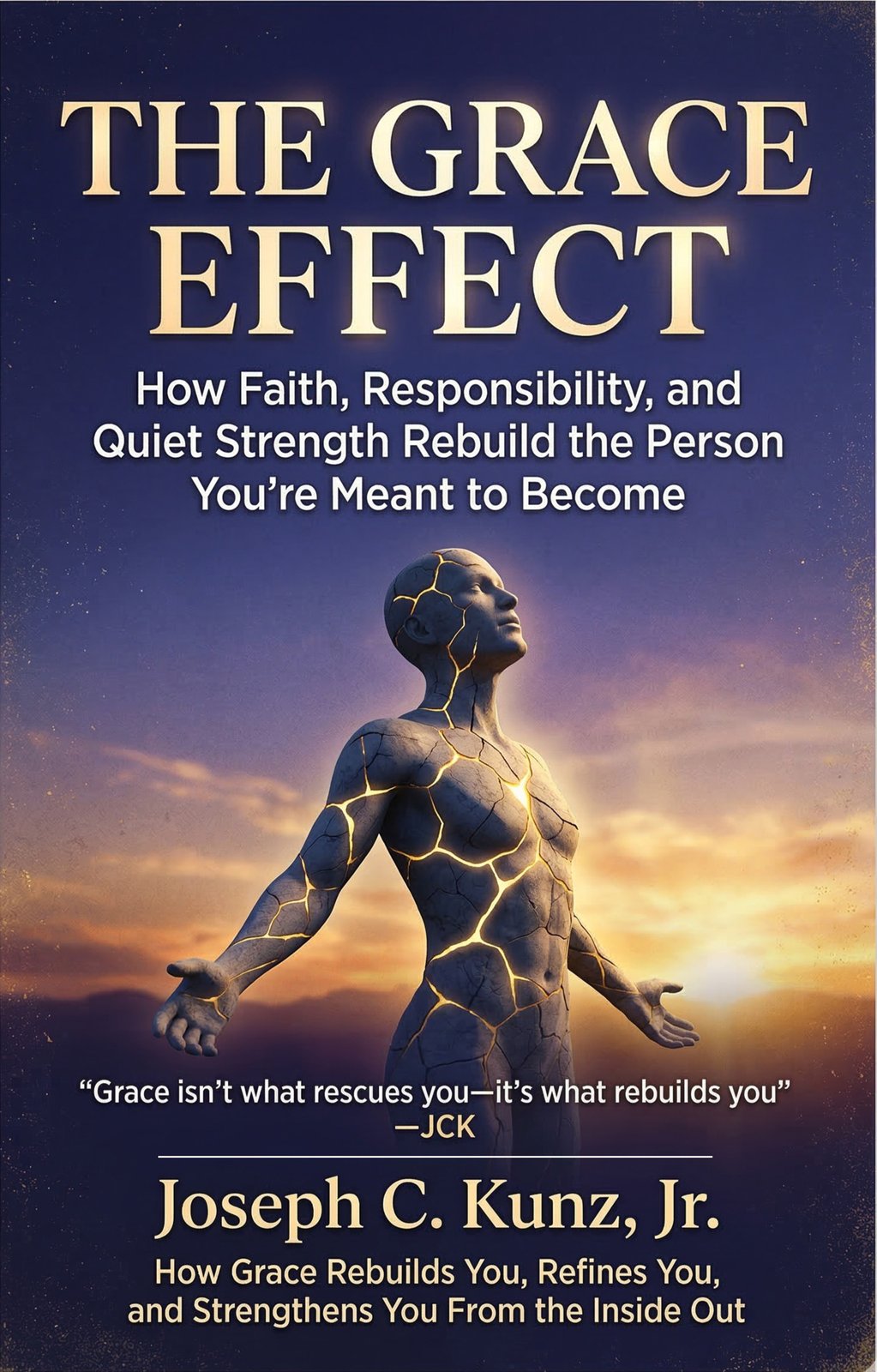
You don’t need another spiritual mood swing. You don’t need another “I’ll get serious when life calms down.” Life doesn’t calm down. It just changes costumes.
That’s why this essay—Faith Isn’t a Feeling — It’s a Discipline—matters. Because the men who win at what matters aren’t the ones who feel the most. They’re the ones who keep a standard when their emotions are throwing a tantrum in the back seat.
And here’s the loving part nobody says out loud anymore: Your family doesn’t need your theories. They need your stability. Your work doesn’t need your intentions. It needs your integrity. Your legacy doesn’t need your speeches. It needs your repeatable actions.
The Grace Effect isn’t a “be nicer” book. It’s a backbone book. Grace doesn’t erase standards—it powers them. It doesn’t remove consequences—it gives you the strength to face them without becoming bitter inside them.
If you’re tired of drifting, tired of negotiating, tired of living under your moods—stop scrolling and start building.
Forthcoming. Stay tuned.