Faith Isn’t a Crutch — It’s a Competitive Edge
Faith isn’t weakness—it’s raw fuel for clarity, resilience, and the strength to win where others stall out. —Joseph C. Kunz, Jr.
Why Faith Makes You Sharper, Stronger, and More Unstoppable in Life and Business
By Joseph C. Kunz, Jr.
Synopsis
This is not an essay about sentimental religion, emotional comfort, or using faith as a way to avoid hardship, pressure, or reality. In this essay, Joseph C. Kunz, Jr. challenges a modern assumption that treats faith as weakness and dependence. He argues the opposite: rightly lived, faith is not a crutch but a competitive edge—an inner source of clarity, steadiness, endurance, and discipline that gives a person strength where others lose their footing.
Kunz makes the case that faith provides advantages the modern world often misreads or ignores. It steadies the mind when conditions become uncertain, gives meaning to effort when results are delayed, and turns setbacks from dead ends into formation. He shows how faith sharpens judgment, checks ego, strengthens humility, and helps people endure long stretches of difficulty without collapsing into panic, bitterness, or drift. The essay also draws a contrast between faith and the hollow substitutes people often rely on instead—raw ambition, self-reliance, hustle culture, or emotional willpower—arguing that these can produce movement for a while, but rarely the kind of durable strength needed for business, leadership, marriage, or legacy.
The conclusion is simple: faith does not make a person softer or less capable—it makes him steadier, stronger, and harder to break. In a culture addicted to shortcuts, noise, and performance, faith becomes an edge because it gives a person what pressure reveals and shallow confidence cannot fake: inner structure, resilience, and the ability to keep building when others stall out.
Faith isn’t weakness—it’s raw fuel for clarity, resilience, and the strength to endure when others falter. —JCK
I. Introduction: The Lie Modern People Tell About Faith
One of the laziest lies modern culture tells is that faith is for weak people.
It is treated like a psychological prop, an emotional safety blanket, or a private superstition for people who cannot handle the real world on its own terms. The strong, we are told, rely on logic, leverage, credentials, networks, hustle, and force of personality. Faith belongs to the soft, the fearful, the unsophisticated, the people who need something extra to get through the day.
That lie sounds intelligent right up until real pressure shows up.
Because pressure reveals what slogans hide. It exposes whether a person has any inner ballast or whether he has simply built his life on adrenaline, ego, self-belief, and surface-level competence. A lot of people look strong when business is good, relationships are smooth, health is stable, and momentum is on their side. But when the season turns—when the money slows, the diagnosis lands, the rejection comes, the betrayal cuts, the marriage gets strained, the results disappear, or the silence stretches longer than expected—suddenly the difference between performance and substance becomes impossible to miss.
That is where faith shows its real power.
Faith is not an escape from reality. It is what enables a person to face reality without fragmentation. It does not remove pain, but it changes what pain does to you. It does not make hardship disappear, but it gives hardship meaning. It does not guarantee winning on your timetable, but it strengthens you to keep showing up when the timetable breaks.
That is why I call faith a competitive edge.
Not because it makes life easier. Because it makes a person steadier.
And in business, in leadership, in family life, and in every long struggle that tests a human being, steadiness is not softness. It is power.
II. Faith as Mental Strength
Let’s begin with something practical: faith strengthens the mind.
Not by making it passive. By making it stable.
A man without faith is often at the mercy of whatever is happening around him. His internal weather follows external conditions. If people praise him, he feels strong. If results come quickly, he feels capable. If the numbers go his way, he feels secure. But if the market turns, the pressure rises, the criticism lands, or the progress slows, his mental footing starts to slip because he built too much of his interior life on outcomes he never fully controlled.
Faith interrupts that fragility.
It gives a person a deeper frame than circumstances. It says that effort still matters when applause disappears. That discipline still matters when progress is slow. That meaning is not erased by delay. That silence is not the same thing as abandonment. That unseen work still counts.
This is not mystical fluff. It is mental architecture.
Faith keeps a person from overreacting to every swing in the environment. It slows panic. It tempers ego. It prevents desperation from becoming decision-making. It gives the mind somewhere to stand when everything outside feels unstable.
That matters in business. That matters in marriage. That matters in leadership. That matters when life gets long and hard.
Because one of the greatest advantages any person can have is not brilliance, speed, or charisma. It is the ability to remain clear-headed when others get noisy, frantic, emotional, or defeated.
Faith helps produce that clarity.
It reminds you that you are not God. That your control is limited. That your duty is still real. That your job is obedience, steadiness, and endurance—not omnipotence.
That kind of perspective protects people from mental chaos. And mental chaos destroys more lives than lack of talent ever will.
III. Faith Turns Obstacles Into Formation
Every person suffers. Every builder gets hit. Every life worth living eventually runs through seasons that feel unfair, exhausting, confusing, or brutal.
The question is never whether you will face resistance. The question is what resistance will do to you.
Without faith, obstacles often feel random, humiliating, and final. They become evidence that life is against you, that your effort was wasted, or that the pain means you are losing. A man in that state becomes bitter, reactive, and smaller. He either hardens into cynicism or collapses into discouragement. He may keep functioning for a while, but inwardly he begins to hollow out.
Faith changes that interpretation.
It does not pretend pain is pleasant. It does not slap a cheap slogan on suffering. It does not call evil good.
But it does insist that hardship can form you instead of merely defeating you.
That is a massive advantage in life.
A person with faith learns to ask different questions in difficulty: What is this season teaching me? What weakness is this exposing? What false dependence is this stripping away? What kind of person am I being forced to become? How do I remain faithful here instead of just resentful?
Those are formation questions.
And people who ask formation questions come out of hard seasons different. Stronger. Deeper. Less naïve. Less arrogant. Less dependent on easy outcomes to feel stable. They do not merely survive adversity. They are refined by it.
That refinement matters because most real success—whether in business, marriage, parenting, healing, or legacy-building—requires the ability to suffer without falling apart.
Faith helps a person do that.
It teaches humility, because it reminds you that you are limited. It teaches patience, because it forces you to live without immediate resolution. It teaches endurance, because it tells you that a delayed result is not a meaningless one. It teaches perspective, because it pulls your eyes off the moment and places them back on the larger structure of your life.
That is not weakness. That is maturity under pressure.
IV. Faith Checks Ego and Strengthens Discipline
There is another reason faith is such an edge: it makes a person harder to corrupt from the inside.
A lot of talented people do not fail because they are weak in ability. They fail because they are ungoverned in ego.
Success magnifies what is already there. Give an undisciplined man momentum, money, status, or applause, and you often intensify the very flaws that will eventually ruin him. Pride gets louder. Gratitude gets thinner. Impulse gets stronger. Self-trust starts to mutate into self-worship.
Faith pushes back against that.
Faith reminds a person that gifts are not self-created. That success is not self-explaining. That ability is real, but not ultimate. That power without humility becomes dangerous fast.
This is one reason faith produces better discipline over time. A faithful person has a reason to govern appetite, ego, anger, greed, lust, vanity, and self-deception. He is not merely trying to optimize performance. He is trying to become the right kind of man.
That is a much stronger motive.
Because discipline based only on ambition eventually cracks when ambition is frustrated. But discipline rooted in conviction lasts longer. It survives slow seasons. It survives obscurity. It survives disappointment. It survives the kind of long obedience that shallow self-help culture cannot sustain.
Faith trains a person to do the next right thing even when it is boring. Even when nobody sees it. Even when it costs something. Even when the reward is delayed.
That habit becomes a real advantage.
In business, it means you do not panic and flail every time results fluctuate. In marriage, it means you stay faithful when emotions cool and responsibility gets heavier. In leadership, it means you make harder, cleaner decisions because you are less addicted to approval. In private life, it means you are becoming somebody with inner order instead of impressive chaos.
That kind of person is rarer than most people think.
And rarity has value.
V. The Real Edge: Faith Outlasts the Alternatives
Here is the deeper truth:
Most of the alternatives to faith work for a while.
Ambition works for a while. Adrenaline works for a while. Charm works for a while. Talent works for a while. Anger works for a while. Ego works for a while. Hustle works for a while. Even self-belief works for a while.
But many of those systems collapse when life stops cooperating.
Ambition becomes exhaustion. Adrenaline becomes burnout. Charm becomes manipulation. Talent becomes entitlement. Anger becomes poison. Ego becomes blindness. Hustle becomes emptiness. Self-belief becomes panic the moment the self no longer feels strong enough.
Faith outlasts those systems because faith is not built on emotional momentum. It is built on deeper allegiance, deeper meaning, and deeper order.
That is why faithful people can endure long seasons where external proof is scarce. They are not powered only by immediate reinforcement. They can keep building in obscurity. They can keep working through disappointment. They can keep loving through difficulty. They can keep leading through fatigue. They can keep believing while the visible returns are still taking their time.
That is an edge.
And not just in some abstract spiritual sense.
It is an edge in how you think. How you recover. How you judge risk. How you handle rejection. How you treat people. How you endure pressure. How you respond when the world does not clap for you.
People without inner structure are often impressive right up until the season changes.
Faith gives you structure that the season cannot easily take away.
VI. Conclusion: Faith Is Not the Crutch. It’s the Advantage
So let’s say it plainly:
Faith is not a crutch for weak people.
It is one of the deepest sources of strength a person can possess.
It sharpens judgment because it clears out panic and ego. It strengthens resilience because it gives pain meaning. It deepens discipline because it roots behavior in conviction, not mood. It builds endurance because it teaches a person to keep going when the visible rewards disappear.
That does not make faith easy. It makes faith powerful.
And in a culture obsessed with shortcuts, appearances, self-promotion, and immediate results, that kind of power is easy to misunderstand. People confuse noise for strength and self-assertion for mastery. But life has a way of sorting all of that out. Pressure eventually reveals who has substance and who has branding.
Faith produces substance.
Not perfect people. Not pain-free people. Not passive people.
Steadier people. Clearer people. More governable from within and less manipulated from without. People who can take a hit without losing themselves. People who can endure a drought without worshiping despair. People who can keep building when everybody else needs constant applause to stay in motion.
That is why faith is an edge.
Not because it exempts you from hard reality, but because it equips you to face hard reality without coming apart.
And in life, in business, in leadership, and in legacy, that may be one of the most practical advantages a person can have.
Faith isn’t about escaping reality—it’s about facing it with a steadiness that pressure cannot extinguish. —JCK
Related Essays: For Those Who See Faith as Fuel, Not a Weakness
If this essay struck a chord, these will dig even deeper into how faith becomes resilience in action.
1. Why Your Faith Should Make You Unshakable, Not Unlikable
Real faith builds calm confidence and strength—not arrogance or hostility.
2. God Never Promised Me Comfort, But He Did Promise Meaning
Faith doesn’t erase hardship—it transforms it into purpose and endurance.
Reader Comment: This essay helped me see that struggles aren’t proof of God’s absence—they’re where His meaning shows up.
Related Book: Grace Is What Carries You When Nothing Else Will
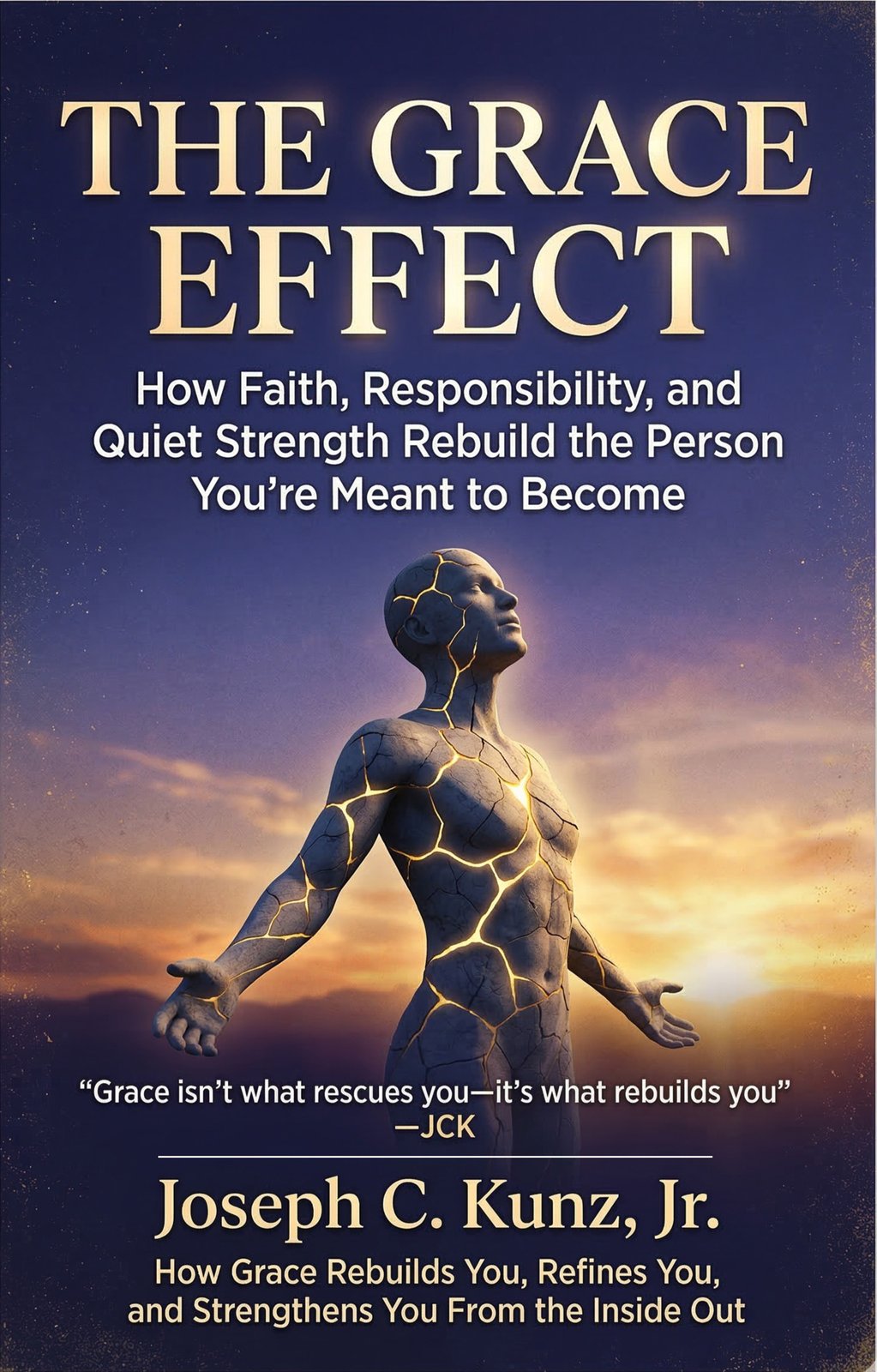
The Grace Effect
When life knocks you flat, talent won’t save you. Money won’t comfort you. Even grit has limits. What carries you through the dark nights, the hard losses, the moments when you’re not sure you can take another step? Grace.
The world misunderstands grace. They see it as soft, fragile, passive. But real grace is anything but. Grace is strength with restraint. It’s power under control.
It’s the steady hand that keeps you from breaking when the weight of life feels unbearable.
The Grace Effect isn’t about living an easy life—it’s about living a meaningful one. It’s for the men and women who are tired of noise, shallow victories, and chasing things that don’t last.
It’s for those who want something deeper: purpose, resilience, and a way of living that stands firm when everything else collapses.
If you’ve ever wondered how to keep going when most people quit, how to stay steady when life shakes you to your core, this book will show you the way.
Discover The Grace Effect — because true strength doesn’t come from shouting louder, but from standing taller when the world tries to knock you down.
Release announcement coming.