Civilization Is Not Rebuilt from an Office
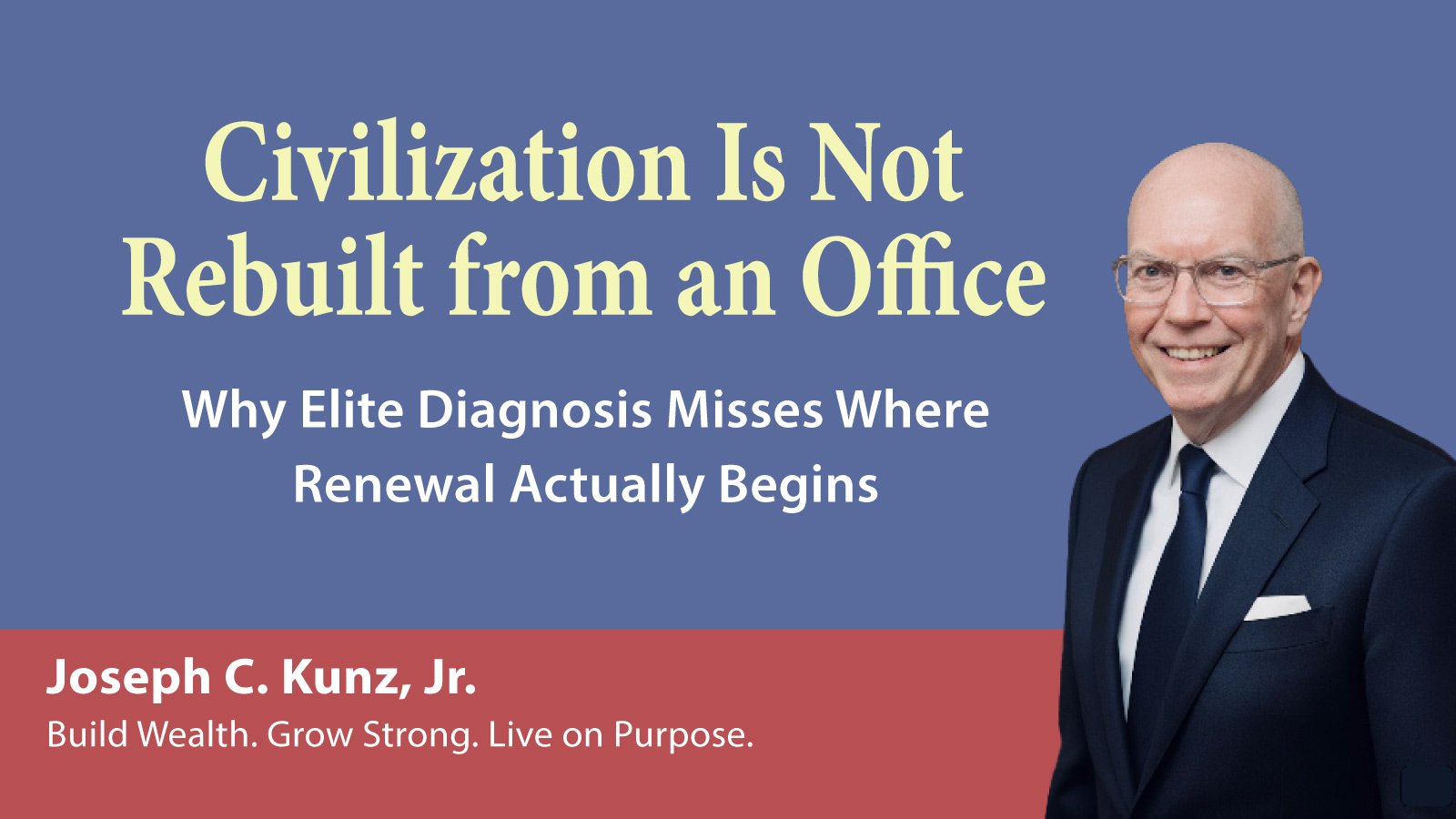
Civilization does not collapse because too few elites sound the alarm. It collapses when too few ordinary people keep living the truth. —Joseph C. Kunz, Jr.
Why Elite Diagnosis Misses Where Renewal Actually Begins
By Joseph C. Kunz, Jr.
Synopsis
This isn’t another populist rant against intellectuals, nor is it a sneer at serious cultural diagnosis. In this essay, Joseph C. Kunz, Jr. argues that many elite critiques of civilizational decline are strongest at the level of lament and weakest at the level of repair. They identify real decay—moral confusion, institutional corruption, spiritual drift—but often describe it from such altitude that they miss the places where renewal actually begins: the soul, the home, the church, the work ethic, the habits of self-government, and the daily disciplines of ordinary believers.
Kunz makes the case that Christianity has never been kept alive mainly by institutions, public rhetoric, or fashionable defenders, but by ordinary men and women who kept living it when the culture stopped helping. He explains why diagnosis from above can become rhetorically inflated and practically thin, how the public square is always downstream from personal formation, and why a civilization is not rebuilt by the people most skilled at describing collapse, but by the people willing to carry weight, tell the truth, keep vows, form children, and live under God without waiting for elite permission.
The conclusion is simple: a society is not renewed by grand pronouncements alone. It is renewed from the ground up by believers and builders who understand that Christianity is not preserved mainly in essays, institutions, or public lament, but in lived obedience. Because civilization is not rebuilt from an office—it is rebuilt where people still take truth seriously enough to live by it.
Christianity has survived for centuries not because elites always defended it, but because ordinary believers kept living it. —JCK
I. Introduction: The Altitude Problem
The older I get, the less patience I have for elite essays that diagnose civilization as if the writer were delivering a weather report from above the clouds.
I do not say that because I think the culture is healthy. I do not say it because I deny the moral confusion, spiritual drift, or institutional cowardice that marks so much of modern life. I say it because some of the people most eager to describe the collapse of the public square seem oddly detached from the actual places where moral order is either built or lost: the soul, the family, the church, the work ethic, the daily habits of self-government, and the ordinary disciplines that keep a human life from drifting into appetite and noise.
They know how to indict a civilization.
I am less convinced they know how a civilization is repaired.
That is the problem with a great deal of elite cultural diagnosis today. It is often strongest at the level of abstraction and weakest at the level of formation. It knows how to name what is broken out there. It has much less to say about the quieter, harder, less glamorous work by which men and women resist that brokenness in ordinary life.
And that matters, because civilization is never rebuilt by diagnosis alone.
It is rebuilt by people.
Not by people who merely describe what the culture has become, but by people who still know how to live differently inside it.
II. I Do Not Reject the Warning
Let me be clear about something at the outset.
I do not reject the warning that our public life has become morally hollow. I do not reject the claim that a society cannot endure when freedom is severed from truth, when appetite is celebrated as identity, when moral judgment is treated as oppression, and when faith is pushed to the margins as if it were merely a private hobby.
That concern is serious.
A free society cannot remain free when it no longer remembers what freedom is for. A public square cannot stay healthy when it has been stripped of moral seriousness, transcendent accountability, and the virtues required to sustain liberty. Human beings are not machines, appetites, or voting blocs. They are moral and spiritual creatures. If a civilization refuses to honor that reality, it does not become neutral. It becomes thin, unstable, manipulative, and eventually cruel.
So I do not reject the diagnosis that something deep has gone wrong.
What I reject is the assumption that cultural diagnosis from above is the same thing as cultural renewal from below.
It is not.
And the people most fluent in describing civilizational collapse are not always the people most qualified to explain how renewal actually happens.
III. What I Reject Is the Altitude
The problem with much elite writing on cultural decay is not that it cares too much. It is that it often speaks from such altitude that the world below starts disappearing.
Everything becomes the public square, the body politic, the regime, the institutions, the age, the spirit of the times. Every paragraph sounds large. Every judgment sounds final. Every sentence arrives dressed for a funeral.
And because the scale is so grand, reality gets flattened.
What disappears first is ordinary life.
Marriage disappears.
Parenting disappears.
Daily work disappears.
The disciplines of speech, self-command, repentance, sacrifice, and truth-telling disappear.
The quiet Christian who keeps going without applause disappears.
The family still trying to hand on standards in a soft age disappears.
The local church still doing the unglamorous work of forming souls disappears.
In other words, the places where moral order is either built or lost stop being visible.
This is what I mean by the altitude problem.
Some writers seem to think civilization rises or falls mainly through institutions, public rhetoric, intellectual clarity, and broad civilizational confrontation. Those things matter. But they are not where civilization begins. They are not where it is first preserved. And they are certainly not where it is usually rebuilt.
A civilization is not renewed because enough intellectuals learn to sound alarmed in complete sentences.
It is renewed when enough people recover the moral and spiritual habits that make a civilization worth saving in the first place.
IV. Christianity Was Never Kept Alive Mainly from the Top Down
This is one of the deepest things the elite perspective often misses.
Christianity has never been kept alive mainly by elites, institutions, or public intellectuals. It has survived for centuries because ordinary believers kept living it.
They kept vows.
They formed children.
They buried their dead.
They practiced repentance.
They told the truth when lying would have been easier.
They honored God without waiting for the culture to clap.
They kept the faith in homes, churches, workplaces, neighborhoods, and communities—long after respectable opinion had moved on.
That is how Christianity has endured.
Not because the powerful always defended it.
Not because the institutions always honored it.
Not because the intellectual class always understood it.
But because ordinary men and women kept living under its authority when the world around them had grown indifferent, embarrassed, or hostile.
Public institutions matter. Of course they do. Schools matter. Laws matter. Media matter. Universities matter. The state matters. A society that desacralizes itself will eventually produce institutional forms that reflect that choice.
But the faith is never finally kept alive by those institutions.
It is kept alive on the ground.
It is kept alive by believers who still pray, still repent, still worship, still raise their children in truth, still honor their word, still practice self-restraint, still work honestly, and still refuse to make peace with lies.
That is why I have limited patience for essays that describe civilizational decay as though the main drama were what institutions have done to Christianity.
I am more interested in the people who keep living Christianity anyway.
V. The Public Square Is Downstream
One of the great errors of top-heavy cultural criticism is that it treats the public square as the main battlefield rather than the downstream result.
But the public square is always downstream.
Downstream from the soul.
Downstream from the family.
Downstream from the church.
Downstream from the work ethic.
Downstream from the private habits that either form character or dissolve it.
A hollow public square does not appear out of nowhere. It emerges when enough people stop governing themselves under truth. It appears when self-restraint is replaced by self-expression, when duty becomes optional, when comfort becomes sacred, and when private exemptions slowly corrode the moral structure of the people who inhabit public life.
That is how collapse actually works.
It does not begin only with bad laws, corrupt institutions, or secular ideologies. It begins earlier and closer to home. It begins when fathers stop leading. When mothers are left to carry everything alone. When churches become embarrassed by clarity. When citizens outsource conscience. When comfort starts negotiating with conviction. When people keep making small excuses and calling them private.
Nothing stays private forever.
Private disorder becomes public disorder.
Private cowardice becomes public confusion.
Private drift becomes institutional decay.
That is why I trust builders more than diagnosticians.
Builders know that what holds a life together is never repaired by rhetoric alone.
VI. The Trouble with Elite Diagnosis
When elite diagnosis is at its worst, it confuses three things that must be kept distinct.
It confuses naming the problem with solving the problem.
It confuses public lament with moral seriousness.
And it confuses intellectual clarity with civilizational repair.
Those are not the same things.
A man may know exactly how to describe the nakedness of the public square and still have almost nothing useful to say about how a people becomes clothed again.
He may be right about what institutions have done and still miss what ordinary believers are doing every day to resist decay.
He may speak brilliantly about civilization and remain curiously blind to the boring, repetitive, deeply human disciplines by which civilization is actually sustained.
This is not anti-intellectualism. It is simply intellectual honesty.
Ideas matter enormously. Words matter. Public argument matters. Serious diagnosis matters. But ideas detached from daily life become sterile. They start sounding complete long before they have been tested by marriage, work, suffering, child-rearing, temptation, fatigue, money, risk, disappointment, and the thousand ordinary pressures that reveal whether a worldview can actually carry weight.
That is why some elite writing sounds so polished and yet so oddly weightless.
It has diagnosis without dust on its shoes.
VII. What Renewal Actually Looks Like
Renewal does not begin when somebody finally writes the perfect essay about civilizational collapse.
Renewal begins when ordinary people recover ordinary obedience.
It begins when a man tells the truth even when a lie would benefit him.
It begins when a husband keeps his vows when the mood is gone.
It begins when a parent refuses to surrender the moral atmosphere of the home.
It begins when parents stop outsourcing formation and start treating their children’s souls as their first human responsibility.
It begins when churches recover the courage to speak clearly about sin, grace, repentance, judgment, and mercy.
It begins when workers stop despising discipline and start seeing work as one of the schools of character.
It begins when citizens refuse to make idols of politics, comfort, or self-expression.
That is not dramatic enough for some writers.
Too bad.
That is how civilization is rebuilt.
Not all at once.
Not from a podium.
Not from an office.
Not by denunciation alone.
It is rebuilt in homes, in habits, in vows, in work, in worship, in families, in self-command, in repentance, in witness, and in the quiet refusal to drift with an age that has mistaken appetite for liberty.
This is the kind of renewal elite diagnosis often misses because it is too busy scanning the skyline to notice the foundations.
VIII. Why My Trust Lies Elsewhere
If I sound skeptical of elite cultural rhetoric, it is not because I despise intellect. It is because I have learned where I place my trust.
I trust men and women who have had to build.
I trust people who have carried weight, paid bills, buried loved ones, raised children, run businesses, shown up when tired, repented when wrong, and kept going when no one was watching.
I trust believers whose Christianity did not depend on institutional approval.
I trust the people who still know how to live truth before they try to lecture the world about it.
That does not make them infallible. It does make them harder to fool.
Because they know something some intellectuals forget: collapse is not mainly repaired by theory. It is repaired by people willing to govern themselves under God and reality.
That is the real conservative task.
That is the real Christian task.
That is the real builder’s task.
Not merely to diagnose decay, but to live in a way that denies decay the final word.
IX. Conclusion: Where Renewal Actually Begins
I understand why elite essays on cultural collapse attract attention. They are often learned, forceful, and morally alarmed. They name real dangers. Sometimes they even say things that desperately need saying.
But too often they still miss the ground where renewal actually begins.
They speak as though Christianity stands or falls mainly with the institutions above us.
It does not.
They speak as though the decisive drama is what the state, the schools, the media, or the cultural class has done.
That matters. But it is not the whole story.
The deeper story is what ordinary believers have kept doing in spite of all that.
For centuries, Christianity has survived not because elites always defended it, but because ordinary people kept living it. They kept their faith when the institutions weakened. They carried truth into homes, marriages, work, worship, suffering, and sacrifice. They formed children. They buried the dead. They repented of sin. They worshiped without applause. They practiced fidelity when nobody was writing essays about them.
That is not a side story.
That is the main story.
Civilization is not rebuilt from an office.
It is rebuilt where truth is still obeyed, where vows are still kept, where work is still honored, where children are still formed, where sin is still confessed, where grace is still believed, and where ordinary men and women still live under God without waiting for the culture above them to notice.
That is where renewal begins.
That is where Christianity survives.
And that is where the future is being built, whether the elites notice it or not.
Civilization is rebuilt by people who live the truth, not by people who only diagnose its absence. —JCK
Related Essays: For readers tired of diagnosis that never touches the ground
If this essay hit a nerve, these go deeper into the lived faith, self-government, and ordinary obedience that keep a civilization from going hollow.
In a low-trust age, the gospel is often rejected before it is even heard, which is why a life that holds under pressure can preach more convincingly than a thousand arguments.
Reader Comment: This reminded me that the strongest Christian argument is often a life that refuses to crack when the pressure is real.
2. Stop Pointing at Them. Start Looking in the Mirror.
Christianity’s civilizational power begins with repentance and self-government, because a free society cannot survive when believers keep diagnosing the culture while refusing to examine themselves.
Quote: Christianity’s civilizational power begins in the mirror. —JCK
Related Book: The Elites Will Not Save What They Never Had to Build
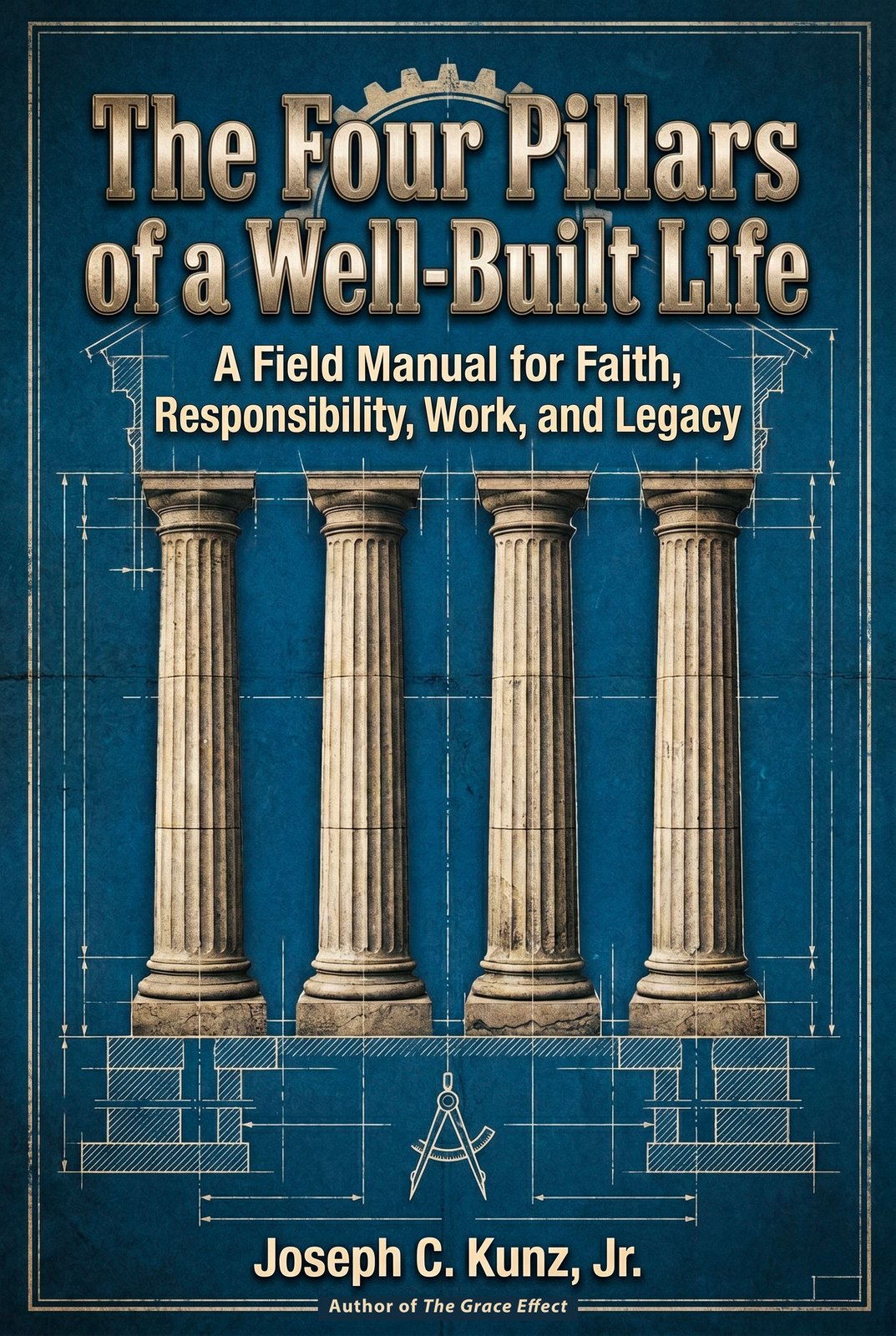
The Four Pillars of a Well-Built Life
The Four Pillars of a Well-Built Life.
Let’s stop pretending the people who lecture us most fluently about civilizational collapse are the same people who know how to rebuild one.
Civilization is not held together by essays alone. It is held together by fathers who stay. Mothers who form souls. Families who keep standards. Believers who tell the truth. Men and women who work, repent, endure, forgive, build, and keep going when nobody is watching.
That is the real fight. Not sounding alarmed. Not looking profound. Not performing moral seriousness for people who already agree with you.
Actually living in a way that keeps the floor from caving in.
That is why I wrote The Four Pillars of a Well-Built Life.
This book is for people who are done admiring truth from a distance. It is for people who want to build a life that holds—through Faith, Responsibility, Work, and Legacy—while the culture gets softer, louder, and more detached from reality.
Because your children do not need another elegant diagnosis. Your family does not need another office-built theory. And your future will not be saved by people who can describe collapse but cannot carry weight.
You need structure. You need moral backbone. You need a life built on something stronger than mood, noise, and applause.
Read more about The Four Pillars of a Well-Built Life and build the kind of life that keeps civilization from going hollow.
Soon to be released.