Artificial Intelligence Will Not Rise Above Us
A machine may become more capable than its makers. It cannot become wiser on their behalf. —Joseph C. Kunz, Jr.
Why No Machine Can Supply the Wisdom Its Makers Lack
By Joseph C. Kunz, Jr.
Synopsis
This isn’t an argument against artificial intelligence, technological progress, or the ordinary people working to develop and use new technology. Nor is it an attempt to predict every danger or opportunity AI may eventually create. In this essay, Joseph C. Kunz, Jr. argues that artificial intelligence may become more capable than its makers without becoming wiser on their behalf. Greater intelligence can increase human power, but it cannot produce character, conscience, moral judgment, or a worthy purpose for that power.
Kunz makes the case that artificial intelligence cannot be separated from the people, institutions, incentives, beliefs, and culture that shape it. AI enters businesses, governments, schools, homes, churches, hospitals, and other institutions that already contain honesty and deception, humility and pride, responsibility and evasion. It may help people work faster, decide more efficiently, and reach farther, but it can also magnify their weaknesses and give them a convenient place to hide from accountability. The machine may perform the task, but human beings still choose the purpose, accept the answer, and bear responsibility for the result.
The conclusion is simple: no machine can supply the wisdom its makers lack. Artificial intelligence may exceed us in speed, memory, calculation, and access to information, but it will not rise morally above the people and institutions that build, direct, and use it. The future of AI will therefore depend not only on what our machines are capable of becoming, but on whether we are forming human beings wise and responsible enough to govern what they build.
Intelligence can increase our power. Only wisdom can tell us what that power is for. —JCK
I. Introduction: A Question from an Ordinary User
I am not a computer scientist, engineer, programmer, or expert on artificial intelligence.
I am a businessman, writer, husband, father, grandfather, publisher, and ordinary user of a technology that is becoming more capable almost by the week.
I have used AI to examine ideas, organize information, improve writing, question assumptions, and see problems from different directions. At its best, it can be an extraordinary assistant. It can help a person work faster, think more clearly, and notice connections that might otherwise have been missed.
I also know enough to recognize how much I do not understand.
I cannot confidently predict where this technology will lead. I do not know which occupations it will transform, which industries it will disrupt, which medical discoveries it may help produce, or which dangers will prove most serious.
I am also aware that artificial intelligence may eventually exceed individual human beings in many forms of technical performance. When I say that AI will not rise above us, I do not mean that it will never calculate faster, remember more, detect patterns better, or perform certain tasks with greater accuracy than we can.
I mean something more fundamental.
Why should we assume that a machine becoming more intelligent will make the people using it any wiser?
That question may be more important than many of the technical questions surrounding AI.
Artificial intelligence may become better than human beings at performing countless tasks. It may calculate more quickly, remember more accurately, compare more information, and recognize patterns beyond the reach of the unaided human mind.
But intelligence and wisdom are not the same thing.
A machine may help us do almost anything.
It cannot decide, on its own, what is worth doing.
II. Intelligence and Wisdom Are Different
We often speak about intelligence as though it were the highest human quality.
Intelligent people solve difficult problems. They learn quickly. They understand complicated systems. They discover new methods, build new tools, and make possible what previous generations could not imagine.
Intelligence matters.
But intelligence alone does not tell us what is good.
It does not tell us what is just.
It does not tell us what another human being is worth.
It does not tell us when power should be restrained, when profit should be refused, when efficiency should yield to dignity, or when something technically possible should not be done.
Those are questions of wisdom, conscience, character, and moral judgment.
Intelligence is largely concerned with means:
How can this be done?
How can it be done faster?
How can it be made more accurate, efficient, persuasive, or profitable?
Wisdom is concerned with ends:
Should this be done?
Whom will it serve?
What might it destroy?
What responsibility comes with this power?
What kind of person—or society—will this help us become?
An intelligent person may discover a more effective way to persuade people.
A wise person asks whether the persuasion is honest.
An intelligent business may learn how to keep customers watching, clicking, buying, and returning.
A wise business asks whether it is serving those customers or exploiting their weaknesses.
An intelligent government may learn how to collect more information, predict behavior, and influence public decisions.
A wise government asks whether it has the moral authority to do so.
An intelligent student may use AI to complete an assignment in minutes.
A wise student understands that avoiding the work may also mean avoiding the formation the work was meant to produce.
Artificial intelligence may help us pursue an objective with astonishing effectiveness.
It cannot establish the moral worth of the objective merely by pursuing it well.
Artificial intelligence may make certain forms of intelligence more available.
It cannot make wisdom automatic.
That is not an insult to technology. It is simply a recognition of what technology is.
A tool can increase our power.
It cannot determine whether we deserve to exercise it.
III. Every Tool Bears the Mark of Human Purpose
A hammer can build a house or break a window.
Money can support a family, fund a business, preserve an inheritance, corrupt a politician, or destroy a person who worships it.
Language can clarify truth or conceal it.
Education can form judgment or merely provide credentials.
Political authority can protect freedom or slowly replace it.
The moral meaning of a tool cannot be separated from the purposes, character, and judgment of the people using it.
Artificial intelligence is far more complicated than a hammer, however, and intellectual honesty requires us to acknowledge the difference.
AI systems do not always behave exactly as their designers expect. Complex systems can produce errors, misunderstand instructions, repeat hidden distortions, or behave poorly in circumstances their creators did not anticipate. Decent people can build something harmful by mistake. Good intentions do not eliminate technical failure, limited knowledge, or unintended consequences.
That is another reason humility matters.
Still, AI does not enter an empty world.
It enters a human world that already contains honesty and deception, humility and pride, courage and cowardice, generosity and greed, responsibility and evasion.
It will be used by people trying to cure disease.
It will also be used by people trying to exploit weakness.
It will help teachers explain difficult subjects.
It may also help students avoid learning them.
It will help businesses serve customers more efficiently.
It may also help businesses study and manipulate customers more precisely.
It will help writers organize their thoughts.
It may also allow people to publish thoughts they never genuinely considered, tested, or earned.
Artificial intelligence does not remove the moral condition of its users.
It extends their reach.
This is why describing AI as a mirror is not quite enough.
A mirror reflects what stands before it.
AI may multiply what it receives.
It can help one good idea reach millions of people.
It can also help one falsehood travel farther and faster than its creator ever could have carried it alone.
It can extend compassion.
It can extend manipulation.
It can organize knowledge.
It can accelerate confusion.
The machine does not purify the purpose.
It increases the capacity.
IV. Institutions Do Not Escape Human Nature
Most people working inside governments, corporations, universities, schools, hospitals, technology companies, and other institutions are ordinary people trying to do their jobs.
They are earning a living.
They are supporting families.
They want to be competent, respected, and useful.
Many are serious, conscientious people who sincerely want their work to benefit others.
This discussion should not become an accusation against them.
But good intentions do not cause human weakness to disappear.
People remain subject to pressure, ambition, fear, conformity, incomplete knowledge, professional incentives, and the understandable desire to believe that their work is important and morally justified.
Institutions are also shaped by what they reward.
A business that rewards profit above every other consideration will increasingly make decisions according to profit.
A government agency whose importance depends upon identifying and managing more problems may develop an institutional preference for expanded authority.
A university that rewards intellectual conformity may become less willing to question fashionable ideas.
A school that rewards completed assignments and test results more than genuine understanding may encourage the appearance of learning rather than learning itself.
These tendencies are not universal, and they do not prove that everyone inside an institution is dishonest.
They show something more ordinary and more difficult to escape: institutions develop habits.
They develop accepted language, customary assumptions, internal loyalties, professional incentives, and ways of explaining their own importance.
They also divide responsibility among many people.
One person designs a system.
Another approves the budget.
Another writes the policy.
Another selects the information.
Another sets the performance target.
Another uses the result.
Each person may perform only one limited function, yet together they create an outcome no single participant fully intended or entirely controls.
Artificial intelligence will be developed and used inside these already existing structures.
That means it will not be shaped only by programming.
It will also be shaped by budgets, deadlines, politics, corporate goals, professional reputations, customer demands, public pressure, legal concerns, moral beliefs, and cultural assumptions.
A machine may perform the task.
Human beings and institutions still decide which tasks matter.
They decide what should be measured.
They decide what counts as success.
They decide which errors are acceptable and which are intolerable.
They decide who is allowed to question the result.
They decide whose interests are protected and whose concerns receive less attention.
AI may make institutional decisions faster and more consistent.
But consistency is not the same as justice.
Efficiency is not the same as wisdom.
And a decision does not become morally sound merely because a computer applies it to everyone in the same way.
V. The Temptation to Hide Behind the Machine
One of the greatest dangers of artificial intelligence may be the opportunity it gives human beings to escape responsibility.
We already hear people say:
“The policy requires it.”
“The system would not allow it.”
“The computer rejected the application.”
“The guidelines were followed.”
“The decision was made above my level.”
AI may give us a new and even more convincing version:
“The algorithm decided.”
That sentence could become a hiding place.
A manager may deny someone an opportunity and blame the system.
A business may mistreat customers and claim that the process was automated.
A writer may publish an error and say that AI supplied the information.
A professional may follow a machine’s recommendation without exercising independent judgment.
A government agency may make decisions affecting thousands of citizens while insisting that the model applied the same neutral standard to everyone.
But a machine cannot accept moral responsibility.
It cannot feel shame.
It cannot repent.
It cannot explain why a human being should be treated with dignity.
It cannot answer before God, a family, a community, a patient, a customer, a student, or a citizen.
Only people can do those things.
Whenever AI is involved, someone still decides to trust it.
Someone chooses how it will be used.
Someone determines how much human review is required.
Someone accepts, rejects, or fails to examine its output.
Someone benefits from the decision.
Someone bears the consequences.
In large systems, responsibility may be divided. It may be difficult to trace. Several people or institutions may share it.
But it does not disappear.
The machine must never become the place where human accountability goes to hide.
VI. What Responsible Use Requires
The answer is not to reject artificial intelligence.
Human beings have always built tools to increase their strength, speed, memory, reach, productivity, and understanding.
AI may become one of the most useful tools ever created.
But powerful tools require more from their users, not less.
Responsible use begins with humility.
We must recognize that a confident answer may still be wrong. A persuasive explanation may still be incomplete. A system trained on enormous amounts of information may still repeat human error, distortion, prejudice, or fashionable nonsense.
Responsible use also requires competence.
People should understand enough about the tools they use to recognize their limitations. A person should not surrender professional judgment merely because a machine appears more certain than he feels.
It requires honesty.
A student should not pretend that machine-generated work is his own. A writer should not publish arguments he has not examined. A business should not conceal the use of AI when that information matters to the customer.
It requires accountability.
People and institutions should remain answerable for the decisions they make with AI. They should not receive the benefits of automation while transferring every moral cost to the machine.
Responsible use also requires the ability to question a decision.
When AI affects a person’s employment, education, medical care, finances, legal rights, or access to public services, that person should not be trapped beneath a conclusion that no responsible human being can explain or reconsider.
A system becomes especially dangerous when it is powerful enough to decide but too complicated—or too protected—to challenge.
And responsible use requires limits.
Not everything that can be automated should be automated.
Some decisions involve human dignity, trust, mercy, judgment, and responsibility in ways that cannot be reduced to efficiency.
A physician may use AI to review medical information, but the patient still needs a responsible human being.
A teacher may use AI to explain a difficult lesson, but a child still needs formation, encouragement, discipline, and example.
A business may use AI to improve service, but a customer still deserves honesty and fair treatment.
A government may use AI to organize information, but citizens must not become data points managed by systems no one can question.
The proper question is not merely:
Can AI do this?
The more serious question is:
What happens to us if we allow it to?
VII. What Are We Becoming?
Most public discussions ask what artificial intelligence will become.
Will it become more capable than us?
Will it replace us?
Will it deceive us?
Will it control us?
Those questions matter.
But another question may be closer to home:
What are we becoming as we learn to depend upon it?
Will we become more thoughtful because AI helps us examine ideas?
Or less thoughtful because it does the examining for us?
Will we become more productive?
Or merely more hurried?
Will we use the time saved to build better lives?
Or fill that time with more noise?
Will students learn more because help is always available?
Or will they lose the patience required to struggle with something difficult?
Will writers develop clearer ideas?
Or will they become editors of sentences they never truly thought?
Will citizens become better informed?
Or more willing to accept whatever answer sounds confident and agrees with them?
A tool changes the world.
It may also change the person using it.
Every tool teaches habits.
A calculator can free the mind for more advanced reasoning, but dependence upon it can weaken basic skill.
Navigation software can help us travel farther, but it may also reduce our ability to find our way without assistance.
Social media can connect people across great distances while weakening attention, patience, and presence.
AI will also form habits in its users.
It may teach us to ask better questions.
It may also teach us to expect immediate answers.
It may deepen thought.
It may also make the first plausible answer feel sufficient.
It may help people develop their abilities.
It may allow them to avoid developing those abilities at all.
That is why the formation of the user matters as much as the design of the machine.
A disciplined person may use AI to extend discipline.
A lazy person may use it to avoid effort.
A truthful person may use it to clarify.
A dishonest person may use it to deceive more effectively.
A wise person may treat AI as an assistant.
A dependent person may slowly treat it as an authority.
The most important question is not whether AI will become human.
It is whether human beings will surrender the qualities that machines cannot possess on their behalf.
VIII. Conclusion: The Wisdom Must Come from Somewhere
Artificial intelligence may eventually exceed human beings in ways we cannot yet imagine.
It may solve problems that have resisted generations of effort.
It may improve medicine, education, engineering, business, communication, and scientific discovery.
We should not fear every advance merely because it is new.
But neither should we confuse increasing capability with moral progress.
No machine can supply the wisdom its makers lack.
It cannot give a business the character to refuse dishonest profit.
It cannot give a government the humility to respect the limits of its authority.
It cannot give a student the desire to learn.
It cannot give a writer the courage to tell the truth.
It cannot give a family faith.
It cannot give a civilization a moral foundation it has already abandoned.
Those things must come from somewhere else.
They come from formation.
They come from families, faith, discipline, education, experience, suffering, responsibility, tradition, honest work, and the willingness to answer for what we do.
Artificial intelligence may help us carry more weight.
It cannot tell us which weight is ours to carry.
It may help us build faster.
It cannot decide what is worth building.
It may give us more power than any previous generation possessed.
It cannot make us worthy of that power.
Artificial intelligence will not rise morally above us because morality is not produced by greater processing power.
It is formed in human beings.
The future of AI will therefore reveal more than what our machines can do.
It will reveal what kind of people we have become.
And whether we are wise enough to remain responsible for what we build.
The machine may exceed our abilities, but it cannot rise above the moral responsibility of the people who build and use it. —JCK
Related Essays: Where Human Formation Still Matters
These two essays carry the argument into the places where technology and institutions most easily begin replacing human responsibility.
1. Who Is Raising Your Child — You or the Algorithm?
Powerful technology can influence a child’s attention, appetites, habits, and understanding of the world, but parents still carry the first responsibility to form the person behind the screen.
Reader Comment: This essay brings the AI discussion into the home. It reminds us that protecting children from harmful technology is important, but it can never replace the deeper work of teaching judgment, discipline, faith, and self-government.
Quote: A machine may shape a child’s attention, but the home must still shape the child. —JCK
2. No Government Can Give You Character
Government can establish laws, preserve order, and restrain harmful conduct, but it cannot produce conscience, courage, wisdom, discipline, or moral responsibility inside a human being.
Reader Comment: Read this next if you want to explore the distinction between external control and internal formation. Rules can influence behavior, but they cannot build the character required to use freedom—or artificial intelligence—wisely.
Quote: Character cannot be downloaded, delegated, or legislated. It must be formed. —JCK
Related Book: Smarter Machines Still Need Stronger People
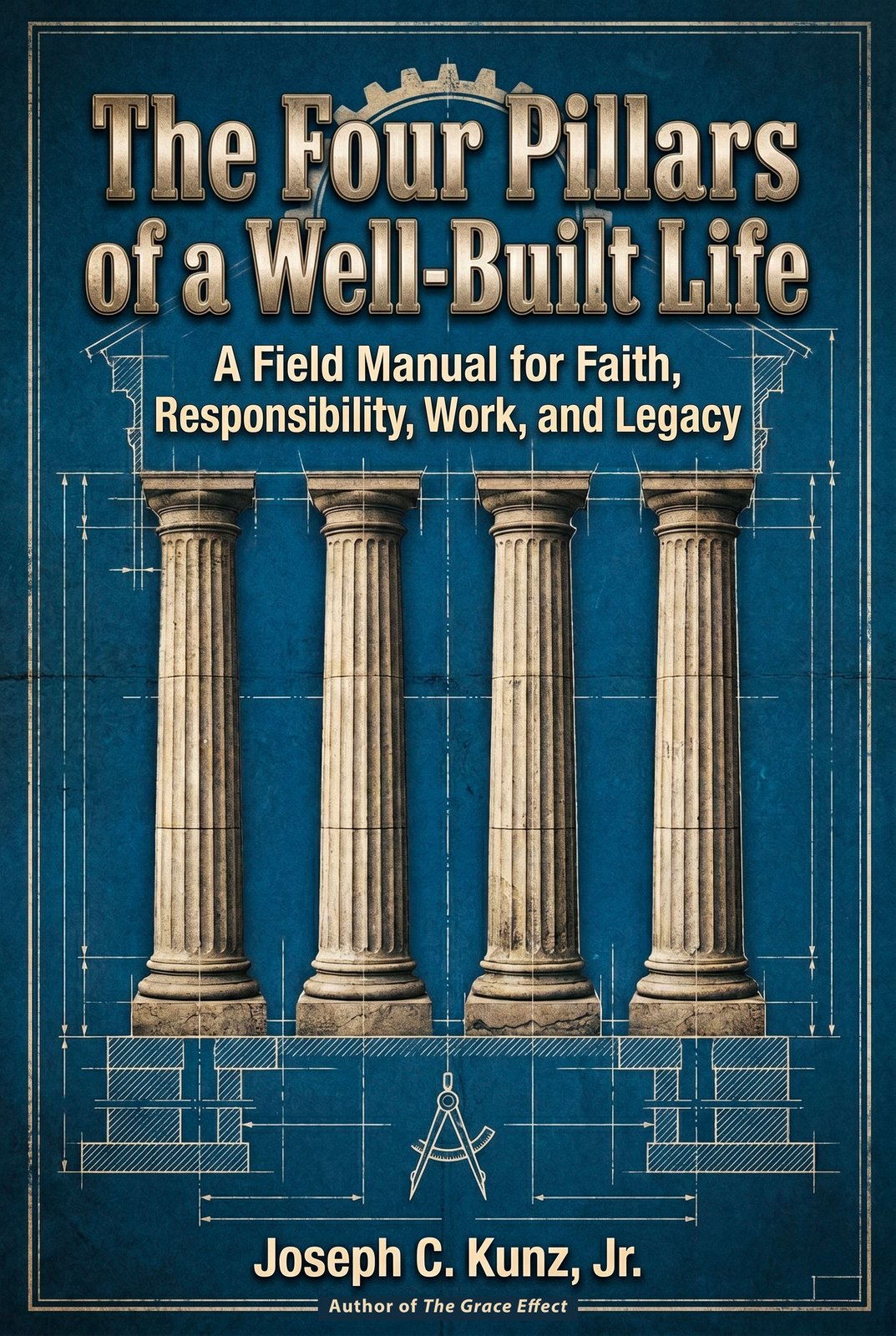
The Four Pillars of a Well-Built Life
Artificial intelligence may help us work faster, search farther, calculate better, and organize more information than any previous generation could have imagined.
But it cannot tell us what a human life is for.
It cannot give us faith.
It cannot teach us to govern ourselves.
It cannot turn productivity into stewardship.
It cannot decide what kind of inheritance we should leave behind.
That is why I am writing The Four Pillars of a Well-Built Life.
This book is not about resisting technology or retreating from the modern world. It is about building the kind of person who can use powerful tools without becoming dependent upon them, manipulated by them, or morally weakened by them.
Faith provides the foundation beneath our decisions.
Responsibility provides the inner frame required for self-government.
Work and wealth give us the competence, independence, and strength to build something useful.
Legacy reminds us that the final question is not merely what we created, but what kind of people and world we handed forward.
Artificial intelligence may change the tools.
It does not change the architecture of a life that holds.
If you believe technology should serve human beings rather than replace human judgment, this book is for you.
If you believe freedom still requires character and self-government, this book is for you.
If you believe families must form children before machines and institutions form them instead, this book is for you.
If you believe greater power demands greater responsibility, this book is for you.
We do not need to become less intelligent to remain human.
We need to become wise enough to govern what our intelligence allows us to build.
Being Built to Hold: The Four Pillars of a Well-Built Life