A Conservative Credo for a Life That Holds
Conservatism endures only when moral order, self-government, stewardship, and inheritance remain strong enough to hold both freedom and civilization together. —Joseph C. Kunz, Jr.
Why Moral Order, Self-Government, Stewardship, and Legacy Still Matter
By Joseph C. Kunz, Jr.
Synopsis
This isn’t another polished statement about “traditional values,” nor is it a generic attempt to make conservatism sound respectable, compassionate, and civilized to people who already reject its first principles. In this essay, Joseph C. Kunz, Jr. argues that conservatism is not first a political preference, a party temperament, or a nostalgic attachment to the past, but a disciplined recognition of moral order, human limitation, responsibility, stewardship, and inheritance. A true conservative credo does not begin with policy. It begins with reality.
Kunz makes the case that conservatism cannot survive as a loose collection of opinions about small government, free markets, patriotism, religious liberty, and family values. Those things matter, but they only hold together when they are placed in the right order. Faith is the foundation. Responsibility is the frame. Work and wealth are the arena of stewardship and independence. Legacy is the test of whether a people still remember that they are trustees, not owners, of what they have received. These pillars are not a rigid ideology. They are a clear way of helping ordinary people understand the permanent structures that make freedom possible and civilization durable.
The conclusion is simple: conservatism is not the defense of comfort, nostalgia, or partisan identity. It is the defense of the permanent things that make a worthy life and a free society possible. If a people lose moral order, self-government, stewardship, and inheritance, they will not remain free no matter how often they use the word.
Freedom does not survive on sentiment, slogans, or political energy. It survives where moral order still governs the soul. —JCK
I. Introduction: Why Politics Cannot Save What the Soul Has Lost
A society does not collapse first at the ballot box.
It collapses in the soul, in the home, in the church, in the school, in the habits of daily life, in the corruption of language, and in the quiet loss of the moral instincts that once made freedom livable.
That is why so much of modern conservatism feels weak even when it wins arguments, passes laws, or sounds morally indignant on television. It often speaks as though politics were the center of the fight. It is not. Politics matters, of course. Law matters. Elections matter. Public institutions matter. But all of them are downstream. A nation’s public life rests on private formation. Culture rests on moral imagination, discipline, worship, memory, loyalty, and restraint. And those things rest on what a people believe about God, man, truth, duty, freedom, and the purpose of life itself.
That is why conservatism must be more than reaction. It must be more than policy preference. It must be more than “leave me alone,” “cut taxes,” “respect the Constitution,” or “don’t redefine the family.” Those are fragments. Some are important fragments. But fragments do not hold a civilization together.
A real conservative credo has to do something harder. It has to name the structure of reality. It has to explain what must be conserved, why it must be conserved, what threatens it, and what kind of human being is required to carry it forward.
I use the Four Pillars here not as a tidy ideology, but as a clear way of helping ordinary people understand the permanent structures that allow a life, a culture, and a nation to hold. They are not a substitute for the rich inheritance of conservative thought. They are a way of naming, in plain English, what that inheritance has always known.
II. Faith: The Foundation Beneath Freedom
Every serious conservatism begins with the recognition that there is a permanent moral order.
Man does not create it. He does not amend it by majority vote. He does not improve it by appetite, ideology, or sentiment. He may submit to it, rebel against it, distort it, ignore it, or try to rename it, but he does not author it.
This is the first line of separation between conservatism and every counterfeit version of it.
A society can go on talking endlessly about rights, equality, dignity, freedom, tolerance, justice, and democracy. But once those words are severed from transcendent truth, they do not keep their meaning for long. They become slogans, then instruments, then weapons. They become whatever the strong, the clever, or the fashionable class needs them to mean.
Freedom cut loose from truth does not remain freedom. It becomes appetite for a while, confusion after that, and control in the end.
That is why faith comes first.
Not because conservatism is merely church language in pressed clothes. Not because every political dispute must be turned into a sermon. But because a society that no longer acknowledges any authority above the self will soon acknowledge no authority except power.
A conservative understands that man is not self-created. He understands that evil is real, sin is real, limits are real, and so are duty, consequence, and judgment. He understands that human dignity is not something conferred by the state, nor generated by self-expression, nor secured by public affirmation. It is rooted in something prior and higher.
This is where true humility begins.
Not in softness. Not in self-erasure. Not in social performance. But in the disciplined recognition that reality is not arranged around the self. That truth is not ours to manufacture. That life is received before it is managed.
Without that foundation, conservatism becomes style. It becomes manners without metaphysics. It becomes procedure without conviction. It becomes a preference for lower taxes and older buildings in a civilization that no longer remembers what man is for.
III. Responsibility: The Frame That Makes Freedom Possible
If faith is the foundation, responsibility is the frame.
This is the part modern man dislikes most, because he wants freedom without form. He wants rights without duties, autonomy without consequence, influence without obedience, and desire without discipline. He wants to be affirmed in public and ungoverned in private.
But conservatism begins with the opposite instinct. It knows that freedom survives only where people are capable of governing themselves.
Self-government is not first a constitutional principle. It is a personal one.
A man who cannot govern his appetites will not remain free in any meaningful sense. A people who cannot restrain themselves will eventually be restrained from above. Disorder always creates a market for control.
That is why prudence matters. That is why restraint matters. That is why character matters. Not as quaint virtues for commencement speeches, but as load-bearing conditions of liberty.
A free society requires adults.
Not enlarged children with degrees and opinions. Not permanent adolescents demanding affirmation from institutions. Not moral exhibitionists who perform compassion in public while their own habits are chaotic, dependent, indulgent, and unserious. It requires men and women who know that duty comes before demand, that desire is not sovereign, that consequence is real, and that saying no is one of the first acts of civilization.
This truth does not live only in laws. It lives at the family table, where children learn that they are not the center of the universe. It lives in marriage, where sacrifice matters more than mood. It lives in church pews, where man is reminded that he is not ultimate. It lives in neighborhoods, friendships, schools, workplaces, and daily routines where habits are formed long before ideology arrives to justify or destroy them.
This is why responsibility is the second pillar. It gives shape to freedom. It forms moral muscle. It teaches people how to live without being endlessly managed. And it reminds a civilization that self-government is not a slogan for campaign season. It is a discipline of soul.
IV. Work and Wealth: Stewardship, Independence, and Moral Weight
Conservatism does not treat work and wealth as embarrassing subjects, nor as ultimate ends.
It understands them as morally serious because they shape habits, distribute power, test character, create independence, and reveal whether a people still knows the difference between stewardship and appetite.
Work is not merely a paycheck. It is formation.
It teaches patience, competence, reliability, endurance, delayed gratification, sacrifice, usefulness, and service. It trains the instinct to build, repair, maintain, contribute, and carry responsibility in the real world. Honest work is one of the great schools of self-government because it forces a person out of fantasy and into consequence.
Property matters for the same reason.
Not because things are sacred, but because stewardship is. Ownership binds freedom to responsibility. It teaches consequence. It gives households, churches, associations, and local communities room to act without waiting for distant institutions to manage every human need. A society with no serious doctrine of property will eventually have no serious doctrine of independence. It will be populated by dependents who call their dependency security and by rulers who call their control compassion.
A conservative should not be embarrassed to say this: wealth honestly earned, wisely managed, and morally ordered is not a stain. It is a tool.
But it is only a tool.
It becomes corrupt when it becomes vanity, indulgence, status theater, appetite without restraint, or power detached from responsibility. Wealth should strengthen households, support institutions, reward discipline, widen freedom, and make generosity possible. It should not turn people soft, hollow, decadent, and performative.
The point is not riches for their own sake. The point is ordered independence.
The healthy conservative instinct is not to worship markets, but to understand that economic life is never morally neutral. Work forms souls. Property creates leverage against centralized power. Stewardship teaches a people that freedom is not sustained by slogans, but by people who can actually build, save, produce, own, repair, give, and endure.
V. Legacy: The Great Chain of Obligation
A civilization dies when it stops thinking in terms of inheritance.
That is one of the deepest conservative convictions, and one of the most necessary in an age obsessed with self-expression. Modern life trains people to think in terms of immediate preference, personal identity, present experience, and emotional validation. It asks: What feels right now? What expresses me now? What benefits me now? What satisfies me now?
Conservatism asks a different question: What have we received, and what do we owe?
That question changes everything.
It reminds us that life is inherited before it is redesigned. That institutions should be understood before they are dismantled. That custom, convention, memory, and prescription are not chains upon the soul, but repositories of hard-won social wisdom. The dead are not always right. But neither are the living automatically wiser simply because they are alive later.
A conservative knows that civilization is easier to damage than to rebuild.
He knows that some reforms are necessary, but not all change is progress. Some change is merely corruption with a marketing department. Some reform is vandalism carrying the banner of compassion. Some liberation is just the stripping away of the structures that protect dignity, discipline, continuity, and reverence.
That is why prudence stands guard over legacy.
A conservative is not a curator of every old habit merely because it is old. But neither is he intoxicated by novelty. He tests change against reality, continuity, and consequence. He asks whether it strengthens the structure or weakens it. Whether it deepens inheritance or severs it. Whether it serves those who come after us or flatters those who happen to be alive right now.
Legacy is not nostalgia.
It is responsibility extended through time.
It means fidelity to what was worth preserving, courage to repair what has decayed, seriousness about what must be handed on, and humility about our place in the story. We did not create the moral and civilizational inheritance we live inside, and we do not have the right to squander it for comfort, novelty, or applause.
A people who live only for the present eventually lose both past and future. They become culturally homeless, politically manipulable, morally weightless, and easy to govern because they no longer remember where they came from or what they owe.
VI. What Conservatism Must Reject
A credo is not complete unless it names the diseases it resists.
Conservatism must reject the lie that man is self-creating.
It must reject the fantasy that freedom means multiplying choices without reference to truth, discipline, or ends.
It must reject the sentimentalism that mistakes compassion for indulgence and love for unconditional approval.
It must reject the centralization of power that hollows out families, churches, local associations, and communities while claiming to protect them.
It must reject the ideological abstraction that tries to reorganize society from the top down according to theory instead of inherited wisdom, moral law, and human limits.
It must reject the corruption of language that calls disorder authenticity, appetite identity, censorship safety, dependency justice, and civilizational decline progress.
It must reject the reduction of politics to performance, outrage, branding, and tribal adrenaline.
And it must reject the cowardice of conservatives who speak endlessly about courts, elections, markets, and procedural wins while refusing to say plainly that no civilization can survive without moral order, disciplined households, reverence, restraint, memory, and the formation of souls.
The public square did not become hollow because the wrong people won office. It became hollow because the inner life of the culture thinned out first.
VII. The Conservative Task
The task of conservatism is not to preserve comfort.
It is not to baptize the status quo.
It is not to defend every old custom merely because it is old.
It is not to provide more polished language for a managerial class that wants order without truth.
And it is not to keep a nation materially productive while it becomes morally incoherent.
The conservative task is harder than that, and more serious.
It is to conserve the truths, loyalties, institutions, habits, restraints, affections, and disciplines that make a worthy life possible. It is to defend the conditions under which freedom can survive because virtue still exists, families still form souls, churches still teach reverence, property still creates independence, work still forms character, and inheritance still teaches a people that they are not the first or last actors in the drama of civilization.
That work begins with first principles, but it does not end in theory. It must be lived. It must be embodied. It must show up in language, habits, money, worship, household order, local loyalty, discipline, work, child-rearing, marriage, memory, and the quiet refusal to surrender reality to fashion.
A conservative credo that cannot be lived will not hold.
And a conservative movement that forgets what man is for will eventually conserve nothing worth keeping.
VIII. Conclusion: The Structure That Holds
The conservative question is not merely, “What policies do we prefer?”
The conservative question is, “What kind of world must be protected, and what kind of people must be formed, if freedom is going to survive at all?”
That is why the Four Pillars matter.
Not because they reduce conservatism to a formula, but because they help us see the order of things.
Faith tells us what is permanent.
Responsibility teaches us how to stand upright under it.
Work and wealth teach stewardship, discipline, and independence in the real world.
Legacy reminds us that none of this belongs to us alone.
That is conservatism at its strongest: not a nostalgia machine, not a polite style of decline, not a branding exercise for respectable people, and not a collection of resentments looking for an election.
It is a moral architecture for a life that holds, a society that remembers, and a civilization still worthy of being handed on.
The conclusion is simple: conservatism is not the defense of comfort, but of permanence; not the protection of appetite, but the formation of character; not the management of decline, but the preservation of the truths and structures without which neither freedom nor human dignity can endure.
A civilization holds only when truth is honored, responsibility is lived, stewardship is practiced, and legacy is treated as sacred trust. —JCK
Related Essays: For the Reader Who Knows Public Decay Starts in Private Disorder
If this essay landed, these two go deeper into the same civilizational fault lines from different angles.
1. When Freedom Is Cut Loose from Truth
A hard-edged argument that freedom detached from moral order, self-government, and transcendent accountability does not become noble or neutral—it becomes hollow, unstable, and easy to manipulate.
Reader Comment: This essay explained why so much modern talk about freedom feels impressive on the surface but empty underneath. It didn’t just criticize the culture—it showed what had to be rebuilt.
2. The Day the Pieces Fit: Christianity, Americanism, and the Builder’s Life
A clarifying essay on why faith must come first, and why self-reliance, ordered liberty, and the builder’s life only make full sense when they are placed downstream from Christianity.
JCK Quote: When the order is wrong, even good things begin to decay. Put faith first, and the rest can finally stand upright. —JCK
Related Book: Don’t Hand Your Children a Slogan
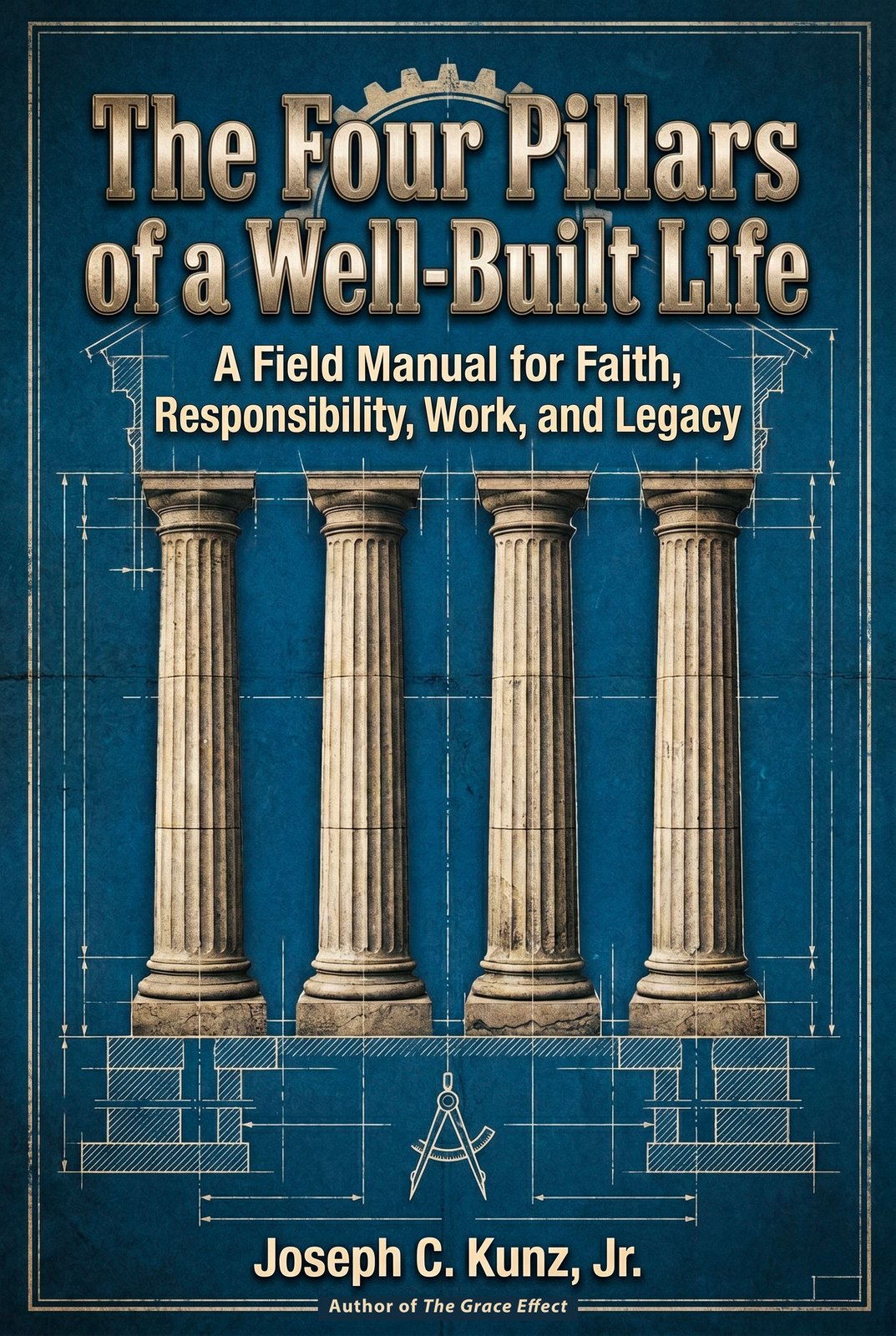
The Four Pillars of a Well-Built Life
You do not need another political talking point. You do not need another election-season adrenaline rush dressed up as conviction. And you definitely do not need a version of conservatism that knows how to win an argument online but does not know how to form a soul, hold a family together, build a life, or pass anything sound to the people who come after you.
That is the deeper burden behind this essay.
If faith is weak, responsibility collapses.
If responsibility collapses, freedom turns soft.
If freedom turns soft, work becomes selfish, wealth becomes performative, and legacy gets spent like loose change.
And when that happens, a people may still call themselves conservative long after they have forgotten what was ever worth conserving in the first place.
That is why I wrote The Four Pillars of a Well-Built Life.
This book is not about managing decline more politely. It is about recovering the moral structure that allows a man or woman to stand upright in an age of drift, confusion, appetite, and noise. It is about faith, responsibility, work and wealth, and legacy—not as slogans, but as the load-bearing realities that make a life hold and make freedom survivable.
The Four Pillars of a Well-Built Life — A framework for people who are done drifting and ready to build something that lasts. Coming soon.